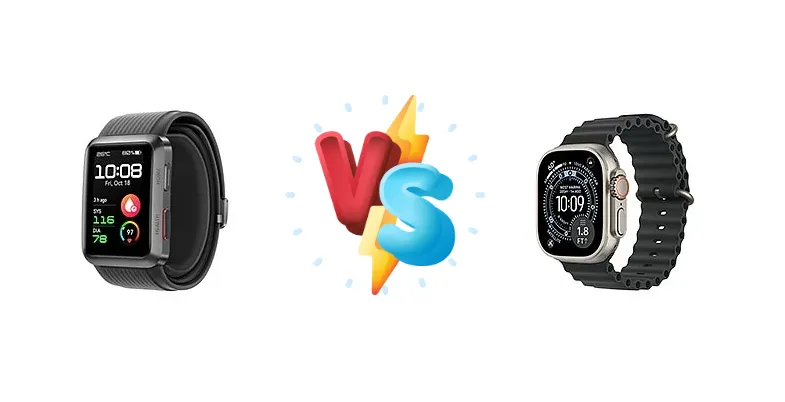
The smartwatch market is bifurcated: those prioritizing comprehensive health monitoring and those deeply embedded in a specific ecosystem. The Huawei Watch D, with its integrated blood pressure monitoring, directly challenges the Apple Watch Ultra 3, a powerhouse of performance and ecosystem integration. This comparison dissects the strengths and weaknesses of each, moving beyond simple spec sheets to understand real-world implications.
🏆 Quick Verdict
For the average user prioritizing seamless integration with other Apple devices and a robust app ecosystem, the Apple Watch Ultra 3 is the superior choice. However, users specifically seeking integrated blood pressure monitoring and potentially longer battery life may find the Huawei Watch D a compelling alternative, despite its limited app support.
| Network |
|---|
| 2G bands | N/A | GSM 850 / 900 / 1800 / 1900 |
| 3G bands | N/A | HSDPA 850 / 900 / 1700(AWS) / 1900 / 2100 - International, China, HK |
| 4G bands | N/A | 1, 2, 3, 4, 5, 6, 7, 8, 18, 19, 20, 25, 26, 28, 39, 40, 41, 66 - International, China, HK |
| 5G bands | - | SA/NSA |
| EDGE | No | - |
| GPRS | No | - |
| Speed | No | HSPA, LTE, 5G |
| Technology | No cellular connectivity | GSM / HSPA / LTE / 5G |
| Launch |
|---|
| Announced | 2022, May 18 | 2025, September 09 |
| Status | Available. Released 2022, October 12 | Available. Released 2025, September 19 |
| Body |
|---|
| Build | Glass front, aluminum frame | Sapphire crystal front, ceramic/sapphire crystal back, titanium frame (grade 5) |
| Dimensions | 51 x 38 x 13.6 mm (2.01 x 1.50 x 0.54 in) | 49 x 44 x 12 mm (1.93 x 1.73 x 0.47 in) |
| SIM | No | eSIM |
| Weight | 40.9 g (1.45 oz) | 61.6 g or 61.8 g (black) (2.15 oz) |
| | IP68
Blood Pressure Measurement & ECG with built-in pump & inflatable strap | - |
| Display |
|---|
| Protection | - | Sapphire crystal glass |
| Resolution | 456 x 280 pixels (~326 ppi density) | 514 x 422 pixels (~326 ppi density) |
| Size | 1.64 inches | 1.98 inches |
| Type | AMOLED | Retina LTPO3 OLED, 3000 nits (peak) |
| Platform |
|---|
| CPU | - | Dual-core |
| Chipset | - | Apple S10 |
| GPU | - | PowerVR |
| OS | HarmonyOS 2.1 | watchOS 26, upgradable to watchOS 26.1 |
| Memory |
|---|
| Card slot | No | No |
| Internal | 4GB | 64GB |
| Sound |
|---|
| 3.5mm jack | No | - |
| 35mm jack | No | No |
| Loudspeaker | No | Yes, with dual speakers (86-decibel) |
| Comms |
|---|
| Bluetooth | 5.1, LE | 5.3, A2DP, LE |
| NFC | Yes (market/region dependent) | Yes |
| Positioning | GPS | GPS (L1+L5), GLONASS, GALILEO, BDS, QZSS |
| Radio | No | No |
| USB | No | No |
| WLAN | No | Wi-Fi 802.11 b/g/n, dual-band |
| Features |
|---|
| Sensors | Accelerometer, gyro, heart rate, SpO2, thermometer (skin temperature), differential pressure sensor | Accelerometer, gyro, heart rate, barometer, always-on altimeter (-500m to 9000m), compass, SpO2, VO2max, temperature (body), temperature (water) |
| Battery |
|---|
| Charging | 3.5W wireless | Wireless, 0-80% in 45 min |
| Type | Li-Ion 451 mAh | Li-Ion 599 mAh |
| Misc |
|---|
| Colors | Graphite Black | Natural, Black |
| Models | MLY-B10, MLY-B11, MLY-B19 | A3281, A3282 |
| Price | About 350 EUR | € 828.00 |
| SAR | - | 1.16 W/kg (head) |
| SAR EU | - | 1.19 W/kg (head) |
Huawei Watch D
- Integrated blood pressure monitoring offers a unique health advantage.
- Potentially longer battery life due to lower charging wattage.
- May be more affordable than the Apple Watch Ultra 3.
- Limited app ecosystem compared to watchOS.
- Performance likely lags behind the Apple S10 chipset.
- Lack of detailed specifications hinders a complete assessment.
Apple Watch Ultra 3
- Powerful Apple S10 chipset delivers smooth performance.
- Extensive app ecosystem and seamless Apple integration.
- Fast charging (0-80% in 45 minutes) provides convenience.
- Higher price point compared to the Huawei Watch D.
- Battery life may be shorter with heavy usage.
- Ecosystem lock-in may be a drawback for non-Apple users.
Display Comparison
While specific display details for the Huawei Watch D are absent, its focus is clearly on functionality over visual extravagance. The Apple Watch Ultra 3, benefiting from Apple’s display expertise, likely features a significantly brighter and more color-accurate display. The Ultra 3’s likely use of LTPO technology allows for a variable refresh rate, conserving battery when static content is displayed. This is a key advantage for all-day wear, especially during sleep tracking.
Camera Comparison
Neither device is focused on camera capabilities, a common trait for smartwatches. The absence of camera details for both suggests they are not primary selling points. The focus remains on health tracking and notifications, rather than photographic features.
Performance
The Apple Watch Ultra 3’s dual-core Apple S10 chipset represents a significant performance advantage over the Huawei Watch D, which lacks detailed processor information. The S10, built on an efficient process node, handles complex tasks like workout tracking, app execution, and Siri interactions with ease. While the Huawei Watch D likely prioritizes power efficiency, the S10’s architecture allows for a smoother, more responsive user experience. The Ultra 3’s chipset also benefits from tight software optimization within the watchOS ecosystem.
Battery Life
The Huawei Watch D’s 3.5W wireless charging suggests a focus on conservative power consumption, potentially leading to longer battery life between charges. However, the Apple Watch Ultra 3’s wireless charging, achieving 0-80% in 45 minutes, offers a faster top-up when needed. The actual battery life will depend on usage patterns, but the Ultra 3’s more efficient chipset and optimized software may mitigate the impact of its faster charging cycle.
Buying Guide
Buy the Huawei Watch D if you need a smartwatch with integrated, medical-grade blood pressure monitoring and are comfortable with a less expansive app ecosystem. This is ideal for individuals proactively managing hypertension or requiring frequent blood pressure checks. Buy the Apple Watch Ultra 3 if you prefer a seamless experience within the Apple ecosystem, demand high performance for apps and workouts, and value a vast selection of third-party applications and features.
Frequently Asked Questions
❓ How accurate is the blood pressure monitoring on the Huawei Watch D compared to a traditional cuff?
While the Huawei Watch D offers convenient blood pressure monitoring, it's crucial to understand it's not a replacement for clinical-grade equipment. Accuracy can vary based on proper wearing technique and individual physiological factors. It's best used for trend tracking and should be validated with a traditional cuff periodically.
❓ Can I use the Apple Watch Ultra 3 to make phone calls without my iPhone nearby?
The Apple Watch Ultra 3, with its cellular connectivity option, allows you to make and receive phone calls, send texts, and stream music without your iPhone present. However, you'll need an active cellular plan specifically for the watch, separate from your iPhone plan.
❓ Does the Huawei Watch D integrate with popular third-party fitness apps like Strava?
Integration with third-party apps is a known limitation of the Huawei Watch D. While it syncs with Huawei’s Health app, compatibility with platforms like Strava is limited or non-existent, potentially frustrating users heavily invested in those ecosystems.