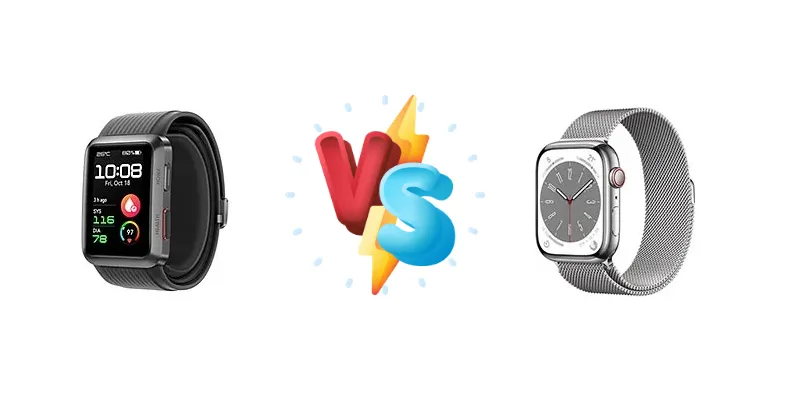
The smartwatch market is booming, and two contenders vying for your wrist are the Huawei Watch D and the Apple Watch Series 8. Both offer a wealth of features, but cater to different ecosystems and priorities. Let's dive into a comprehensive comparison to help you decide which one is the perfect fit.
🏆 Quick Verdict
The Apple Watch Series 8 takes the lead for overall performance, seamless iOS integration, and a wider app ecosystem. However, the Huawei Watch D shines with its unique blood glucose monitoring capabilities and robust health tracking features, making it a compelling choice for those prioritizing health insights.
| Network |
|---|
| 2G bands | N/A | GSM 850 / 900 / 1800 / 1900 |
| 3G bands | N/A | HSDPA 850 / 900 / 1700(AWS) / 1900 / 2100 - International, China, HK |
| 4G bands | N/A | 1, 2, 3, 4, 5, 6, 7, 8, 18, 19, 20, 25, 26, 28, 39, 40, 41, 66 - International, China, HK |
| EDGE | No | - |
| GPRS | No | - |
| Speed | No | HSPA, LTE |
| Technology | No cellular connectivity | GSM / HSPA / LTE |
| | - | 1, 2, 3, 4, 5, 6, 7, 12, 13, 14, 17, 18, 19, 25, 26, 39, 40, 41, 66 - USA, LATAM, Canada |
| Launch |
|---|
| Announced | 2022, May 18 | 2022, September 07 |
| Status | Available. Released 2022, October 12 | Available. Released 2022, September 16 |
| Body |
|---|
| Build | Glass front, aluminum frame | Sapphire crystal front, ceramic/sapphire crystal back, stainless steel frame |
| Dimensions | 51 x 38 x 13.6 mm (2.01 x 1.50 x 0.54 in) | 45 x 38 x 10.7 mm (1.77 x 1.50 x 0.42 in) |
| SIM | No | eSIM |
| Weight | 40.9 g (1.45 oz) | 42.3 g (41mm), 51.5 g (45mm) (1.48 oz) |
| | IP68
Blood Pressure Measurement & ECG with built-in pump & inflatable strap | IP6X certified
50m water resistant
ECG certified (region dependent SW application; HW available on all models) |
| Display |
|---|
| Protection | - | Sapphire crystal glass |
| Resolution | 456 x 280 pixels (~326 ppi density) | 484 x 396 pixels (~326 ppi density) |
| Size | 1.64 inches | 1.9 inches |
| Type | AMOLED | Retina LTPO OLED, 1000 nits (peak) |
| | - | Always-on display |
| Platform |
|---|
| CPU | - | Dual-core |
| Chipset | - | Apple S8 |
| GPU | - | PowerVR |
| OS | HarmonyOS 2.1 | watchOS 9.0, upgradable to watchOS 26.1 |
| Memory |
|---|
| Card slot | No | No |
| Internal | 4GB | 32GB 1GB RAM |
| | - | eMMC 5.1 |
| Sound |
|---|
| 3.5mm jack | No | No |
| 35mm jack | No | No |
| Loudspeaker | No | Yes |
| Comms |
|---|
| Bluetooth | 5.1, LE | 5.3, A2DP, LE |
| NFC | Yes (market/region dependent) | Yes |
| Positioning | GPS | GPS, GLONASS, GALILEO, QZSS, BDS |
| Radio | No | No |
| USB | No | No |
| WLAN | No | Wi-Fi 802.11 b/g/n, dual-band |
| Features |
|---|
| Sensors | Accelerometer, gyro, heart rate, SpO2, thermometer (skin temperature), differential pressure sensor | Accelerometer, gyro, heart rate, barometer, always-on altimeter, compass, SpO2, VO2max, temperature (body) |
| | - | Temperature sensing (0.01˚ accuracy)
Natural language commands and dictation (talking mode)
Ultra Wideband (UWB) support |
| Battery |
|---|
| Charging | 3.5W wireless | Wireless, 0-80% in 45 min |
| Type | Li-Ion 451 mAh | Li-Ion 308 mAh |
| Misc |
|---|
| Colors | Graphite Black | Graphite, Silver, Gold |
| Models | MLY-B10, MLY-B11, MLY-B19 | A2773, A2775, A2772, A2774, A2857, A2858, watch6,16, watch6,17 |
| Price | About 350 EUR | About 330 EUR |
| SAR | - | 0.31 W/kg (head) 0.55 W/kg (body) |
| SAR EU | - | 0.31 W/kg (head) 0.55 W/kg (body) |
Huawei Watch D
- Unique blood glucose monitoring (where available)
- Long battery life (7-14 days)
- Robust health tracking features
- Stylish design
- Good value for money
- Slower performance
- Limited app ecosystem
- Charging is slower
- Android-centric (less seamless with iOS)
Apple Watch Series 8
- Excellent performance
- Seamless iOS integration
- Vast app ecosystem
- Bright and vibrant display
- Fast charging
- Advanced health features (ECG, temperature sensing)
- Shorter battery life (18 hours)
- More expensive
- Limited compatibility with Android
- Requires an iPhone
Display Comparison
Both watches feature vibrant, high-resolution displays. The Apple Watch Series 8 boasts a slightly brighter display, making it easier to view outdoors. The Huawei Watch D's display is also excellent, but may not be quite as visible in direct sunlight. Both offer customizable watch faces.
Camera Comparison
Neither the Huawei Watch D nor the Apple Watch Series 8 have built-in cameras. This is a common omission in smartwatches.
Performance
The Apple Watch Series 8, powered by the S8 chip and dual-core processor, delivers significantly faster and smoother performance than the Huawei Watch D. App loading times are quicker, and the overall user experience feels more responsive. The Huawei Watch D's performance is adequate for everyday tasks, but it doesn't match the Apple Watch's speed.
Battery Life
The Apple Watch Series 8 offers faster charging (0-80% in 45 minutes) and generally provides around 18 hours of battery life with typical use. The Huawei Watch D's battery life is estimated to be around 7-14 days depending on usage, but charging is slower with 3.5W wireless charging.
Buying Guide
The Huawei Watch D is ideal for users focused on health monitoring, particularly those interested in non-invasive blood glucose tracking (where available and approved). It's a good option for Android users seeking a feature-rich smartwatch. The Apple Watch Series 8 is best for iPhone users who want a premium smartwatch experience with a vast app selection, excellent performance, and tight integration with the Apple ecosystem.
Frequently Asked Questions
❓ Can the Huawei Watch D track blood glucose without a sensor?
The Huawei Watch D uses non-invasive optical sensors to estimate blood glucose levels. However, it's important to note that this is an estimate and not a replacement for traditional blood glucose monitoring methods. Availability and regulatory approvals vary by region.
❓ Is the Apple Watch Series 8 compatible with Android phones?
No, the Apple Watch Series 8 is designed exclusively for use with iPhones. It requires an iPhone to function.