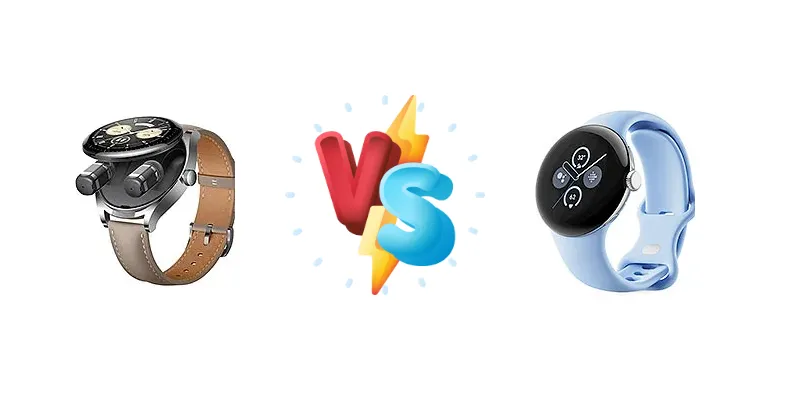
The smartwatch market offers a spectrum of choices, from prioritizing seamless convenience to maximizing performance. The Huawei Watch Buds and Google Pixel Watch 2 represent distinct approaches: the former emphasizing wireless charging and a potentially more streamlined experience, while the latter leverages Qualcomm's silicon and the Wear OS ecosystem. This comparison dissects their core differences to help you determine which aligns with your needs.
🏆 Quick Verdict
For the average user prioritizing a hassle-free experience and wireless charging, the Huawei Watch Buds offer compelling simplicity. However, the Google Pixel Watch 2, powered by the Qualcomm 5100 chipset, wins for users demanding a more robust and feature-rich smartwatch platform with faster charging capabilities.
| Network |
|---|
| 2G bands | N/A | GSM 850 / 900 / 1800 / 1900 |
| 3G bands | N/A | HSDPA 850 / 900 / 1700(AWS) / 1900 / 2100 |
| 4G bands | N/A | LTE |
| EDGE | No | - |
| GPRS | No | - |
| Speed | No | HSPA, LTE |
| Technology | No cellular connectivity | GSM / HSPA / LTE |
| Launch |
|---|
| Announced | 2022, December 09 | 2023, October 04 |
| Status | Available. Released 2022, December 09 | Available. Released 2023, October 12 |
| Body |
|---|
| Build | Glass front, stainless steel frame | Glass front (Gorilla Glass 5), aluminum frame |
| Dimensions | 47 x 47.5 x 15 mm (1.85 x 1.87 x 0.59 in) | 41 x 41 x 12.3 mm (1.61 x 1.61 x 0.48 in) |
| SIM | No | eSIM |
| Weight | 66.5 g (2.36 oz) | 31 g (1.09 oz) |
| | Built-in wireless earbuds housed beneath the display; charging from the watch
Compatible with standard 22mm straps | - |
| Display |
|---|
| Protection | - | Corning Gorilla Glass 5 |
| Resolution | 466 x 466 pixels (~326 ppi density) | 450 x 450 pixels (~320 ppi density) |
| Size | 1.43 inches | 1.2 inches |
| Type | AMOLED | AMOLED, 1000 nits (peak) |
| Platform |
|---|
| Chipset | - | Qualcomm 5100 |
| OS | HarmonyOS 3.0 | Android Wear OS 4 |
| Memory |
|---|
| Card slot | No | No |
| Internal | - | 32GB 2GB RAM |
| Sound |
|---|
| 3.5mm jack | No | - |
| 35mm jack | No | No |
| Loudspeaker | No | Yes |
| Comms |
|---|
| Bluetooth | 5.2, A2DP, LE | 5.0, A2DP, LE |
| NFC | Yes | Yes |
| Positioning | GPS, GLONASS, GALILEO, BDS | GPS, GLONASS, GALILEO, BDS, QZSS |
| Radio | No | No |
| USB | No | No |
| WLAN | No | Wi-Fi 802.11 b/g/n |
| Features |
|---|
| Sensors | Accelerometer, gyro, heart rate, SpO2 | Accelerometer, gyro, heart rate, altimeter, compass, SpO2, thermometer (skin temperature), skin conductance |
| Battery |
|---|
| Charging | Wireless | Wired, 80% in 45 min |
| Type | Li-Ion 410 mAh (watch) | Li-Ion 306 mAh |
| Misc |
|---|
| Colors | Black, Khaki | Polished Silver, Matte Black, Champagne Gold |
| Models | - | G4TSL, GC3G8, GD2WG |
| Price | About 400 EUR | About 160 EUR |
Huawei Watch Buds
- Convenient wireless charging
- Potentially simpler user interface
- Elegant and minimalist design (assumed)
- Lack of chipset information suggests limited performance
- Slower charging compared to the Pixel Watch 2
- Potentially limited app ecosystem
Google Pixel Watch 2
- Powerful Qualcomm 5100 chipset for smooth performance
- Faster wired charging (80% in 45 minutes)
- Access to the extensive Wear OS app ecosystem
- Requires a charging cable
- Potentially more complex user interface
- May have shorter battery life due to higher performance
Display Comparison
Information regarding display specifications is absent from the provided data. However, given Huawei's history with AMOLED displays, the Watch Buds likely utilizes this technology for vibrant colors. The Pixel Watch 2, being a newer device, likely benefits from advancements in panel technology, potentially including LTPO for variable refresh rates and improved power efficiency. Bezels and color accuracy will be key differentiators, but without specific data, a definitive comparison is impossible. The Pixel Watch 2's always-on display functionality, common in Wear OS devices, is also a potential advantage.
Camera Comparison
Neither device is explicitly described as having a camera. Smartwatches rarely prioritize camera functionality due to size constraints and image quality limitations. Therefore, this section is not applicable to this comparison.
Performance
The Google Pixel Watch 2's Qualcomm 5100 chipset is the clear performance leader. While the specific core configuration and clock speeds are not provided, Qualcomm's silicon is designed for wearable devices, offering a balance of power and efficiency. This translates to smoother animations, faster app loading times, and more responsive interactions compared to the Huawei Watch Buds, which lacks any chipset information. The absence of chipset details for the Huawei Watch Buds suggests a focus on basic functionality rather than intensive processing. The Pixel Watch 2's use of an unspecified RAM configuration (likely LPDDR5x) further enhances multitasking capabilities.
Battery Life
The Huawei Watch Buds' wireless charging offers convenience, but typically comes with a trade-off in charging speed. The Google Pixel Watch 2, with its wired charging, achieves 80% charge in 45 minutes, a significantly faster rate. While the mAh capacity of both devices is unknown, the Pixel Watch 2's faster charging mitigates concerns about battery life for users who frequently need to top up their device. The wireless charging of the Huawei Watch Buds is ideal for overnight charging, but less practical for quick boosts throughout the day.
Buying Guide
Buy the Huawei Watch Buds if you value the convenience of wireless charging above all else and prefer a potentially more closed, streamlined ecosystem. This watch is ideal for users who want a simple, elegant smartwatch experience without the need for cables. Buy the Google Pixel Watch 2 if you prioritize performance, app availability through Wear OS, and faster charging speeds. This watch is best suited for users deeply integrated into the Google ecosystem and those who demand a more versatile smartwatch experience.
Frequently Asked Questions
❓ Does the lack of chipset information for the Huawei Watch Buds indicate it's significantly less capable than the Pixel Watch 2?
Yes, the absence of chipset details strongly suggests the Huawei Watch Buds prioritize basic functionality over performance. The Qualcomm 5100 in the Pixel Watch 2 is specifically designed for wearables, offering a substantial performance advantage for tasks like app loading, animations, and health tracking.
❓ How does the wireless charging of the Huawei Watch Buds compare to the convenience of using a charging cable with the Pixel Watch 2?
Wireless charging offers a cleaner aesthetic and eliminates the need for a cable, but it's generally slower than wired charging. The Pixel Watch 2's 80% charge in 45 minutes is significantly faster, making it more practical for users who need a quick power boost. The Huawei Watch Buds are better suited for overnight charging.
❓ What are the implications of the Google Pixel Watch 2 running Wear OS?
Wear OS provides access to a vast library of apps through the Google Play Store, seamless integration with other Google services (like Google Assistant and Google Maps), and regular software updates. This offers a more versatile and feature-rich experience compared to the potentially more closed ecosystem of the Huawei Watch Buds.