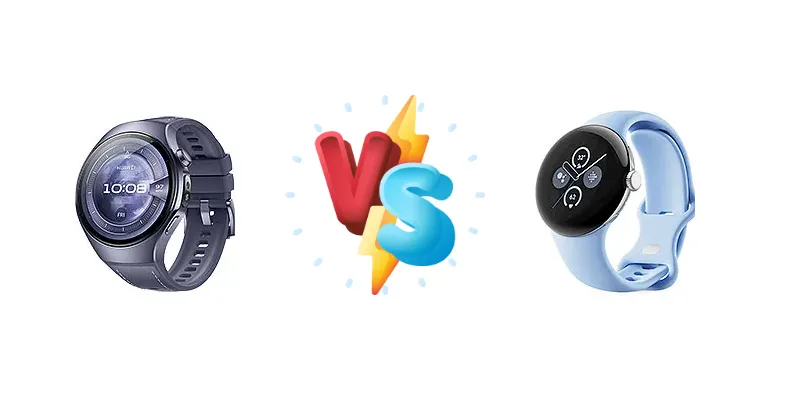
The smartwatch market is increasingly competitive, with Huawei and Google offering compelling options. The Huawei Watch 5 leans into its established wireless charging ecosystem and potentially longer battery life, while the Google Pixel Watch 2 introduces the Qualcomm 5100 platform promising improved performance and a faster charging experience. This comparison dissects the key differences to help you choose the right wearable.
🏆 Quick Verdict
For the average user prioritizing performance and quick top-ups, the Google Pixel Watch 2 is the stronger choice thanks to the Qualcomm 5100 chipset and 45-minute 80% charge time. However, users deeply invested in Huawei’s wireless charging infrastructure and seeking maximum convenience may prefer the Watch 5.
| Network |
|---|
| 2G bands | GSM 850 / 900 / 1800 / 1900 - cellular model only | GSM 850 / 900 / 1800 / 1900 |
| 3G bands | HSDPA 800 / 850 / 900 / 1700(AWS) / 1900 / 2100 - cellular model only | HSDPA 850 / 900 / 1700(AWS) / 1900 / 2100 |
| 4G bands | 1, 2, 3, 4, 5, 7, 8, 9, 18, 19, 20, 26, 28, 34, 38, 39, 40, 41, 66 - cellular model only | LTE |
| Speed | HSPA, LTE - cellular model only | HSPA, LTE |
| Technology | GSM / HSPA / LTE | GSM / HSPA / LTE |
| Launch |
|---|
| Announced | 2025, May 15 | 2023, October 04 |
| Status | Available. Released 2025, May 21 | Available. Released 2023, October 12 |
| Body |
|---|
| Build | Sapphire Glass, ceramic backAerospace-grade titanium or 316L stainless steel frame (46mm)904L stainless steel or 316L stainless steel frame (42mm) | Glass front (Gorilla Glass 5), aluminum frame |
| Dimensions | 46 x 46.7 x 11.3 mm (1.81 x 1.84 x 0.44 in) | 41 x 41 x 12.3 mm (1.61 x 1.61 x 0.48 in) |
| SIM | eSIM - cellular model only | eSIM |
| Weight | 48/51/58/63 g (1.69 oz) | 31 g (1.09 oz) |
| Display |
|---|
| Protection | Sapphire Glass | Corning Gorilla Glass 5 |
| Resolution | 466 x 466 pixels (~310 ppi density) | 450 x 450 pixels (~320 ppi density) |
| Size | 1.5 inches | 1.2 inches |
| Type | LTPO AMOLED, 3000 nits (peak) | AMOLED, 1000 nits (peak) |
| Platform |
|---|
| Chipset | - | Qualcomm 5100 |
| OS | HarmonyOS 4.0 | Android Wear OS 4 |
| Memory |
|---|
| Card slot | No | No |
| Internal | Unspecified | 32GB 2GB RAM |
| Sound |
|---|
| 35mm jack | No | No |
| Loudspeaker | Yes | Yes |
| Comms |
|---|
| Bluetooth | 5.2, A2DP, LE | 5.0, A2DP, LE |
| NFC | Yes | Yes |
| Positioning | GPS (L1+L5), BDS (B1I+B1C), GALILEO (E1+E5a), QZSS (L1+L5), GLONASS | GPS, GLONASS, GALILEO, BDS, QZSS |
| Radio | No | No |
| USB | No | No |
| WLAN | Wi-Fi 802.11 a/b/g/n/ac/6, dual-band | Wi-Fi 802.11 b/g/n |
| Features |
|---|
| Sensors | Accelerometer, gyro, heart rate, barometer, compass, SpO2, thermometer (body temperature) | Accelerometer, gyro, heart rate, altimeter, compass, SpO2, thermometer (skin temperature), skin conductance |
| Battery |
|---|
| Charging | 10W wireless | Wired, 80% in 45 min |
| Type | Li-Ion 867 mAh | Li-Ion 306 mAh |
| Misc |
|---|
| Colors | Purple, Silver, Black, Beige, White | Polished Silver, Matte Black, Champagne Gold |
| Models | RTS-AL00, SOC-AL00 | G4TSL, GC3G8, GD2WG |
| Price | $ 326.86 / € 299.00 | About 160 EUR |
Huawei Watch 5
- Convenient 10W wireless charging
- Potential for longer battery life due to optimized chipset
- Seamless integration with Huawei ecosystem
- Slower charging speeds compared to Pixel Watch 2
- Chipset performance likely lower than Qualcomm 5100
- Limited app ecosystem compared to Wear OS
Google Pixel Watch 2
- Fast charging: 80% in 45 minutes
- Powerful Qualcomm 5100 chipset for smooth performance
- Integration with Google services and Wear OS app ecosystem
- Requires wired charging
- Battery life may be shorter due to higher performance
- Potentially higher price point
Display Comparison
Display specifications are absent from the provided data, but considering the market positioning, we can infer differences. The Pixel Watch 2 likely utilizes an AMOLED panel with potentially higher peak brightness for outdoor visibility. Huawei typically focuses on color accuracy and efficient power consumption. The absence of LTPO specification for either watch means we cannot assess adaptive refresh rate capabilities, a key factor in battery life. Bezels are likely comparable, given both watches aim for a premium aesthetic.
Camera Comparison
Neither device is marketed for its camera capabilities, and detailed camera specs are unavailable. Smartwatches generally feature limited camera functionality, primarily for quick scans or remote control features. Any camera present on either device is likely a low-resolution sensor with limited image quality.
Performance
The core differentiator here is the chipset. The Google Pixel Watch 2’s Qualcomm 5100 represents a significant upgrade over the Exynos 9110 found in the original Pixel Watch, offering improved CPU and GPU performance. This translates to smoother animations, faster app loading times, and a more responsive user experience. The Huawei Watch 5’s chipset is unspecified, but given Huawei’s recent focus on efficiency, it likely prioritizes power consumption over raw processing power. The Qualcomm 5100’s architecture, built on a more modern node, also implies better thermal management, reducing the likelihood of performance throttling during sustained use.
Battery Life
Battery capacity is not specified for either watch. However, the charging methods reveal key differences. The Huawei Watch 5’s 10W wireless charging is convenient but slower than the Pixel Watch 2’s wired charging, which achieves 80% charge in just 45 minutes. This faster charging speed is a significant advantage for Pixel Watch 2 users who frequently need to top up their battery. While Huawei may compensate with a larger battery capacity, the slower charging rate could still result in longer downtime.
Buying Guide
Buy the Huawei Watch 5 if you prioritize the convenience of 10W wireless charging and are already embedded in the Huawei ecosystem. This is ideal for users who dislike fiddling with cables and value a seamless charging experience. Buy the Google Pixel Watch 2 if you demand faster charging speeds, a more responsive user interface powered by the Qualcomm 5100, and integration with the broader Google services ecosystem. This is best for users who need a quick power boost and rely heavily on Google apps.
Frequently Asked Questions
❓ Does the Huawei Watch 5 support reverse wireless charging from my Huawei phone?
Given Huawei's ecosystem integration, it's highly probable the Watch 5 supports reverse wireless charging from compatible Huawei smartphones, allowing you to charge the watch directly from your phone's battery. However, this functionality is not explicitly confirmed in the provided data.
❓ How does the Qualcomm 5100 chipset in the Pixel Watch 2 impact app performance compared to previous Wear OS watches?
The Qualcomm 5100 represents a substantial leap in performance for Wear OS smartwatches. Its improved CPU and GPU architecture results in significantly faster app loading times, smoother animations, and a more responsive user interface. Expect a noticeable difference in performance when using demanding apps like Google Maps or music streaming services.
❓ Is the 80% charge in 45 minutes for the Pixel Watch 2 a true '0-80%' charge, or does it slow down significantly towards the end?
While the advertised 45 minutes is for 0-80%, charging speeds typically taper off as the battery nears full capacity. Expect the final 20% to take longer than the initial 80%, but the overall charging time remains significantly faster than the Huawei Watch 5's wireless charging.