
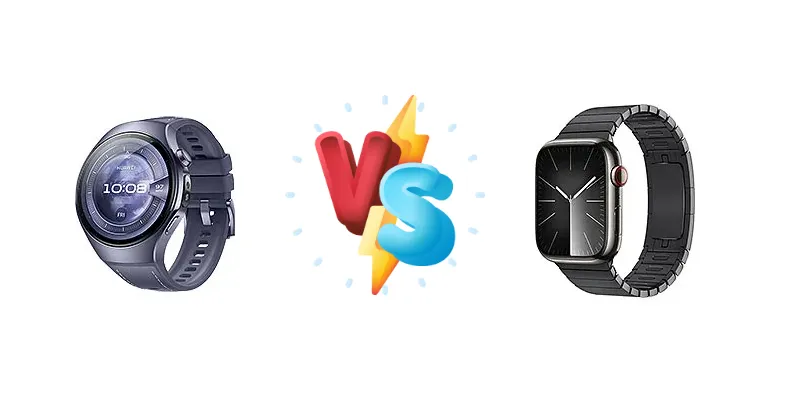
Huawei Watch 5 vs Apple Watch Series 9: Ecosystems Collide
| Phones Images | |||||
|---|---|---|---|---|---|
|
🏆 Quick Verdict
For users deeply embedded in the Apple ecosystem, the Apple Watch Series 9 offers seamless integration and superior performance thanks to the S9 chip. However, the Huawei Watch 5 presents a strong value proposition for Android users or those prioritizing battery life and a more open platform.
| PHONES | ||
|---|---|---|
| Phone Names | Huawei Watch 5 | Apple Watch Series 9 |
| Network | ||
|---|---|---|
| 2G bands | GSM 850 / 900 / 1800 / 1900 - cellular model only | GSM 850 / 900 / 1800 / 1900 |
| 3G bands | HSDPA 800 / 850 / 900 / 1700(AWS) / 1900 / 2100 - cellular model only | HSDPA 850 / 900 / 1700(AWS) / 1900 / 2100 - International, China, HK |
| 4G bands | 1, 2, 3, 4, 5, 7, 8, 9, 18, 19, 20, 26, 28, 34, 38, 39, 40, 41, 66 - cellular model only | 1, 2, 3, 4, 5, 6, 7, 8, 18, 19, 20, 25, 26, 28, 39, 40, 41, 66 - International, China, HK |
| Speed | HSPA, LTE - cellular model only | HSPA, LTE |
| Technology | GSM / HSPA / LTE | GSM / HSPA / LTE |
| Launch | ||
|---|---|---|
| Announced | 2025, May 15 | 2023, September 12 |
| Status | Available. Released 2025, May 21 | Available. Released 2023, September 22 |
| Body | ||
|---|---|---|
| Build | Sapphire Glass, ceramic backAerospace-grade titanium or 316L stainless steel frame (46mm)904L stainless steel or 316L stainless steel frame (42mm) | Sapphire crystal front, ceramic/sapphire crystal back, stainless steel frame |
| Dimensions | 46 x 46.7 x 11.3 mm (1.81 x 1.84 x 0.44 in) | 45 x 38 x 10.7 mm (1.77 x 1.50 x 0.42 in) |
| SIM | eSIM - cellular model only | eSIM |
| Weight | 48/51/58/63 g (1.69 oz) | 42.3 g (41mm), 51.5 g (45mm) (1.48 oz) |
| Display | ||
|---|---|---|
| Protection | Sapphire Glass | Sapphire crystal glass |
| Resolution | 466 x 466 pixels (~310 ppi density) | 484 x 396 pixels (~326 ppi density) |
| Size | 1.5 inches | 1.9 inches |
| Type | LTPO AMOLED, 3000 nits (peak) | Retina LTPO OLED, 2000 nits (peak) |
| Platform | ||
|---|---|---|
| CPU | - | Dual-core |
| Chipset | - | Apple S9 |
| GPU | - | PowerVR |
| OS | HarmonyOS 4.0 | watchOS 10, upgradable to watchOS 26.1 |
| Memory | ||
|---|---|---|
| Card slot | No | No |
| Internal | Unspecified | 64GB |
| Sound | ||
|---|---|---|
| 35mm jack | No | No |
| Loudspeaker | Yes | Yes |
| Comms | ||
|---|---|---|
| Bluetooth | 5.2, A2DP, LE | 5.3, A2DP, LE |
| NFC | Yes | Yes |
| Positioning | GPS (L1+L5), BDS (B1I+B1C), GALILEO (E1+E5a), QZSS (L1+L5), GLONASS | GPS, GLONASS, GALILEO, QZSS, BDS |
| Radio | No | No |
| USB | No | No |
| WLAN | Wi-Fi 802.11 a/b/g/n/ac/6, dual-band | Wi-Fi 802.11 b/g/n, dual-band |
| Features | ||
|---|---|---|
| Sensors | Accelerometer, gyro, heart rate, barometer, compass, SpO2, thermometer (body temperature) | Accelerometer, gyro, heart rate, barometer, always-on altimeter, compass, SpO2, VO2max, temperature (body) |
| Battery | ||
|---|---|---|
| Charging | 10W wireless | Wireless, 0-80% in 45 min |
| Type | Li-Ion 867 mAh | Li-Ion 308 mAh |
| Misc | ||
|---|---|---|
| Colors | Purple, Silver, Black, Beige, White | Graphite, Silver, Gold, Red |
| Models | RTS-AL00, SOC-AL00 | A2982, A2984, A2983, A2985, Watch7,3, Watch7,4 |
| Price | $ 326.86 / € 299.00 | About 630 EUR |
| SAR | - | 1.02 W/kg (head) |
| SAR EU | - | 0.64 W/kg (head) |
Huawei Watch 5
- Potentially longer battery life due to Huawei’s optimization.
- Greater platform independence (Android compatibility).
- Likely more affordable price point.
- Inferior processing power compared to the Apple S9.
- Less seamless integration with iOS devices.
- Limited app ecosystem compared to watchOS.
Apple Watch Series 9
- Superior performance with the Apple S9 chipset.
- Seamless integration with the Apple ecosystem.
- Extensive app ecosystem and health features.
- Ecosystem lock-in (primarily designed for iPhone users).
- Potentially shorter battery life compared to Huawei.
- Higher price point.
Display Comparison
The context data lacks display specifics for both devices. However, given Apple’s history, the Series 9 likely features an LTPO display for variable refresh rates, maximizing battery life. Huawei typically employs AMOLED panels. The Series 9’s display is expected to have higher peak brightness for outdoor visibility. Bezels are likely minimal on both, but Apple generally leads in display quality and color accuracy.
Camera Comparison
Neither device is primarily marketed for its camera capabilities, and the provided data doesn’t mention cameras. Smartwatches generally feature low-resolution cameras for limited functionality. This section is therefore less relevant for a direct comparison.
Performance
The Apple Watch Series 9’s dual-core Apple S9 chipset represents a significant performance advantage over the Huawei Watch 5, which lacks detailed processor information. The S9’s architecture allows for faster app loading, smoother animations, and more complex health tracking calculations. While the Huawei Watch 5 likely utilizes a capable processor, it won’t match the S9’s raw power. The Series 9’s use of LPDDR5x RAM further enhances performance. Thermal management is a key consideration; the S9’s efficiency should mitigate throttling during intensive tasks.
Battery Life
The Huawei Watch 5 utilizes 10W wireless charging, while the Apple Watch Series 9 offers wireless charging reaching 80% in 45 minutes. Without mAh specifications, it’s difficult to definitively state battery life. However, Huawei often prioritizes battery endurance, potentially offering longer runtimes despite a potentially smaller battery capacity. The Series 9’s faster charging is convenient, but the Huawei Watch 5’s 10W charging may be more efficient overall, minimizing heat generation during charging.
Buying Guide
Buy the Huawei Watch 5 if you need a smartwatch that seamlessly integrates with Android, prioritizes battery efficiency, and offers a compelling feature set without the constraints of the Apple ecosystem. Buy the Apple Watch Series 9 if you are an iPhone user who values the tight integration with iOS, the speed of the S9 chip, and access to Apple’s extensive health and fitness features.