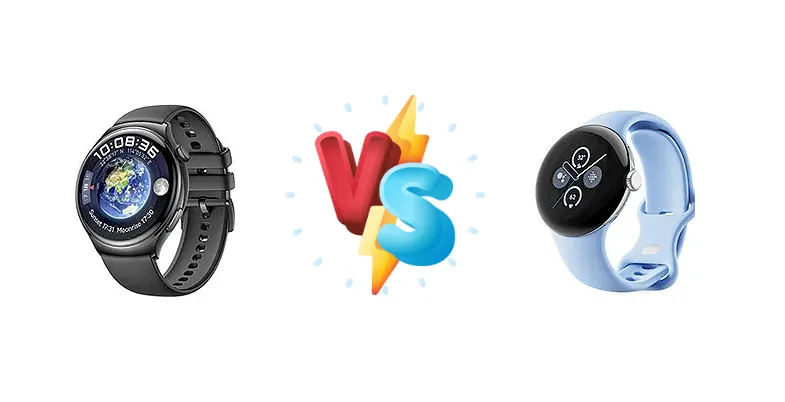
The smartwatch market is heating up, with both Huawei and Google offering compelling options. The Huawei Watch 4, powered by the efficient Snapdragon W5 Gen 1, aims for extended battery life and smooth performance. Meanwhile, the Google Pixel Watch 2, utilizing the Qualcomm 5100, focuses on seamless Wear OS integration and faster charging. This comparison dissects the core differences to help you choose the right wrist companion.
🏆 Quick Verdict
For the average user prioritizing battery life and efficient performance, the Huawei Watch 4 emerges as the winner. Its Snapdragon W5 Gen 1 chipset, built on a 4nm process, offers a significant advantage in power efficiency over the Pixel Watch 2’s Qualcomm 5100. However, the Pixel Watch 2’s faster wired charging is a compelling counterpoint for those who value convenience.
| Network |
|---|
| 2G bands | N/A | GSM 850 / 900 / 1800 / 1900 |
| 3G bands | HSDPA 850 / 900 / 1800 / 1900 / 2100 / 800 | HSDPA 850 / 900 / 1700(AWS) / 1900 / 2100 |
| 4G bands | LTE | LTE |
| Speed | HSPA, LTE | HSPA, LTE |
| Technology | HSPA / LTE | GSM / HSPA / LTE |
| Launch |
|---|
| Announced | 2023, May 10 | 2023, October 04 |
| Status | Available. Released 2023, June 22 | Available. Released 2023, October 12 |
| Body |
|---|
| Build | Glass front, ceramic back, stainless steel frame | Glass front (Gorilla Glass 5), aluminum frame |
| Dimensions | 46.2 x 46.2 x 10.9 mm (1.82 x 1.82 x 0.43 in) | 41 x 41 x 12.3 mm (1.61 x 1.61 x 0.48 in) |
| SIM | eSIM | eSIM |
| Weight | 48 g (1.69 oz) | 31 g (1.09 oz) |
| | 50m water resistant
5 ATM
Compatible with standard 22mm straps | - |
| Display |
|---|
| Protection | - | Corning Gorilla Glass 5 |
| Resolution | 466 x 466 pixels (~310 ppi density) | 450 x 450 pixels (~320 ppi density) |
| Size | 1.5 inches | 1.2 inches |
| Type | AMOLED | AMOLED, 1000 nits (peak) |
| | * the display resolution is unconfirmed
Always-on display | - |
| Platform |
|---|
| CPU | Quad-core 1.7 GHz Cortex-A53 | - |
| Chipset | Qualcomm Snapdragon W5 Gen 1 (4 nm) | Qualcomm 5100 |
| GPU | Adreno 702 | - |
| OS | HarmonyOS 3.0 | Android Wear OS 4 |
| Memory |
|---|
| Card slot | No | No |
| Internal | 32GB 2GB RAM | 32GB 2GB RAM |
| Sound |
|---|
| 3.5mm jack | No | - |
| 35mm jack | No | No |
| Loudspeaker | Yes | Yes |
| Comms |
|---|
| Bluetooth | 5.2, A2DP, LE | 5.0, A2DP, LE |
| NFC | Yes | Yes |
| Positioning | GPS, GLONASS, BDS, GALILEO, QZSS | GPS, GLONASS, GALILEO, BDS, QZSS |
| Radio | No | No |
| USB | No | No |
| WLAN | Wi-Fi 802.11 b/g/n (market/region dependent) | Wi-Fi 802.11 b/g/n |
| Features |
|---|
| Sensors | Accelerometer, gyro, heart rate, barometer, compass, SpO2, thermometer (body temperature) | Accelerometer, gyro, heart rate, altimeter, compass, SpO2, thermometer (skin temperature), skin conductance |
| Battery |
|---|
| Charging | Wireless | Wired, 80% in 45 min |
| Type | Li-Ion 530 mAh | Li-Ion 306 mAh |
| Misc |
|---|
| Colors | Black | Polished Silver, Matte Black, Champagne Gold |
| Models | ARC-AL00 | G4TSL, GC3G8, GD2WG |
| Price | About 450 EUR | About 160 EUR |
Huawei Watch 4
- Superior power efficiency with Snapdragon W5 Gen 1
- Potentially longer battery life
- Smoother performance for demanding apps
- Relies on HarmonyOS, potentially limiting app availability
- Wireless charging is slower than Pixel Watch 2's wired charging
Google Pixel Watch 2
- Seamless integration with Google ecosystem
- Faster charging (80% in 45 minutes)
- Access to a wider range of Wear OS apps
- Less power-efficient chipset (Qualcomm 5100)
- Likely requires more frequent charging
Display Comparison
While both watches likely feature AMOLED displays (data not provided), the core difference lies in the underlying efficiency. The chipset powering the watch directly impacts display power draw. The Snapdragon W5 Gen 1’s 4nm architecture in the Huawei Watch 4 allows for more efficient display management, potentially extending battery life even with similar display characteristics. We expect both to offer vibrant colors and good outdoor visibility, but the Huawei Watch 4 has an edge in sustained brightness due to its power efficiency.
Camera Comparison
Neither device is marketed for its camera capabilities, and detailed camera specs are unavailable. Smartwatch cameras are generally limited in quality, serving primarily for quick scans or remote control functionality. Therefore, this is not a significant differentiating factor between these two models.
Performance
The Huawei Watch 4’s Qualcomm Snapdragon W5 Gen 1 (4nm) represents a significant leap in smartwatch chipset technology. The 4nm process node inherently delivers better power efficiency and thermal performance compared to the Qualcomm 5100 in the Pixel Watch 2. While the 5100 is a capable chip, the W5 Gen 1’s quad-core 1.7 GHz Cortex-A53 architecture is optimized for wearable workloads, resulting in smoother animations and faster app loading times, especially for complex tasks. The Pixel Watch 2 will likely feel responsive for basic notifications and fitness tracking, but the Huawei Watch 4 should handle more demanding applications with greater ease.
Battery Life
The Huawei Watch 4 benefits significantly from the Snapdragon W5 Gen 1’s power efficiency. While specific battery capacities are not provided, the 4nm process allows for longer runtimes between charges. The Google Pixel Watch 2 compensates with faster charging – reaching 80% in 45 minutes. This is a crucial trade-off: the Pixel Watch 2 offers convenience for users who don’t mind charging daily, while the Huawei Watch 4 prioritizes longevity, potentially lasting multiple days on a single charge depending on usage.
Buying Guide
Buy the Huawei Watch 4 if you need exceptional battery life, value efficient performance for everyday tasks, and prefer a more independent smartwatch ecosystem with HarmonyOS. Buy the Google Pixel Watch 2 if you prioritize tight integration with the Google ecosystem, rely heavily on Wear OS apps, and prefer the convenience of rapid 80% charging in under an hour, even if it means more frequent charging cycles.
Frequently Asked Questions
❓ Does the Qualcomm 5100 in the Pixel Watch 2 get noticeably warm during extended use, like during a workout with GPS enabled?
The Qualcomm 5100, being built on a less efficient process node than the Snapdragon W5 Gen 1, is more prone to thermal throttling under sustained load. Users may experience some warmth during prolonged GPS tracking or demanding app usage. The Huawei Watch 4, with its 4nm chipset, is expected to manage heat more effectively.
❓ How does HarmonyOS on the Huawei Watch 4 compare to Wear OS in terms of app availability and customization options?
HarmonyOS, while improving, still lags behind Wear OS in terms of app ecosystem size. While Huawei is expanding its app library, you'll find a significantly wider selection of apps available on the Google Play Store for Wear OS. Customization options are also more limited on HarmonyOS compared to the extensive watch face and app customization available on Wear OS.
❓ Is the 45-minute charge time for the Pixel Watch 2 truly representative of real-world usage, or does it slow down significantly after 80%?
The 45-minute charge time for the Pixel Watch 2 is typically to reach 80%. The final 20% often charges at a slower rate to protect battery health, meaning a full 0-100% charge will likely take closer to 60-75 minutes. The Huawei Watch 4's wireless charging, while slower overall, offers a more consistent charging rate.