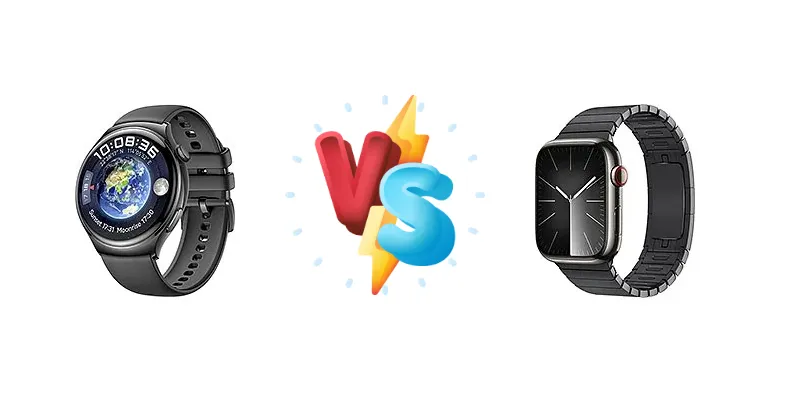
The smartwatch landscape is dominated by Apple, but Huawei is making a strong push with the Watch 4, powered by Qualcomm's latest wearable chipset. This comparison dissects the core differences between the Huawei Watch 4 and the Apple Watch Series 9, focusing on the architectural implications of their respective processors and how those translate to real-world user experience.
🏆 Quick Verdict
For the average user prioritizing seamless ecosystem integration and established app support, the Apple Watch Series 9 remains the superior choice. However, the Huawei Watch 4’s Snapdragon W5 Gen 1 offers a compelling alternative, particularly for those seeking potentially better battery efficiency and a more open platform.
| Network |
|---|
| 2G bands | N/A | GSM 850 / 900 / 1800 / 1900 |
| 3G bands | HSDPA 850 / 900 / 1800 / 1900 / 2100 / 800 | HSDPA 850 / 900 / 1700(AWS) / 1900 / 2100 - International, China, HK |
| 4G bands | LTE | 1, 2, 3, 4, 5, 6, 7, 8, 18, 19, 20, 25, 26, 28, 39, 40, 41, 66 - International, China, HK |
| Speed | HSPA, LTE | HSPA, LTE |
| Technology | HSPA / LTE | GSM / HSPA / LTE |
| Launch |
|---|
| Announced | 2023, May 10 | 2023, September 12 |
| Status | Available. Released 2023, June 22 | Available. Released 2023, September 22 |
| Body |
|---|
| Build | Glass front, ceramic back, stainless steel frame | Sapphire crystal front, ceramic/sapphire crystal back, stainless steel frame |
| Dimensions | 46.2 x 46.2 x 10.9 mm (1.82 x 1.82 x 0.43 in) | 45 x 38 x 10.7 mm (1.77 x 1.50 x 0.42 in) |
| SIM | eSIM | eSIM |
| Weight | 48 g (1.69 oz) | 42.3 g (41mm), 51.5 g (45mm) (1.48 oz) |
| | 50m water resistant
5 ATM
Compatible with standard 22mm straps | - |
| Display |
|---|
| Protection | - | Sapphire crystal glass |
| Resolution | 466 x 466 pixels (~310 ppi density) | 484 x 396 pixels (~326 ppi density) |
| Size | 1.5 inches | 1.9 inches |
| Type | AMOLED | Retina LTPO OLED, 2000 nits (peak) |
| | * the display resolution is unconfirmed
Always-on display | - |
| Platform |
|---|
| CPU | Quad-core 1.7 GHz Cortex-A53 | Dual-core |
| Chipset | Qualcomm Snapdragon W5 Gen 1 (4 nm) | Apple S9 |
| GPU | Adreno 702 | PowerVR |
| OS | HarmonyOS 3.0 | watchOS 10, upgradable to watchOS 26.1 |
| Memory |
|---|
| Card slot | No | No |
| Internal | 32GB 2GB RAM | 64GB |
| Sound |
|---|
| 3.5mm jack | No | - |
| 35mm jack | No | No |
| Loudspeaker | Yes | Yes |
| Comms |
|---|
| Bluetooth | 5.2, A2DP, LE | 5.3, A2DP, LE |
| NFC | Yes | Yes |
| Positioning | GPS, GLONASS, BDS, GALILEO, QZSS | GPS, GLONASS, GALILEO, QZSS, BDS |
| Radio | No | No |
| USB | No | No |
| WLAN | Wi-Fi 802.11 b/g/n (market/region dependent) | Wi-Fi 802.11 b/g/n, dual-band |
| Features |
|---|
| Sensors | Accelerometer, gyro, heart rate, barometer, compass, SpO2, thermometer (body temperature) | Accelerometer, gyro, heart rate, barometer, always-on altimeter, compass, SpO2, VO2max, temperature (body) |
| Battery |
|---|
| Charging | Wireless | Wireless, 0-80% in 45 min |
| Type | Li-Ion 530 mAh | Li-Ion 308 mAh |
| Misc |
|---|
| Colors | Black | Graphite, Silver, Gold, Red |
| Models | ARC-AL00 | A2982, A2984, A2983, A2985, Watch7,3, Watch7,4 |
| Price | About 450 EUR | About 630 EUR |
| SAR | - | 1.02 W/kg (head) |
| SAR EU | - | 0.64 W/kg (head) |
Huawei Watch 4
- Potentially longer battery life due to the 4nm Snapdragon W5 Gen 1.
- More open ecosystem and wider compatibility with Android devices.
- Quad-core processor may handle multitasking more efficiently.
- App ecosystem is less mature than watchOS.
- Brand recognition and support may be lower than Apple.
Apple Watch Series 9
- Seamless integration with the Apple ecosystem.
- Vast app library and strong developer support.
- Advanced features like fall detection and ECG.
- Requires an iPhone for full functionality.
- Potentially shorter battery life compared to the Huawei Watch 4.
Display Comparison
While specific display specs (brightness, panel type) are not provided, both watches utilize wireless charging, suggesting a focus on convenience. The Apple Watch Series 9 likely benefits from Apple’s display calibration expertise, potentially offering superior color accuracy. However, the Huawei Watch 4’s display technology is unknown, making a definitive comparison impossible without further data. The absence of LTPO information for the Huawei Watch 4 is a notable omission, potentially impacting its always-on display efficiency compared to the Apple Watch.
Camera Comparison
Neither device is primarily marketed for its camera capabilities, and detailed camera specs are unavailable. This comparison section is therefore limited. Both likely feature basic camera functionality for quick snapshots or potentially video calls, but are not intended to compete with dedicated camera devices.
Performance
The core difference lies in the chipsets. The Apple Watch Series 9 features Apple’s custom S9, a dual-core processor optimized for watchOS. Conversely, the Huawei Watch 4 utilizes the Qualcomm Snapdragon W5 Gen 1, a quad-core 1.7 GHz Cortex-A53 processor built on a 4nm process. The 4nm node of the Snapdragon W5 Gen 1 *should* offer better thermal efficiency than the process node used in the S9 (likely a 5nm or similar), potentially leading to less throttling during sustained tasks. However, Apple’s tight software-hardware integration often allows it to extract more performance from fewer cores. The quad-core configuration of the Snapdragon W5 Gen 1 suggests a greater capacity for parallel processing, which could benefit multitasking and complex background operations.
Battery Life
The Snapdragon W5 Gen 1’s 4nm process is a significant advantage for battery life. While mAh ratings are missing, the improved efficiency of the 4nm node suggests the Huawei Watch 4 could potentially offer longer runtimes between charges. The Apple Watch Series 9 charges to 80% in 45 minutes, a useful metric, but without knowing the Huawei Watch 4’s charging speed, a direct comparison is difficult. The Snapdragon W5 Gen 1’s power efficiency could offset a potentially smaller battery capacity in the Huawei Watch 4.
Buying Guide
Buy the Huawei Watch 4 if you need a smartwatch with potentially longer battery life due to the efficient 4nm Snapdragon W5 Gen 1, and prefer a more open ecosystem less reliant on a specific smartphone brand. Buy the Apple Watch Series 9 if you prioritize tight integration with the Apple ecosystem, access to a vast app library, and advanced features like fall detection and ECG, even if it means more frequent charging.
Frequently Asked Questions
❓ Does the Snapdragon W5 Gen 1 in the Huawei Watch 4 offer comparable performance to the Apple S9?
While the Apple S9 is a highly optimized chip, the Snapdragon W5 Gen 1’s quad-core architecture and 4nm process provide a strong foundation for performance. Apple’s software integration gives it an edge, but the Huawei Watch 4 should handle everyday tasks and most apps without issue. Direct performance benchmarks are needed for a definitive answer.
❓ How does the Huawei Watch 4’s compatibility compare to the Apple Watch Series 9, especially for Android users?
The Apple Watch Series 9 is exclusively compatible with iPhones. The Huawei Watch 4, powered by Wear OS, offers broader compatibility with both Android and iOS devices, though functionality may be limited on iOS. This makes the Huawei Watch 4 a more versatile option for users not invested in the Apple ecosystem.
❓ What are the implications of the Apple Watch Series 9's 0-80% charge time of 45 minutes for daily use?
The 45-minute 0-80% charge time is convenient for topping up the Apple Watch Series 9 during a morning routine or before a workout. However, it also highlights the potential need for more frequent charging compared to a device with potentially longer battery life, like the Huawei Watch 4.