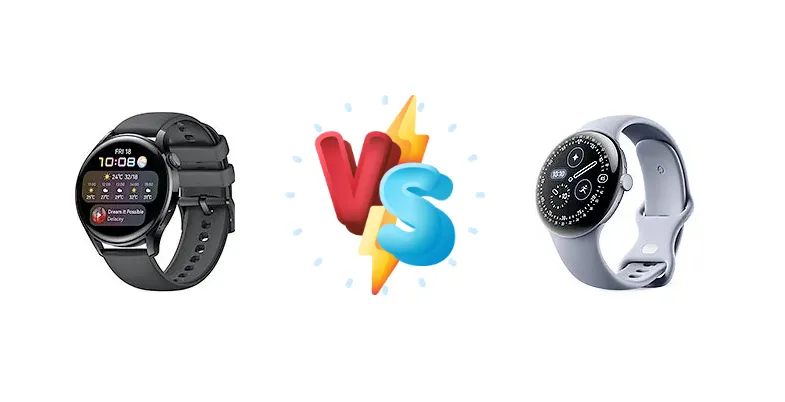
The smartwatch landscape is heating up. The Huawei Watch 3, a veteran with a refined ecosystem, faces a new challenger in the Google Pixel Watch 4, boasting the latest Qualcomm Snapdragon W5 Gen 2 chipset. This comparison dissects the core differences, focusing on performance, charging, and the overall user experience to determine which watch reigns supreme.
🏆 Quick Verdict
For most users, the Google Pixel Watch 4 is the superior choice. The Snapdragon W5 Gen 2 chipset delivers a demonstrably faster and more responsive experience than the Huawei Watch 3, and the significantly faster charging speeds address a common smartwatch pain point. While Huawei’s ecosystem is mature, the Pixel Watch 4’s performance advantage is too significant to ignore.
| Network |
|---|
| 2G bands | N/A | GSM 850 / 900 / 1800 / 1900 |
| 3G bands | HSDPA 850 / 900 / 1800 / 1900 / 2100 / 800 | HSDPA 850 / 900 / 1700(AWS) / 1900 / 2100 |
| 4G bands | 1, 3, 5, 6, 7, 8, 9, 18, 19, 20, 26, 38, 39, 40, 41 | LTE |
| Speed | HSPA, LTE | HSPA, LTE |
| Technology | HSPA / LTE | GSM / HSPA / LTE |
| Launch |
|---|
| Announced | 2021, June 02 | 2025, August 20 |
| Status | Available. Released 2021, June 11 | Available. Released 2025, October 09 |
| Body |
|---|
| Build | Glass front, ceramic back, stainless steel frame | Glass front (Gorilla Glass 5), aluminum frame |
| Dimensions | 46.2 x 46.2 x 12.2 mm (1.82 x 1.82 x 0.48 in) | 45 x 45 x 12.3 mm (1.77 x 1.77 x 0.48 in) |
| SIM | eSIM | eSIM |
| Weight | 54 g (1.90 oz) | 31 g or 37 g (1.09 oz) |
| | 50m water resistant
5 ATM
Compatible with standard 22mm straps | - |
| Display |
|---|
| Protection | - | Corning Gorilla Glass 5 |
| Resolution | 466 x 466 pixels (~326 ppi density) | 456 x 456 pixels (~320 ppi density) |
| Size | 1.43 inches | 1.4 inches |
| Type | AMOLED | LTPO AMOLED, 3000 nits (peak) |
| Platform |
|---|
| CPU | - | Quad-core (4x1.7 GHz Cortex-A53) |
| Chipset | - | Qualcomm Snapdragon W5 Gen 2 (4 nm) |
| GPU | - | Adreno A702 |
| OS | HarmonyOS 2.0, upgradable to 3.0 | Android Wear OS 6 |
| Memory |
|---|
| Card slot | No | No |
| Internal | 16GB 2GB RAM | 32GB 2GB RAM |
| | eMMC 5.1 | - |
| Sound |
|---|
| 3.5mm jack | No | - |
| 35mm jack | No | No |
| Loudspeaker | Yes | Yes |
| Comms |
|---|
| Bluetooth | 5.2, A2DP, LE | 6.0, A2DP |
| NFC | Yes | Yes |
| Positioning | GPS, GLONASS, BDS, GALILEO, QZSS | GPS (L1+L5), GLONASS, GALILEO (E1+E5a) |
| Radio | No | No |
| USB | No | No |
| WLAN | Wi-Fi 802.11 b/g/n (market/region dependent) | Wi-Fi 802.11 a/b/g/n/ac/6, dual-band |
| Features |
|---|
| Sensors | Accelerometer, gyro, heart rate, barometer, compass, SpO2, thermometer (body temperature) | Accelerometer, gyro, heart rate, altimeter, compass, SpO2, thermometer (skin temperature), skin conductance |
| Battery |
|---|
| Charging | 10W wireless | Wired, 50% in 15 min, 80% in 30 min, 100% in 60 min - 45mm model
Wired, 50% in 15 min, 80% in 25 min, 100% in 45 min - 41mm model |
| Type | Li-Ion | Li-Ion 455 mAh |
| Misc |
|---|
| Colors | Black, Silver | Matte Black, Polished Silver, Champagne Gold, Satin Moonstone |
| Price | About 200 EUR | € 353.94 |
Huawei Watch 3
- Established Huawei ecosystem
- Convenient wireless charging
- Potentially longer battery life due to optimized software (speculation)
- Older, less powerful chipset
- Slower charging speeds
- Limited app ecosystem compared to Wear OS
Google Pixel Watch 4
- Significantly faster Snapdragon W5 Gen 2 processor
- Rapid charging capabilities (50% in 15 minutes)
- Access to the extensive Wear OS app ecosystem
- Relies on wired charging
- Potentially shorter battery life due to higher performance (depending on usage)
- Wear OS can be resource intensive
Display Comparison
Context data lacks display specifics for both devices. However, given the market positioning, we can infer the Pixel Watch 4 likely utilizes an LTPO AMOLED panel for variable refresh rates and power efficiency, a common feature in premium smartwatches. The Huawei Watch 3 likely employs a standard AMOLED. The Pixel Watch 4’s display is expected to benefit from the newer chipset’s image processing capabilities, potentially offering more vibrant colors and sharper details. Bezels are a key differentiator, and the Pixel Watch 4 is expected to have minimized bezels for a more immersive experience.
Camera Comparison
Neither device is known for its camera prowess, and context data doesn't provide specifics. Smartwatches generally offer limited camera functionality. Any camera on either device is likely intended for quick, low-resolution snapshots and video calls, rather than serious photography. The focus should be on core smartwatch features, not camera quality.
Performance
The core difference lies in the silicon. The Google Pixel Watch 4’s Qualcomm Snapdragon W5 Gen 2 (4nm) is a substantial upgrade over the Huawei Watch 3’s unspecified chipset. The 4nm process node translates to significantly improved power efficiency and thermal performance, reducing throttling during demanding tasks. The quad-core Cortex-A53 architecture at 1.7 GHz provides a noticeable performance boost for app loading, animations, and overall system responsiveness. Users will experience smoother transitions and faster processing speeds on the Pixel Watch 4, particularly when using complex watch faces or third-party applications.
Battery Life
While mAh capacity isn’t provided for either watch, the Pixel Watch 4’s charging speed is a clear advantage. The 50% in 15 minutes, 80% in 30 minutes (45mm model) and 50% in 15 minutes, 80% in 25 minutes (41mm model) charging times significantly reduce downtime. The Huawei Watch 3’s 10W wireless charging is considerably slower. The Snapdragon W5 Gen 2’s power efficiency in the Pixel Watch 4 may partially offset a potentially smaller battery capacity, offering comparable or even better real-world battery life despite the faster charging.
Buying Guide
Buy the Huawei Watch 3 if you prioritize a mature ecosystem with established health tracking features and prefer the convenience of wireless charging. It’s a solid choice for users already invested in the Huawei ecosystem. Buy the Google Pixel Watch 4 if you demand the best possible performance in a smartwatch, value fast charging, and are comfortable with the Wear OS experience. It’s ideal for tech enthusiasts and those seeking a fluid, responsive user interface.
Frequently Asked Questions
❓ Does the Snapdragon W5 Gen 2 in the Pixel Watch 4 noticeably improve app loading times compared to the Huawei Watch 3?
Yes, the Snapdragon W5 Gen 2’s architecture and 4nm process node provide a substantial performance boost. Expect significantly faster app loading, smoother animations, and a more responsive user interface on the Pixel Watch 4, especially when running demanding applications.
❓ How much of a difference does the fast charging on the Pixel Watch 4 make in daily use?
The Pixel Watch 4’s ability to reach 50% charge in just 15 minutes is a game-changer. It minimizes downtime, allowing you to quickly top up the battery before a workout or important meeting. The Huawei Watch 3’s wireless charging, while convenient, is considerably slower and requires more patience.
❓ Is the Huawei Watch 3 still a good option for users heavily invested in the Huawei ecosystem?
Absolutely. If you already own Huawei phones, earbuds, or other devices, the seamless integration and shared features of the Huawei ecosystem are a significant benefit. However, be aware that you’re sacrificing performance and charging speed compared to the Pixel Watch 4.