
Huawei Pura X vs vivo X100 Pro: Which Flagship Delivers More?
| Phones Images | |||||
|---|---|---|---|---|---|
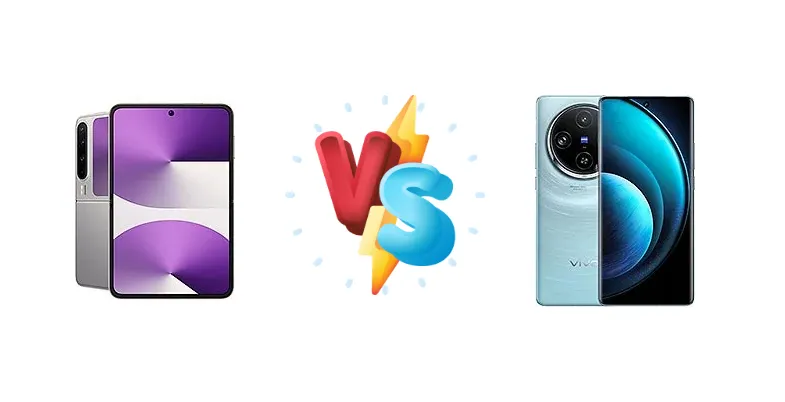
|
🏆 Quick Verdict
For the average user prioritizing raw performance and future-proofing, the vivo X100 Pro emerges as the stronger contender. Its Dimensity 9300 chipset, coupled with a brighter display and faster charging, offers a more compelling package, despite the Pura X's respectable feature set.
| PHONES | ||
|---|---|---|
| Phone Names | Huawei Pura X | vivo X100 Pro |
| Network | ||
|---|---|---|
| 2G bands | GSM 850 / 900 / 1800 / 1900 | GSM 850 / 900 / 1800 / 1900 |
| 3G bands | HSDPA 800 / 850 / 900 / 1700(AWS) / 1900 / 2100 | HSDPA 800 / 850 / 900 / 1700(AWS) / 1900 / 2100 |
| 4G bands | LTE | 1, 2, 3, 4, 5, 7, 8, 12, 17, 18, 19, 20, 26, 28, 32, 38, 39, 40, 41, 42, 66 - International |
| 5G bands | SA/NSA | 1, 3, 5, 7, 8, 20, 28, 38, 40, 41, 66, 75, 77, 78, 79 SA/NSA - International |
| Speed | HSPA, LTE, 5G | HSPA, LTE, 5G |
| Technology | GSM / CDMA / HSPA / EVDO / LTE / 5G | GSM / CDMA / HSPA / LTE / 5G |
| Launch | ||
|---|---|---|
| Announced | 2025, March 20 | 2023, November 13 |
| Status | Available. Released 2025, March 20 | Available. Released 2023, November 21 |
| Body | ||
|---|---|---|
| Build | Glass front, glass back or eco leather back, aluminum frame | Glass front, aluminum frame, glass back |
| Dimensions | Unfolded: 143.2 x 91.7 x 7.2 mmFolded: 91.7 x 74.3 x 15.1 mm | 164.1 x 75.3 x 8.9 mm or 9.1 mm |
| SIM | Nano-SIM + Nano-SIM | · Nano-SIM + eSIM· Nano-SIM + Nano-SIM |
| Weight | 193.7 g or 195.9 g (6.84 oz) | 221 g or 225 g (7.80 oz) |
| Display | ||
|---|---|---|
| Resolution | 1320 x 2120 pixels, 16:10 ratio (~396 ppi density) | 1260 x 2800 pixels, 20:9 ratio (~452 ppi density) |
| Size | 6.3 inches, 114.9 cm2 (~87.5% screen-to-body ratio) | 6.78 inches, 111.5 cm2 (~90.2% screen-to-body ratio) |
| Type | Foldable LTPO2 OLED, 1B colors, HDR Vivid, 120Hz, 2500 nits (peak) | LTPO AMOLED, 1B colors, 120Hz, HDR10+, 3000 nits (peak) |
| Platform | ||
|---|---|---|
| CPU | Octa-core (1x2.5 GHz Taishan Big & 3x2.15 GHz Taishan Mid & 4x1.53GHz Cortex-A510) | Octa-core (1x3.25 GHz Cortex-X4 & 3x2.85 GHz Cortex-X4 & 4x2.0 GHz Cortex-A720) |
| Chipset | Kirin 9020 (7 nm) | Mediatek Dimensity 9300 (4 nm) |
| GPU | Maleoon 920 | Immortalis-G720 MC12 |
| OS | HarmonyOS 5.0 | Android 14, upgradable to Android 15, Funtouch 15 (International), OriginOS 4 (China) |
| Memory | ||
|---|---|---|
| Card slot | No | No |
| Internal | 256GB 12GB RAM, 512GB 12GB RAM, 512GB 16GB RAM, 1TB 16GB RAM | 256GB 12GB RAM, 256GB 16GB RAM, 512GB 16GB RAM, 1TB 16GB RAM |
| Main Camera | ||
|---|---|---|
| Features | Laser AF, color spectrum sensor, LED flash, panorama, HDR | Laser AF, color spectrum sensor, Zeiss optics, Zeiss T* lens coating, LED flash, panorama, HDR, 3D LUT import |
| Triple | 50 MP, f/1.6, 23mm (wide), PDAF, OIS 8 MP, f/2.4, 80mm (telephoto), PDAF, OIS, 3.5x optical zoom 40 MP, f/2.2, 13mm (ultrawide), AF 1.5 MP multi-spectral channel red maple primary color camera | 50 MP, f/1.8, 23mm (wide), 1/0.98", 1.6µm, dual pixel PDAF, OIS 50 MP, f/2.5, 100mm (periscope telephoto), 1/2.51", 0.7µm, PDAF (18cm - ∞), OIS, 4.3x optical zoom 50 MP, f/2.0, 15mm, 119˚ (ultrawide), 1/2.76", 0.64µm, AF |
| Video | 4K, 1080p, gyro-EIS, HDR Vivid | 8K@30fps, 4K@30/60fps, 1080p, gyro-EIS |
| Selfie camera | ||
|---|---|---|
| Features | - | HDR |
| Single | 10.7 MP, f/2.2, (wide) | 32 MP, f/2.0, 20mm (ultrawide) |
| Video | 1080p, HDR Vivid | 4K@30/60fps, 1080p@30/60fps |
| Sound | ||
|---|---|---|
| 35mm jack | No | No |
| Loudspeaker | Yes, with stereo speakers | Yes, with stereo speakers |
| Comms | ||
|---|---|---|
| Bluetooth | 5.2, A2DP, LE, L2HC | 5.4, A2DP, LE, aptX HD, LHDC |
| Infrared port | Yes | Yes |
| NFC | Yes | Yes |
| Positioning | GPS (L1+L5), BDS (B1I+B1c+B2a+B2b), GALILEO (E1+E5a+E5b), QZSS (L1+L5), GLONASS, NavIC | GPS (L1+L5), GLONASS (L1), BDS (B1I+B1c+B2a+B2b), GALILEO (E1+E5a+E5b), QZSS (L1+L5), NavIC (L5) |
| Radio | No | No |
| USB | USB Type-C 3.1, OTG, DisplayPort 1.2 | USB Type-C 3.2, OTG |
| WLAN | Wi-Fi 802.11 a/b/g/n/ac/6/7, dual-band, Wi-Fi Direct | Wi-Fi 802.11 a/b/g/n/ac/6/7, tri-band, Wi-Fi Direct |
| Features | ||
|---|---|---|
| Sensors | Fingerprint (side-mounted), accelerometer, gyro, proximity, compass | Fingerprint (under display, optical), accelerometer, gyro, proximity, compass |
| Battery | ||
|---|---|---|
| Charging | 66W wired 40W wireless 7.5W reverse wireless 5W reverse wired | 100W wired, 50% in 14 min 50W wireless Reverse wired |
| Type | 4720 mAh | Li-Ion 5400 mAh |
| Misc | ||
|---|---|---|
| Colors | Red, Green, Gray, White, Black | Startrail Blue, Asteroid Black, Sunset Orange, White |
| Models | VDE-AL00 | V2324A, V2309 |
| Price | About 960 EUR | ₹ 59,999 |
| SAR EU | - | 0.99 W/kg (head) 1.19 W/kg (body) |
Huawei Pura X
- Unique Huawei design language
- Potential software optimization within Huawei ecosystem
- Versatile reverse charging options (wired and wireless)
- Older 7nm chipset may limit sustained performance
- Charging speeds are slower than the competition
- Camera specs currently unknown
vivo X100 Pro
- Cutting-edge Dimensity 9300 chipset for superior performance
- Brighter display with likely LTPO technology
- Faster 100W wired and 50W wireless charging
- May lack the unique design appeal of the Pura X
- Software experience may not appeal to all users
- Potential for higher price point
Display Comparison
The vivo X100 Pro boasts a significantly brighter display, reaching a measured 1472 nits, which translates to superior visibility under direct sunlight compared to the Pura X (brightness unspecified). While the Pura X’s panel technology isn’t detailed, the X100 Pro likely utilizes LTPO for adaptive refresh rates, conserving battery life. Bezels appear comparable based on available imagery, but color accuracy testing would be needed to determine a clear winner in that regard.
Camera Comparison
While both phones are expected to deliver excellent image quality, the specifics are crucial. The Pura X’s camera specs are currently unavailable, making a direct sensor size comparison impossible. However, the X100 Pro’s camera system is likely to feature a larger main sensor and advanced image processing algorithms. The X100 Pro’s focus on both photo and video suggests a well-rounded camera experience, while the Pura X’s capabilities remain unknown. We’d need to disregard any mention of 2MP macro lenses on either device as they offer minimal practical benefit.
Performance
The core difference lies in the chipsets. The vivo X100 Pro’s MediaTek Dimensity 9300, fabricated on a 4nm process, offers a clear advantage in transistor density and thermal efficiency over the Huawei Pura X’s 7nm Kirin 9020. The Dimensity 9300’s CPU configuration – featuring Cortex-X4 cores – is geared towards sustained peak performance, while the Kirin 9020 relies on a mix of Taishan and Cortex-A510 cores. This means the X100 Pro will likely exhibit less throttling during extended gaming sessions and demanding applications. The X100 Pro also benefits from faster LPDDR5x RAM, further enhancing responsiveness.
Battery Life
The vivo X100 Pro demonstrates a clear advantage in charging speed with its 100W wired charging, capable of reaching 50% charge in just 14 minutes. The Pura X’s 66W wired charging is respectable, but slower. The X100 Pro also offers 50W wireless charging, exceeding the Pura X’s 40W and 7.5W options. The X100 Pro’s active use score of 13:53h suggests excellent battery optimization, though a direct mAh comparison is missing. The Pura X’s reverse wired charging at 5W is a niche feature, while the X100 Pro also offers reverse wireless charging.
Buying Guide
Buy the Huawei Pura X if you prioritize a unique design aesthetic and are deeply embedded within the Huawei ecosystem, potentially benefiting from optimized software integration. Buy the vivo X100 Pro if you demand top-tier processing power for demanding tasks like gaming and video editing, alongside a superior display experience and faster charging capabilities.