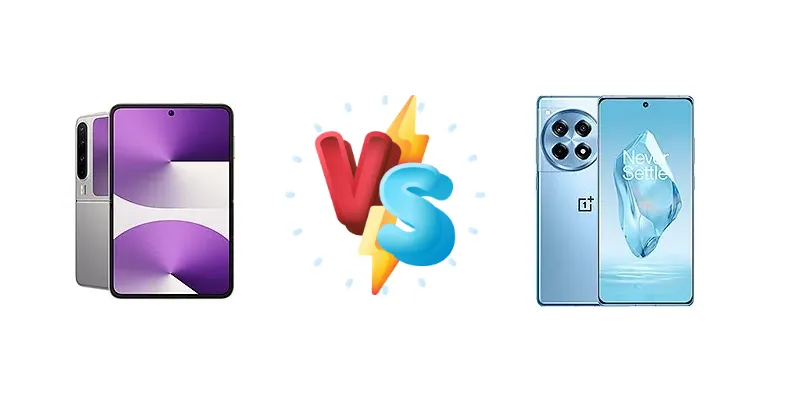
The Huawei Pura X and OnePlus 12R represent distinct approaches to the premium smartphone market. The Pura X, powered by Huawei’s Kirin 9020, aims to deliver a refined experience within the Huawei ecosystem. Conversely, the OnePlus 12R leverages the proven Qualcomm Snapdragon 8 Gen 2, focusing on raw performance and rapid charging at a competitive price point. This comparison dissects their key differences to help you choose the right device.
🏆 Quick Verdict
For most users, the OnePlus 12R emerges as the stronger choice. Its Snapdragon 8 Gen 2 chipset provides demonstrably superior performance and efficiency, coupled with incredibly fast 100W charging and a bright, vibrant display. While the Pura X offers wireless charging and a unique design, it can't match the 12R's overall value.
| Network |
|---|
| 2G bands | GSM 850 / 900 / 1800 / 1900 | GSM 850 / 900 / 1800 / 1900 |
| 3G bands | HSDPA 800 / 850 / 900 / 1700(AWS) / 1900 / 2100 | HSDPA 850 / 900 / 1700(AWS) / 1900 / 2100 |
| 4G bands | LTE | 1, 2, 3, 4, 5, 7, 8, 12, 17, 18, 19, 20, 26, 28, 32, 38, 39, 40, 41, 66 |
| 5G bands | SA/NSA | 1, 2, 3, 5, 7, 8, 12, 20, 28, 38, 40, 41, 66, 77, 78 SA/NSA |
| Speed | HSPA, LTE, 5G | HSPA, LTE, 5G |
| Technology | GSM / CDMA / HSPA / EVDO / LTE / 5G | GSM / CDMA / HSPA / LTE / 5G |
| Launch |
|---|
| Announced | 2025, March 20 | 2024, January 23 |
| Status | Available. Released 2025, March 20 | Available. Released 2024, February 06 |
| Body |
|---|
| Build | Glass front, glass back or eco leather back, aluminum frame | Glass front (Gorilla Glass Victus 2), aluminum frame, glass back |
| Dimensions | Unfolded: 143.2 x 91.7 x 7.2 mmFolded: 91.7 x 74.3 x 15.1 mm | 163.3 x 75.3 x 8.8 mm (6.43 x 2.96 x 0.35 in) |
| SIM | Nano-SIM + Nano-SIM | · Nano-SIM + Nano-SIM + eSIM (max 2 at a time)· Nano-SIM + Nano-SIM |
| Weight | 193.7 g or 195.9 g (6.84 oz) | 207 g (7.30 oz) |
| Display |
|---|
| Protection | - | Corning Gorilla Glass Victus 2 |
| Resolution | 1320 x 2120 pixels, 16:10 ratio (~396 ppi density) | 1264 x 2780 pixels (~450 ppi density) |
| Size | 6.3 inches, 114.9 cm2 (~87.5% screen-to-body ratio) | 6.78 inches, 111.7 cm2 (~90.9% screen-to-body ratio) |
| Type | Foldable LTPO2 OLED, 1B colors, HDR Vivid, 120Hz, 2500 nits (peak) | LTPO4 AMOLED, 1B colors, 120Hz, HDR10+, Dolby Vision, 1600 nits (HBM), 4500 nits (peak) |
| Platform |
|---|
| CPU | Octa-core (1x2.5 GHz Taishan Big & 3x2.15 GHz Taishan Mid & 4x1.53GHz Cortex-A510) | Octa-core (1x3.2 GHz Cortex-X3 & 2x2.8 GHz Cortex-A715 & 2x2.8 GHz Cortex-A710 & 3x2.0 GHz Cortex-A510) |
| Chipset | Kirin 9020 (7 nm) | Qualcomm SM8550-AB Snapdragon 8 Gen 2 (4 nm) |
| GPU | Maleoon 920 | Adreno 740 |
| OS | HarmonyOS 5.0 | Android 14, up to 3 major Android upgrades, OxygenOS 15 |
| Memory |
|---|
| Card slot | No | No |
| Internal | 256GB 12GB RAM, 512GB 12GB RAM, 512GB 16GB RAM, 1TB 16GB RAM | 128GB 8GB RAM, 256GB 8GB RAM, 256GB 12GB RAM, 256GB 16GB RAM |
| Main Camera |
|---|
| Features | Laser AF, color spectrum sensor, LED flash, panorama, HDR | Laser AF, color spectrum sensor, LED flash, HDR, panorama |
| Triple | 50 MP, f/1.6, 23mm (wide), PDAF, OIS
8 MP, f/2.4, 80mm (telephoto), PDAF, OIS, 3.5x optical zoom
40 MP, f/2.2, 13mm (ultrawide), AF
1.5 MP multi-spectral channel red maple primary color camera | 50 MP, f/1.8, 24mm (wide), 1/1.56", 1.0µm, multi-directional PDAF, OIS
8 MP, f/2.2, 16mm, 112˚ (ultrawide), 1/4.0", 1.12µm
2 MP (macro) |
| Video | 4K, 1080p, gyro-EIS, HDR Vivid | 4K@30/60fps, 1080p@30/60/120/240fps, gyro-EIS, OIS |
| Selfie camera |
|---|
| Features | - | HDR, panorama |
| Single | 10.7 MP, f/2.2, (wide) | 16 MP, f/2.4, 26mm (wide), 1/3", 1.0µm |
| Video | 1080p, HDR Vivid | 1080p@30fps, gyro-EIS |
| Sound |
|---|
| 35mm jack | No | No |
| Loudspeaker | Yes, with stereo speakers | Yes, with stereo speakers |
| Comms |
|---|
| Bluetooth | 5.2, A2DP, LE, L2HC | 5.3, A2DP, LE, aptX HD |
| Infrared port | Yes | Yes |
| NFC | Yes | Yes |
| Positioning | GPS (L1+L5), BDS (B1I+B1c+B2a+B2b), GALILEO (E1+E5a+E5b), QZSS (L1+L5), GLONASS, NavIC | GPS, GALILEO, GLONASS, BDS, QZSS |
| Radio | No | No |
| USB | USB Type-C 3.1, OTG, DisplayPort 1.2 | USB Type-C 2.0 |
| WLAN | Wi-Fi 802.11 a/b/g/n/ac/6/7, dual-band, Wi-Fi Direct | Wi-Fi 802.11 a/b/g/n/ac/6/7, dual-band |
| Features |
|---|
| Sensors | Fingerprint (side-mounted), accelerometer, gyro, proximity, compass | Fingerprint (under display, optical), accelerometer, gyro, proximity, compass |
| Battery |
|---|
| Charging | 66W wired
40W wireless
7.5W reverse wireless
5W reverse wired | 100W wired, 100% in 26 min |
| Type | 4720 mAh | Li-Ion 5500 mAh |
| Misc |
|---|
| Colors | Red, Green, Gray, White, Black | Iron Gray, Cool Blue, Electric Violet, Sunset Dune |
| Models | VDE-AL00 | CPH2609, CPH2585, CPH2611 |
| Price | About 960 EUR | € 410.84 / $ 399.95 / £ 649.00 |
| SAR | - | 1.19 W/kg (head) 0.82 W/kg (body) |
Huawei Pura X
- Wireless charging capabilities (66W and reverse wireless)
- Potentially unique Huawei design language
- Integration with Huawei ecosystem
- Less powerful Kirin 9020 chipset
- Slower wired charging compared to OnePlus 12R
- Limited software update guarantees
OnePlus 12R
- Superior performance with Snapdragon 8 Gen 2
- Extremely fast 100W wired charging
- Excellent battery life (14:32h active use)
- Lacks wireless charging
- OxygenOS can be divisive among Android purists
- Camera performance not class-leading
Display Comparison
The OnePlus 12R boasts a significantly brighter display, peaking at 1181 nits measured, compared to an unspecified peak brightness for the Pura X. This translates to superior visibility under direct sunlight. While panel technology details for the Pura X are missing, the 12R’s high brightness and likely AMOLED panel (typical for this segment) provide a richer viewing experience. Bezels are expected to be comparable, but the 12R’s brightness advantage is a clear win for outdoor usability.
Camera Comparison
Without detailed camera specifications for the Pura X, a direct comparison is limited. However, given Huawei’s history, it likely emphasizes computational photography. The OnePlus 12R, while not known for camera leadership, benefits from Qualcomm’s image signal processor (ISP). The focus should be on the main sensor size and aperture; larger sensors and wider apertures capture more light, improving low-light performance. Any OIS (Optical Image Stabilization) implementation on either device will be crucial for stable video recording. The 2MP macro cameras often found on both devices are generally of limited practical use.
Performance
The core difference lies in the chipsets. The OnePlus 12R’s Snapdragon 8 Gen 2 (4nm) is built on a more advanced process node than the Huawei Pura X’s Kirin 9020 (7nm). This 4nm process offers better thermal efficiency, meaning the 12R is less likely to throttle under sustained load. The Snapdragon 8 Gen 2’s CPU configuration – a Cortex-X3 prime core alongside A715 and A710 performance cores – is architecturally superior to the Kirin 9020’s Taishan cores and Cortex-A510 efficiency cores, resulting in faster application loading and smoother multitasking. The 12R’s LPDDR5x RAM further enhances performance.
Battery Life
The OnePlus 12R shines in charging speed with its 100W wired charging, achieving a full charge in just 26 minutes. The Pura X offers 66W wired charging, 40W wireless, and even reverse wireless charging (7.5W/5W), providing flexibility but slower overall wired speeds. The 12R’s active use score of 14:32h demonstrates excellent battery life, and while the Pura X’s battery capacity is unknown, the Snapdragon 8 Gen 2’s efficiency gives the 12R a significant advantage in longevity.
Buying Guide
Buy the Huawei Pura X if you prioritize wireless charging convenience, are deeply invested in the Huawei ecosystem, and value a potentially more unique design aesthetic. Buy the OnePlus 12R if you demand top-tier performance for gaming and demanding applications, require the fastest possible wired charging, and seek a more straightforward Android experience with guaranteed software updates.
Frequently Asked Questions
❓ Does the Kirin 9020 in the Pura X suffer from significant thermal throttling during extended gaming sessions?
Given the 7nm process node and the architecture of the Kirin 9020, it is likely to experience more thermal throttling than the Snapdragon 8 Gen 2 in the OnePlus 12R, especially during prolonged, graphically intensive gaming. The 4nm Snapdragon 8 Gen 2 is inherently more efficient and better equipped to maintain peak performance for longer periods.
❓ How does the 100W charging on the OnePlus 12R impact long-term battery health?
While 100W charging is incredibly fast, OnePlus employs charging algorithms designed to mitigate potential long-term battery degradation. The charging rate slows down as the battery approaches full capacity, minimizing stress on the cells. However, consistently using extremely fast charging *can* contribute to slightly faster battery wear over several years compared to slower charging methods.
❓ Is the reverse wireless charging on the Pura X practical for everyday use?
The Pura X’s reverse wireless charging, at 7.5W or 5W, is primarily a convenience feature for topping up accessories like earbuds or smartwatches. It’s too slow to significantly charge a smartphone, making it more of a niche capability than a core benefit.