
Huawei Pura 80 vs. Oppo Find X7 Ultra: A Head-to-Head Flagship Battle
| Phones Images | |||||
|---|---|---|---|---|---|
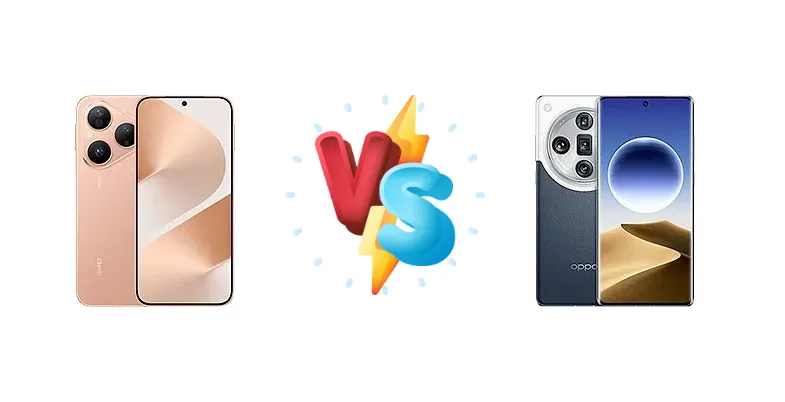
|
🏆 Quick Verdict
For the average user prioritizing raw performance and consistently fast charging, the Oppo Find X7 Ultra emerges as the winner. Its Snapdragon 8 Gen 3 chipset and 100W charging significantly outperform the Pura 80’s Kirin 9010s and 66W charging, despite the Pura 80’s wireless charging advantages.
| PHONES | ||
|---|---|---|
| Phone Names | Huawei Pura 80 | Oppo Find X7 Ultra |
| Network | ||
|---|---|---|
| 2G bands | GSM 850 / 900 / 1800 / 1900 | GSM 850 / 900 / 1800 / 1900 |
| 3G bands | HSDPA 800 / 850 / 900 / 1700(AWS) / 1900 / 2100 | HSDPA 800 / 850 / 900 / 1700(AWS) / 1900 / 2100 |
| 4G bands | 1, 2, 3, 4, 5, 6, 7, 8, 9, 12, 17, 18, 19, 20, 26, 28, 34, 38, 39, 40, 41, 42, 66 - International | 1, 2, 3, 4, 5, 7, 8, 12, 17, 18, 19, 20, 26, 28, 34, 38, 39, 40, 41, 66 |
| 5G bands | SA/NSA - China only | 1, 2, 3, 5, 7, 8, 20, 28, 38, 40, 41, 66, 77, 78, 79 SA/NSA |
| Speed | HSPA, LTE, 5G (China only) | HSPA, LTE, 5G |
| Technology | GSM / CDMA / HSPA / CDMA2000 / LTE / 5G | GSM / CDMA / HSPA / CDMA2000 / LTE / 5G |
| Launch | ||
|---|---|---|
| Announced | 2025, June 11 | 2024, January 08 |
| Status | Available. Released 2025, July 25 | Available. Released 2024, January 12 |
| Body | ||
|---|---|---|
| Build | Glass front, aluminum frame, glass back | Glass front (Gorilla Glass Victus 2), glass back (Gorilla Glass) or eco leather back, aluminum frame |
| Dimensions | 157.7 x 74.4 x 8.2 mm (6.21 x 2.93 x 0.32 in) | 164.3 x 76.2 x 9.5 mm (6.47 x 3.00 x 0.37 in) |
| SIM | Nano-SIM + Nano-SIM | Nano-SIM + Nano-SIM |
| Weight | 211 g (7.44 oz) | 221 g (7.80 oz) |
| Display | ||
|---|---|---|
| Protection | Kunlun Glass 2 | Corning Gorilla Glass Victus 2 |
| Resolution | 1256 x 2760 pixels (~459 ppi density) | 1440 x 3168 pixels (~510 ppi density) |
| Size | 6.6 inches, 105.9 cm2 (~90.3% screen-to-body ratio) | 6.82 inches, 113.0 cm2 (~90.3% screen-to-body ratio) |
| Type | LTPO OLED, 1B colors, HDR Vivid, 120Hz, 1440Hz PWM, 2800 nits (peak) | LTPO AMOLED, 1B colors, 120Hz, Dolby Vision, HDR10+, 1600 nits (typ), 2600 nits (HBM), 4500 nits (peak) |
| Platform | ||
|---|---|---|
| CPU | Octa-core | Octa-core (1x3.3 GHz Cortex-X4 & 3x3.2 GHz Cortex-A720 & 2x3.0 GHz Cortex-A720 & 2x2.3 GHz Cortex-A520) |
| Chipset | Kirin 9010s (7 nm) | Qualcomm SM8650-AB Snapdragon 8 Gen 3 (4 nm) |
| GPU | - | Adreno 750 |
| OS | EMUI 15 (International), HarmonyOS 5.1 (China) | Android 14, up to 4 major Android upgrades, ColorOS 14 |
| Memory | ||
|---|---|---|
| Card slot | No | No |
| Internal | 256GB 12GB RAM, 512GB 12GB RAM, 1TB 12GB RAM | 256GB 12GB RAM, 256GB 16GB RAM, 512GB 16GB RAM |
| Main Camera | ||
|---|---|---|
| Features | Laser AF, color spectrum sensor, LED flash, panorama, HDR | Laser AF, color spectrum sensor, Hasselblad Color Calibration, LED flash, HDR, panorama |
| Quad | - | 50 MP, f/1.8, 23mm (wide), 1.0"-type, 1.6µm, dual pixel PDAF, OIS 50 MP, f/2.6, 65mm (periscope telephoto), 1/1.56", 1.0µm, 2.8x optical zoom, multi-directional PDAF (25cm - ∞), OIS 50 MP, f/4.3, 135mm (periscope telephoto), 1/2.51", 0.7µm, 6x optical zoom, dual pixel PDAF (35cm - ∞), OIS 50 MP, f/2.0, 14mm, 123˚ (ultrawide), 1/1.95", 1.0µm, PDAF |
| Triple | 50 MP, f/1.4-4.0, 24mm (wide), 1/1.3", PDAF, OIS 12 MP, f/3.4, 125mm (periscope telephoto), PDAF, OIS, 5x optical zoom 13 MP, f/2.2, 13mm (ultrawide) | - |
| Video | 4K, 1080p, 1080p@480fps (interpolated), HDR Vivid, gyro-EIS, OIS | 4K@30/60fps, 1080p@30/60/240fps; gyro-EIS; HDR, 10‑bit video, Dolby Vision |
| Selfie camera | ||
|---|---|---|
| Features | HDR, panorama | Panorama |
| Single | 13 MP, f/2.0, (ultrawide), AF | 32 MP, f/2.4, 21mm (wide), 1/2.74", 0.8µm, PDAF |
| Video | 4K, 1080p, 1080p@240fps, HDR Vivid, gyro-EIS | 4K@30/60fps, 1080p@30fps, gyro-EIS |
| Sound | ||
|---|---|---|
| 35mm jack | No | No |
| Loudspeaker | Yes, with stereo speakers | Yes, with stereo speakers |
| Comms | ||
|---|---|---|
| Bluetooth | 5.2, A2DP, LE, L2HC | 5.4, A2DP, LE, aptX HD, LHDC |
| Infrared port | Yes | Yes |
| NFC | Yes | Yes |
| Positioning | GPS (L1+L5), GLONASS (L1), BDS (B1I+B1c+B2a+B2b), GALILEO (E1+E5a+E5b), QZSS (L1+L5), NavIC | GPS (L1+L5), BDS (B1I+B1c+B2a), GALILEO (E1+E5a), QZSS (L1+L5), GLONASS |
| Radio | No | No |
| USB | USB Type-C 2.0, OTG, DisplayPort 1.2 | USB Type-C 3.2, OTG |
| WLAN | Wi-Fi 802.11 a/b/g/n/ac/6/7, dual-band, Wi-Fi Direct | Wi-Fi 802.11 a/b/g/n/ac/6e/7, dual-band, Wi-Fi Direct |
| Features | ||
|---|---|---|
| Sensors | Fingerprint (side-mounted), accelerometer, gyro, proximity, compass | Fingerprint (under display, optical), accelerometer, gyro, proximity, compass |
| Battery | ||
|---|---|---|
| Charging | 66W wired 50W wireless 7.5W reverse wireless 5W reverse wired | 100W wired, PD, 50% in 10 min, 100% in 26 min 50W wireless 10W reverse wireless |
| Type | Market-dependent versions:· Li-Po 5170 mAh - International· Li-Po 5600 mAh - China | 5000 mAh |
| Misc | ||
|---|---|---|
| Colors | Frosted Gold, Frosted White, Frosted Black, Green | Black, Dark Blue, Light Brown |
| Models | HED-LX9 | PHY110, PHY120 |
| Price | About 580 EUR | $ 546.64 |
Huawei Pura 80
- Robust wireless charging options (50W + reverse)
- Seamless Huawei ecosystem integration
- Potentially more refined software experience (depending on user preference)
- Less powerful chipset (Kirin 9010s)
- Slower wired charging (66W)
- Limited information on display quality
Oppo Find X7 Ultra
- Industry-leading Snapdragon 8 Gen 3 performance
- Ultra-fast 100W wired charging
- High peak display brightness (1165 nits)
- Less emphasis on wireless charging ecosystem
- Potential for more aggressive software customization
- Larger size and weight (likely)
Display Comparison
The Oppo Find X7 Ultra boasts a measured peak brightness of 1165 nits, suggesting a significantly more visible display in direct sunlight compared to the Pura 80 (brightness data unavailable). While both likely employ high-refresh-rate OLED panels, the Find X7 Ultra’s higher peak brightness is a tangible advantage for outdoor usability. The absence of detailed display specs for the Pura 80, such as PWM dimming frequency, leaves questions about its suitability for users sensitive to flicker unanswered.
Camera Comparison
Without detailed camera specifications for the Pura 80, a direct comparison is limited. However, the Oppo Find X7 Ultra is expected to feature a cutting-edge camera system leveraging the Snapdragon 8 Gen 3’s advanced ISP. The Find X7 Ultra’s image processing capabilities will likely excel in dynamic range and low-light performance. The Pura 80 will likely rely on Huawei’s computational photography algorithms, but the Snapdragon’s hardware advantage gives Oppo a significant edge. We can assume the Find X7 Ultra will have a larger main sensor and more advanced OIS.
Performance
The core difference lies in the chipsets. The Oppo Find X7 Ultra’s Snapdragon 8 Gen 3 (4nm) is built on a more advanced process node than the Huawei Pura 80’s Kirin 9010s (7nm). This translates to superior power efficiency and thermal management for the Snapdragon, minimizing throttling during sustained workloads. The Snapdragon 8 Gen 3’s CPU configuration – 1x3.3 GHz Cortex-X4, 3x3.2 GHz Cortex-A720, 2x3.0 GHz Cortex-A720, and 2x2.3 GHz Cortex-A520 – provides a clear architectural advantage over the Pura 80’s octa-core setup, particularly in demanding tasks like gaming and video editing. While both are octa-core, the Snapdragon’s core arrangement is optimized for peak performance.
Battery Life
The Oppo Find X7 Ultra demonstrates a clear advantage in charging speed with its 100W wired charging, capable of reaching 100% in just 26 minutes, and 50% in 10 minutes. The Huawei Pura 80’s 66W wired charging is considerably slower. While the Pura 80 offers 50W wireless and 7.5W/5W reverse wireless charging, the Find X7 Ultra’s 50W wireless charging matches it, and the 10W reverse wireless is still useful. The Find X7 Ultra’s active use score of 12:47h suggests excellent battery life, likely benefiting from the Snapdragon 8 Gen 3’s efficiency.
Buying Guide
Buy the Huawei Pura 80 if you prioritize a seamless Huawei ecosystem experience, value robust wireless charging capabilities (50W vs 50W, plus reverse wired), and are comfortable with the limitations of the Kirin chipset. Buy the Oppo Find X7 Ultra if you demand the absolute best Android performance, need the fastest wired charging available (100W), and prioritize a top-tier camera system built around the Snapdragon 8 Gen 3’s image signal processor.