
Huawei Pura 80 vs. Honor Magic6 Pro: A Deep Dive into Flagship Performance
| Phones Images | |||||
|---|---|---|---|---|---|
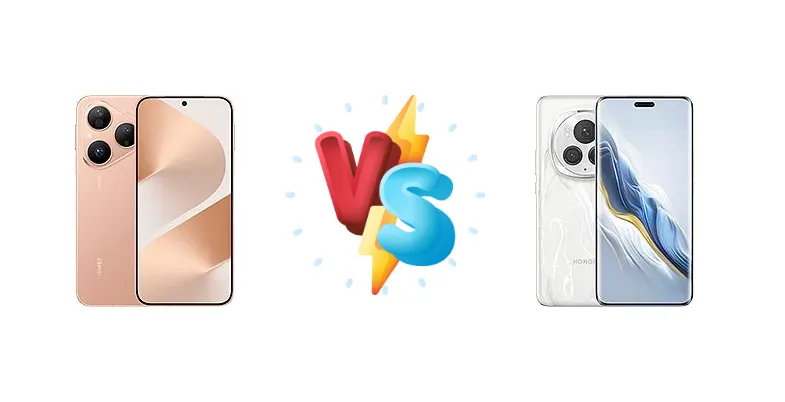
|
🏆 Quick Verdict
For most users, the Honor Magic6 Pro emerges as the stronger contender. Its Snapdragon 8 Gen 3 chipset provides a clear performance advantage, coupled with exceptional battery life (14:06h active use) and a brighter, more vibrant display. While the Pura 80 offers a compelling alternative, the Magic6 Pro’s raw power and efficiency are difficult to ignore.
| PHONES | ||
|---|---|---|
| Phone Names | Huawei Pura 80 | Honor Magic6 Pro |
| Network | ||
|---|---|---|
| 2G bands | GSM 850 / 900 / 1800 / 1900 | GSM 850 / 900 / 1800 / 1900 |
| 3G bands | HSDPA 800 / 850 / 900 / 1700(AWS) / 1900 / 2100 | HSDPA 800 / 850 / 900 / 1700(AWS) / 1900 / 2100 |
| 4G bands | 1, 2, 3, 4, 5, 6, 7, 8, 9, 12, 17, 18, 19, 20, 26, 28, 34, 38, 39, 40, 41, 42, 66 - International | LTE |
| 5G bands | SA/NSA - China only | SA/NSA |
| Speed | HSPA, LTE, 5G (China only) | HSPA, LTE, 5G |
| Technology | GSM / CDMA / HSPA / CDMA2000 / LTE / 5G | GSM / CDMA / HSPA / CDMA2000 / LTE / 5G |
| Launch | ||
|---|---|---|
| Announced | 2025, June 11 | 2024, January 11 |
| Status | Available. Released 2025, July 25 | Available. Released 2024, January 18 |
| Body | ||
|---|---|---|
| Build | Glass front, aluminum frame, glass back | Glass front (NanoCrystal Shield), glass back or silicone polymer back (eco leather) |
| Dimensions | 157.7 x 74.4 x 8.2 mm (6.21 x 2.93 x 0.32 in) | 162.5 x 75.8 x 8.9 mm (6.40 x 2.98 x 0.35 in) |
| SIM | Nano-SIM + Nano-SIM | · Nano-SIM + eSIM· Nano-SIM + Nano-SIM |
| Weight | 211 g (7.44 oz) | 225 g or 229 g (7.94 oz) |
| Display | ||
|---|---|---|
| Protection | Kunlun Glass 2 | NanoCrystal Shield |
| Resolution | 1256 x 2760 pixels (~459 ppi density) | 1280 x 2800 pixels, 19.5:9 ratio (~453 ppi density) |
| Size | 6.6 inches, 105.9 cm2 (~90.3% screen-to-body ratio) | 6.8 inches, 112.8 cm2 (~91.6% screen-to-body ratio) |
| Type | LTPO OLED, 1B colors, HDR Vivid, 120Hz, 1440Hz PWM, 2800 nits (peak) | LTPO OLED, 1B colors, 120Hz, Dolby Vision, HDR, 1600 nits (HBM), 5000 nits (peak) |
| Platform | ||
|---|---|---|
| CPU | Octa-core | Octa-core (1x3.3 GHz Cortex-X4 & 3x3.2 GHz Cortex-A720 & 2x3.0 GHz Cortex-A720 & 2x2.3 GHz Cortex-A520) |
| Chipset | Kirin 9010s (7 nm) | Qualcomm SM8650-AB Snapdragon 8 Gen 3 (4 nm) |
| GPU | - | Adreno 750 |
| OS | EMUI 15 (International), HarmonyOS 5.1 (China) | Android 14, up to 4 major Android upgrades, MagicOS 8 |
| Memory | ||
|---|---|---|
| Card slot | No | No |
| Internal | 256GB 12GB RAM, 512GB 12GB RAM, 1TB 12GB RAM | 256GB 12GB RAM, 256GB 16GB RAM, 512GB 12GB RAM, 512GB 16GB RAM, 1TB 16GB RAM |
| Main Camera | ||
|---|---|---|
| Features | Laser AF, color spectrum sensor, LED flash, panorama, HDR | Laser AF, color spectrum sensor, LED flash, HDR, panorama |
| Triple | 50 MP, f/1.4-4.0, 24mm (wide), 1/1.3", PDAF, OIS 12 MP, f/3.4, 125mm (periscope telephoto), PDAF, OIS, 5x optical zoom 13 MP, f/2.2, 13mm (ultrawide) | 50 MP, f/1.4-2.0, 23mm (wide), 1/1.3", 1.2µm, PDAF, OIS 180 MP, f/2.6, (periscope telephoto), 1/1.49", 0.56µm, PDAF, OIS, 2.5x optical zoom 50 MP, f/2.0, 13mm, 122˚ (ultrawide), 1/2.88", 0.61µm, AF |
| Video | 4K, 1080p, 1080p@480fps (interpolated), HDR Vivid, gyro-EIS, OIS | 4K@24/30/60fps, 1080p@30/60/120/240fps, gyro-EIS, OIS, HDR, 10-bit video |
| Selfie camera | ||
|---|---|---|
| Features | HDR, panorama | - |
| Single | 13 MP, f/2.0, (ultrawide), AF | 50 MP, f/2.0, 22mm (wide), 1/2.93", 0.6µm, AF TOF 3D, (depth/biometrics sensor) |
| Video | 4K, 1080p, 1080p@240fps, HDR Vivid, gyro-EIS | 4K@30fps, 1080p@30/60fps, gyro-EIS |
| Sound | ||
|---|---|---|
| 35mm jack | No | No |
| Loudspeaker | Yes, with stereo speakers | Yes, with stereo speakers |
| Comms | ||
|---|---|---|
| Bluetooth | 5.2, A2DP, LE, L2HC | 5.3, A2DP, LE, aptX HD |
| Infrared port | Yes | Yes |
| NFC | Yes | Yes |
| Positioning | GPS (L1+L5), GLONASS (L1), BDS (B1I+B1c+B2a+B2b), GALILEO (E1+E5a+E5b), QZSS (L1+L5), NavIC | GPS (L1+L5), GLONASS, BDS (B1I+B1c+B2a), GALILEO (E1+E5a) |
| Radio | No | No |
| USB | USB Type-C 2.0, OTG, DisplayPort 1.2 | USB Type-C 3.2, DisplayPort 1.2, OTG |
| WLAN | Wi-Fi 802.11 a/b/g/n/ac/6/7, dual-band, Wi-Fi Direct | Wi-Fi 802.11 a/b/g/n/ac/6/7, dual-band, Wi-Fi Direct |
| Features | ||
|---|---|---|
| Sensors | Fingerprint (side-mounted), accelerometer, gyro, proximity, compass | Fingerprint (under display, optical), Face ID, accelerometer, gyro, proximity, compass |
| Battery | ||
|---|---|---|
| Charging | 66W wired 50W wireless 7.5W reverse wireless 5W reverse wired | 80W wired 66W wireless Reverse wireless 5W reverse wired |
| Type | Market-dependent versions:· Li-Po 5170 mAh - International· Li-Po 5600 mAh - China | Si/C Li-Ion 5600 mAh |
| Misc | ||
|---|---|---|
| Colors | Frosted Gold, Frosted White, Frosted Black, Green | Black, Green, Blue, Purple, White |
| Models | HED-LX9 | BVL-AN16, BVL-N49 |
| Price | About 580 EUR | € 455.54 / $ 899.00 / £ 598.99 |
Huawei Pura 80
- Potentially superior image processing due to Huawei’s software expertise.
- Established Huawei ecosystem integration.
- Competitive charging speeds (66W wired, 50W wireless).
- Less powerful chipset (Kirin 9010s vs Snapdragon 8 Gen 3).
- Likely lower sustained performance due to 7nm process.
- Battery life likely inferior to Magic6 Pro.
Honor Magic6 Pro
- Significantly faster chipset (Snapdragon 8 Gen 3).
- Exceptional battery life (14:06h active use).
- Brighter display (1578 nits).
- May lack the refined camera processing of Huawei devices.
- Software experience may not appeal to all users.
- Potentially higher price point.
Display Comparison
The Honor Magic6 Pro boasts a significantly brighter display, reaching a measured 1578 nits, making it far more readable outdoors under direct sunlight compared to the Pura 80 (brightness data unavailable). While both likely utilize OLED panels, the Magic6 Pro’s brightness advantage is a key differentiator. The absence of PWM frequency data for the Pura 80 makes it difficult to assess potential flicker-related eye strain, while the Magic6 Pro’s high brightness also suggests a potentially higher PWM frequency, benefiting users sensitive to screen flicker. Bezels are expected to be minimal on both devices, typical of flagship designs, but detailed measurements are needed for a precise comparison.
Camera Comparison
Without detailed camera specifications beyond sensor size, a direct comparison is challenging. However, Huawei has a long-standing reputation for strong image processing, particularly in computational photography. The Pura 80 will likely excel in scenarios requiring complex image manipulation. The Magic6 Pro, leveraging the Snapdragon 8 Gen 3’s ISP, should offer excellent image quality and potentially faster processing speeds. The absence of information regarding OIS and lens apertures on both devices hinders a comprehensive assessment. We can assume both will feature multi-camera systems, but the quality will depend heavily on sensor size and image processing algorithms.
Performance
The core performance difference lies in the chipsets. The Honor Magic6 Pro’s Snapdragon 8 Gen 3 (4nm) is built on a more advanced process node than the Huawei Pura 80’s Kirin 9010s (7nm). This translates to superior thermal efficiency and sustained performance under load. The Snapdragon 8 Gen 3’s octa-core configuration (1x3.3 GHz Cortex-X4, 3x3.2 GHz Cortex-A720, 2x3.0 GHz Cortex-A720, 2x2.3 GHz Cortex-A520) is optimized for both peak performance and power efficiency. While both utilize octa-core CPUs, the Snapdragon’s architecture provides a clear advantage in demanding tasks like gaming and video editing. The Pura 80’s Kirin 9010s, while capable, will likely exhibit more thermal throttling during extended intensive use.
Battery Life
The Honor Magic6 Pro’s 14:06h active use score demonstrates a significant advantage in battery life. While the Pura 80 offers 66W wired and 50W wireless charging, the Magic6 Pro’s 80W wired charging is considerably faster, allowing for quicker top-ups. Both support reverse wireless charging, albeit at different wattages (7.5W for Pura 80, unspecified for Magic6 Pro, but likely similar). The Magic6 Pro’s superior battery performance, combined with faster charging, makes it the more convenient option for users who prioritize all-day battery life.
Buying Guide
Buy the Huawei Pura 80 if you prioritize a refined software experience within the Huawei ecosystem and value the brand’s established camera processing style. It’s a good choice for users already invested in Huawei’s services. Buy the Honor Magic6 Pro if you demand top-tier performance for gaming and demanding applications, require exceptional battery endurance, and appreciate a brighter, more visible display in all lighting conditions. It’s the better option for power users and those seeking future-proofing.