
Huawei Pura 80 Ultra vs vivo X100 Pro: A Detailed Comparison
| Phones Images | |||||
|---|---|---|---|---|---|
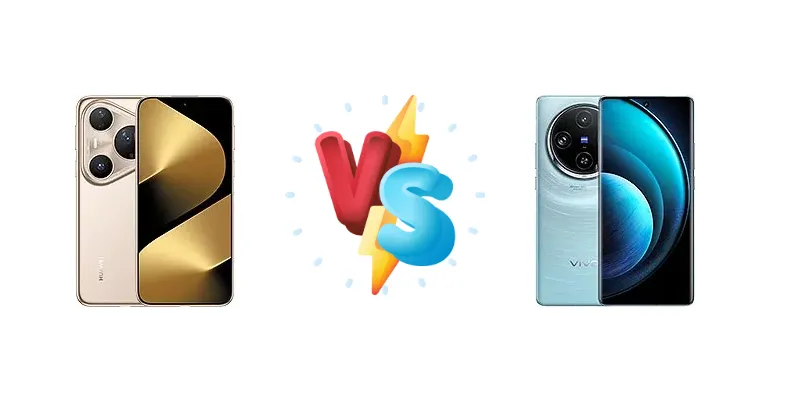
|
🏆 Quick Verdict
For the average user prioritizing all-day battery life and a balanced experience, the Huawei Pura 80 Ultra emerges as the winner. Its impressive 41-hour endurance and robust charging options outweigh the vivo X100 Pro’s performance edge. However, power users demanding the absolute fastest processing speeds will favor the X100 Pro.
| PHONES | ||
|---|---|---|
| Phone Names | Huawei Pura 80 Ultra | vivo X100 Pro |
| Network | ||
|---|---|---|
| 2G bands | GSM 850 / 900 / 1800 / 1900 | GSM 850 / 900 / 1800 / 1900 |
| 3G bands | HSDPA 800 / 850 / 900 / 1700(AWS) / 1900 / 2100 | HSDPA 800 / 850 / 900 / 1700(AWS) / 1900 / 2100 |
| 4G bands | 1, 2, 3, 4, 5, 6, 7, 8, 9, 12, 13, 17, 18, 19, 20, 25, 26, 28, 32, 34, 38, 39, 40, 41, 42, 66 - International | 1, 2, 3, 4, 5, 7, 8, 12, 17, 18, 19, 20, 26, 28, 32, 38, 39, 40, 41, 42, 66 - International |
| 5G bands | SA/NSA - China only | 1, 3, 5, 7, 8, 20, 28, 38, 40, 41, 66, 75, 77, 78, 79 SA/NSA - International |
| Speed | HSPA, LTE, 5G (China only) | HSPA, LTE, 5G |
| Technology | GSM / CDMA / HSPA / CDMA2000 / LTE / 5G | GSM / CDMA / HSPA / LTE / 5G |
| Launch | ||
|---|---|---|
| Announced | 2025, June 11 | 2023, November 13 |
| Status | Available. Released 2025, June 11 | Available. Released 2023, November 21 |
| Body | ||
|---|---|---|
| Build | Glass front, aluminum frame, glass back | Glass front, aluminum frame, glass back |
| Dimensions | 163 x 76.1 x 8.3 mm (6.42 x 3.00 x 0.33 in) | 164.1 x 75.3 x 8.9 mm or 9.1 mm |
| SIM | · Nano-SIM + Nano-SIM + eSIM (max 2 at a time)· Nano-SIM + eSIM | · Nano-SIM + eSIM· Nano-SIM + Nano-SIM |
| Weight | 233.5 g (8.25 oz) | 221 g or 225 g (7.80 oz) |
| Display | ||
|---|---|---|
| Protection | Kunlun Glass 2 (Basalt-tempered) / 2nd-Gen Crystal Armor Kunlun Glass, Mohs level 4 | - |
| Resolution | 1276 x 2848 pixels, 20:9 ratio (~459 ppi density) | 1260 x 2800 pixels, 20:9 ratio (~452 ppi density) |
| Size | 6.8 inches, 111.3 cm2 (~89.7% screen-to-body ratio) | 6.78 inches, 111.5 cm2 (~90.2% screen-to-body ratio) |
| Type | LTPO OLED, 1B colors, HDR Vivid, 120Hz, 1440Hz PWM, 3000 nits (peak) | LTPO AMOLED, 1B colors, 120Hz, HDR10+, 3000 nits (peak) |
| Platform | ||
|---|---|---|
| CPU | Octa-core (1x2.5GHz & 3x2.15 GHz & 4x1.6GHz) | Octa-core (1x3.25 GHz Cortex-X4 & 3x2.85 GHz Cortex-X4 & 4x2.0 GHz Cortex-A720) |
| Chipset | Kirin 9020 (7 nm) | Mediatek Dimensity 9300 (4 nm) |
| GPU | Maleoon 920 | Immortalis-G720 MC12 |
| OS | EMUI 15 (International), HarmonyOS 5.1 (China) | Android 14, upgradable to Android 15, Funtouch 15 (International), OriginOS 4 (China) |
| Memory | ||
|---|---|---|
| Card slot | No | No |
| Internal | 512GB 16GB RAM, 1TB 16GB RAM | 256GB 12GB RAM, 256GB 16GB RAM, 512GB 16GB RAM, 1TB 16GB RAM |
| Main Camera | ||
|---|---|---|
| Features | Laser AF, color spectrum sensor, LED flash, panorama, HDR | Laser AF, color spectrum sensor, Zeiss optics, Zeiss T* lens coating, LED flash, panorama, HDR, 3D LUT import |
| Quad | 50 MP, f/1.6-4.0, 23mm (wide), 1.0"-type, dual pixel PDAF, OIS 50 MP, f/2.4, 83mm (periscope telephoto), 1/1.28", PDAF, sensor-shift OIS, 3.7x optical zoom 12.5 MP, f/3.6, 212mm (periscope telephoto), PDAF, sensor-shift OIS, 9.4x optical zoom 40 MP, f/2.2, 13mm (ultrawide), AF * Both telephoto cameras utilize the same camera sensor w/o continuous optical zoom | - |
| Triple | - | 50 MP, f/1.8, 23mm (wide), 1/0.98", 1.6µm, dual pixel PDAF, OIS 50 MP, f/2.5, 100mm (periscope telephoto), 1/2.51", 0.7µm, PDAF (18cm - ∞), OIS, 4.3x optical zoom 50 MP, f/2.0, 15mm, 119˚ (ultrawide), 1/2.76", 0.64µm, AF |
| Video | 4K, 1080p, 1080p@960fps (interpolated), HDR Vivid, gyro-EIS, OIS | 8K@30fps, 4K@30/60fps, 1080p, gyro-EIS |
| Selfie camera | ||
|---|---|---|
| Features | HDR, panorama | HDR |
| Single | 13 MP, f/2.0, (ultrawide), AF | 32 MP, f/2.0, 20mm (ultrawide) |
| Video | 4K, 1080p, 1080p@240fps, HDR Vivid, gyro-EIS | 4K@30/60fps, 1080p@30/60fps |
| Sound | ||
|---|---|---|
| 35mm jack | No | No |
| Loudspeaker | Yes, with stereo speakers | Yes, with stereo speakers |
| Comms | ||
|---|---|---|
| Bluetooth | 5.2, A2DP, LE, L2HC | 5.4, A2DP, LE, aptX HD, LHDC |
| Infrared port | Yes | Yes |
| NFC | Yes | Yes |
| Positioning | GPS (L1+L5), GLONASS (L1), BDS (B1I+B1c+B2a+B2b), GALILEO (E1+E5a+E5b), QZSS (L1+L5), NavIC | GPS (L1+L5), GLONASS (L1), BDS (B1I+B1c+B2a+B2b), GALILEO (E1+E5a+E5b), QZSS (L1+L5), NavIC (L5) |
| Radio | No | No |
| USB | USB Type-C 3.1, OTG, DisplayPort 1.2 | USB Type-C 3.2, OTG |
| WLAN | Wi-Fi 802.11 a/b/g/n/ac/6/7, dual-band, Wi-Fi Direct | Wi-Fi 802.11 a/b/g/n/ac/6/7, tri-band, Wi-Fi Direct |
| Features | ||
|---|---|---|
| Sensors | Fingerprint (side-mounted), accelerometer, gyro, proximity, compass, barometer | Fingerprint (under display, optical), accelerometer, gyro, proximity, compass |
| Battery | ||
|---|---|---|
| Charging | 100W wired 80W wireless 20W reverse wireless 18W reverse wired | 100W wired, 50% in 14 min 50W wireless Reverse wired |
| Type | Market-dependent versions:· Li-Po 5170 mAh - International· Li-Po 5700 mAh - China | Li-Ion 5400 mAh |
| Misc | ||
|---|---|---|
| Colors | Prestige Gold, Golden Black | Startrail Blue, Asteroid Black, Sunset Orange, White |
| Models | LMR-AL10, LMU-LX9 | V2324A, V2309 |
| Price | About 1880 EUR | ₹ 59,999 |
| SAR EU | - | 0.99 W/kg (head) 1.19 W/kg (body) |
| EU LABEL | ||
|---|---|---|
| Battery | 41:00h endurance, 1000 cycles | - |
| Energy | Class C | - |
| Free fall | Class D (45 falls) | - |
| Repairability | Class C | - |
Huawei Pura 80 Ultra
- Exceptional battery endurance (41h)
- Fastest wireless charging (80W)
- Long-term battery health (1000 cycles)
- Slightly slower active use score
- Less powerful chipset compared to X100 Pro
vivo X100 Pro
- Superior chipset performance (Dimensity 9300)
- Brighter display (1472 nits)
- Faster active use score
- Shorter battery endurance
- Slower wireless charging
Display Comparison
The vivo X100 Pro boasts a significantly brighter display, reaching a measured 1472 nits compared to the Pura 80 Ultra’s 1029 nits. This translates to superior visibility under direct sunlight. While both likely employ LTPO technology for adaptive refresh rates (not specified in the data), the X100 Pro’s higher peak brightness is a clear advantage for outdoor users. The Pura 80 Ultra’s display, while still excellent, will appear comparatively dimmer in bright environments.
Camera Comparison
The provided data doesn’t offer granular camera details, but the ‘Photo / Video’ designation for the X100 Pro suggests a strong emphasis on both aspects. While sensor sizes and apertures are unknown, the X100 Pro’s processor is likely to offer more advanced computational photography capabilities. Huawei has a strong camera reputation, but without specific sensor information, it’s difficult to definitively declare a winner. We can assume both phones will offer excellent image quality, but the X100 Pro’s processing power may give it an edge in challenging lighting conditions.
Performance
The chipset choice is a defining factor. The vivo X100 Pro’s MediaTek Dimensity 9300, fabricated on a 4nm process, offers a theoretical performance advantage over the Huawei Pura 80 Ultra’s 7nm Kirin 9020. The Dimensity 9300’s Cortex-X4 cores, clocked at 3.25 GHz, are designed for sustained peak performance, while the Kirin 9020’s octa-core configuration, though capable, is likely to exhibit more thermal throttling under prolonged heavy loads. This means the X100 Pro is better suited for demanding gaming and video editing tasks.
Battery Life
The vivo X100 Pro delivers a faster active use score of 13:53h compared to the Pura 80 Ultra’s 11:51h, suggesting better power efficiency despite a similar battery capacity (not specified). However, the Pura 80 Ultra compensates with superior charging speeds: 100W wired, 80W wireless, and even 20W reverse wireless charging, exceeding the X100 Pro’s 100W wired and 50W wireless capabilities. The Pura 80 Ultra also boasts a claimed 1000 charge cycles, indicating greater long-term battery health.
Buying Guide
Buy the Huawei Pura 80 Ultra if you need exceptional battery life, reliable fast charging (including 80W wireless), and a polished, mature software experience. Buy the vivo X100 Pro if you prioritize peak performance for demanding tasks like gaming and video editing, and if you value the brightest possible display for outdoor visibility.