
Huawei Pura 80 Ultra vs Sony Xperia 1 VII: A Deep Dive into Flagship Performance
| Phones Images | |||||
|---|---|---|---|---|---|
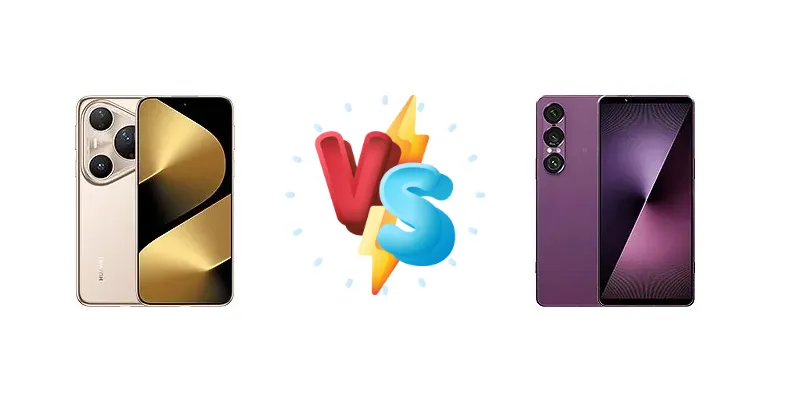
|
🏆 Quick Verdict
For the average user prioritizing battery life and charging speed, the Sony Xperia 1 VII emerges as the stronger contender. Its Snapdragon 8 Elite chipset and significantly higher battery endurance (43:30h vs 41:00h) outweigh the Pura 80 Ultra’s faster wired charging, offering a more consistently reliable experience.
| PHONES | ||
|---|---|---|
| Phone Names | Huawei Pura 80 Ultra | Sony Xperia 1 VII |
| Network | ||
|---|---|---|
| 2G bands | GSM 850 / 900 / 1800 / 1900 | GSM 850 / 900 / 1800 / 1900 |
| 3G bands | HSDPA 800 / 850 / 900 / 1700(AWS) / 1900 / 2100 | HSDPA 800 / 850 / 900 / 1700(AWS) / 1900 / 2100 |
| 4G bands | 1, 2, 3, 4, 5, 6, 7, 8, 9, 12, 13, 17, 18, 19, 20, 25, 26, 28, 32, 34, 38, 39, 40, 41, 42, 66 - International | 1, 2, 3, 4, 5, 7, 8, 12, 13, 17, 19, 20, 25, 26, 28, 32, 34, 38, 39, 40, 41, 66 - Europe |
| 5G bands | SA/NSA - China only | 1, 3, 5, 7, 8, 20, 28, 38, 40, 41, 75, 77, 78 SA/NSA/Sub6 - Europe |
| Speed | HSPA, LTE, 5G (China only) | HSPA, LTE, 5G |
| Technology | GSM / CDMA / HSPA / CDMA2000 / LTE / 5G | GSM / HSPA / LTE / 5G |
| Launch | ||
|---|---|---|
| Announced | 2025, June 11 | 2025, May 13 |
| Status | Available. Released 2025, June 11 | Available. Released 2025, June 04 |
| Body | ||
|---|---|---|
| Build | Glass front, aluminum frame, glass back | Glass front (Gorilla Glass Victus 2), glass back (Gorilla Glass Victus), aluminum frame |
| Dimensions | 163 x 76.1 x 8.3 mm (6.42 x 3.00 x 0.33 in) | 162 x 74 x 8.2 mm (6.38 x 2.91 x 0.32 in) |
| SIM | · Nano-SIM + Nano-SIM + eSIM (max 2 at a time)· Nano-SIM + eSIM | · Nano-SIM + eSIM· Nano-SIM + Nano-SIM |
| Weight | 233.5 g (8.25 oz) | 197 g (6.95 oz) |
| Display | ||
|---|---|---|
| Protection | Kunlun Glass 2 (Basalt-tempered) / 2nd-Gen Crystal Armor Kunlun Glass, Mohs level 4 | Corning Gorilla Glass Victus 2, Mohs level 5 |
| Resolution | 1276 x 2848 pixels, 20:9 ratio (~459 ppi density) | 1080 x 2340 pixels, 19.5:9 ratio (~396 ppi density) |
| Size | 6.8 inches, 111.3 cm2 (~89.7% screen-to-body ratio) | 6.5 inches, 103.7 cm2 (~86.5% screen-to-body ratio) |
| Type | LTPO OLED, 1B colors, HDR Vivid, 120Hz, 1440Hz PWM, 3000 nits (peak) | LTPO OLED, 1B colors, 120Hz, HDR BT.2020 |
| Platform | ||
|---|---|---|
| CPU | Octa-core (1x2.5GHz & 3x2.15 GHz & 4x1.6GHz) | Octa-core (2x4.32 GHz Oryon V2 Phoenix L + 6x3.53 GHz Oryon V2 Phoenix M) |
| Chipset | Kirin 9020 (7 nm) | Qualcomm SM8750-AB Snapdragon 8 Elite (3 nm) |
| GPU | Maleoon 920 | Adreno 830 |
| OS | EMUI 15 (International), HarmonyOS 5.1 (China) | Android 15, up to 4 major Android upgrades |
| Memory | ||
|---|---|---|
| Card slot | No | microSDXC (uses shared SIM slot) |
| Internal | 512GB 16GB RAM, 1TB 16GB RAM | 256GB 12GB RAM, 512GB 12GB RAM |
| Main Camera | ||
|---|---|---|
| Features | Laser AF, color spectrum sensor, LED flash, panorama, HDR | Zeiss optics, Zeiss T* lens coating, color spectrum sensor, LED flash, panorama, HDR, eye tracking |
| Quad | 50 MP, f/1.6-4.0, 23mm (wide), 1.0"-type, dual pixel PDAF, OIS 50 MP, f/2.4, 83mm (periscope telephoto), 1/1.28", PDAF, sensor-shift OIS, 3.7x optical zoom 12.5 MP, f/3.6, 212mm (periscope telephoto), PDAF, sensor-shift OIS, 9.4x optical zoom 40 MP, f/2.2, 13mm (ultrawide), AF * Both telephoto cameras utilize the same camera sensor w/o continuous optical zoom | - |
| Triple | - | 48 MP, f/1.9, 24mm (wide), 1/1.35", 1.12µm, dual pixel PDAF, OIS 12 MP, f/2.3, 85mm (telephoto), f/3.5, 170mm (telephoto), 1/3.5", 1.0µm, dual pixel PDAF, 3.5x-7.1x continuous optical zoom, OIS, 4cm macro @ 120mm, no AF 48 MP, f/2.0, 16mm (ultrawide), 1/1.56", 1.0µm, PDAF |
| Video | 4K, 1080p, 1080p@960fps (interpolated), HDR Vivid, gyro-EIS, OIS | 4K@24/30/60/120fps HDR, 1080p@30/60/120fps; 5-axis gyro-EIS, OIS |
| Selfie camera | ||
|---|---|---|
| Features | HDR, panorama | HDR |
| Single | 13 MP, f/2.0, (ultrawide), AF | 12 MP, f/2.0, 24mm (wide), 1/2.9", 1.22µm |
| Video | 4K, 1080p, 1080p@240fps, HDR Vivid, gyro-EIS | 4K@30/60fps, 1080p@30/60fps, 5-axis gyro-EIS |
| Sound | ||
|---|---|---|
| 35mm jack | No | Yes |
| Loudspeaker | Yes, with stereo speakers | Yes, with stereo speakers |
| Comms | ||
|---|---|---|
| Bluetooth | 5.2, A2DP, LE, L2HC | 6.0, A2DP, LE Audio, aptX HD, aptX Adaptive, aptX Lossless |
| Infrared port | Yes | - |
| NFC | Yes | Yes |
| Positioning | GPS (L1+L5), GLONASS (L1), BDS (B1I+B1c+B2a+B2b), GALILEO (E1+E5a+E5b), QZSS (L1+L5), NavIC | GPS, GLONASS, BDS, GALILEO, QZSS |
| Radio | No | No |
| USB | USB Type-C 3.1, OTG, DisplayPort 1.2 | USB Type-C 3.2, OTG, video output |
| WLAN | Wi-Fi 802.11 a/b/g/n/ac/6/7, dual-band, Wi-Fi Direct | Wi-Fi 802.11 a/b/g/n/ac/6e/7, tri-band, Wi-Fi Direct, DLNA |
| Features | ||
|---|---|---|
| Sensors | Fingerprint (side-mounted), accelerometer, gyro, proximity, compass, barometer | Fingerprint (side-mounted), accelerometer, gyro, proximity, barometer, compass |
| Battery | ||
|---|---|---|
| Charging | 100W wired 80W wireless 20W reverse wireless 18W reverse wired | 30W wired, PD3.0, PPS, 50% in 30 min 15W wireless Reverse wireless |
| Type | Market-dependent versions:· Li-Po 5170 mAh - International· Li-Po 5700 mAh - China | 5000 mAh |
| Misc | ||
|---|---|---|
| Colors | Prestige Gold, Golden Black | Moss Green, Orchid Purple, Slate Black |
| Models | LMR-AL10, LMU-LX9 | XQ-FS54, XQFS54EUKCG.GC, XQFS54EUKCV.GC, XQFS54EUKCB.GC, PDX256 |
| Price | About 1880 EUR | € 1,338.99 / $ 1,394.99 / £ 1,149.94 |
| EU LABEL | ||
|---|---|---|
| Battery | 41:00h endurance, 1000 cycles | 43:30h endurance, 1400 cycles |
| Energy | Class C | Class B |
| Free fall | Class D (45 falls) | Class B (181 falls) |
| Repairability | Class C | Class D |
Huawei Pura 80 Ultra
- Incredibly fast 100W wired charging.
- 80W wireless charging is a significant advantage.
- Reverse wireless charging offers added versatility.
- Lower battery endurance compared to the Xperia 1 VII.
- Kirin 9020 chipset may throttle under heavy load.
Sony Xperia 1 VII
- Superior battery endurance (43:30h).
- Brighter display for outdoor visibility.
- Snapdragon 8 Elite offers best-in-class performance.
- Slower wired charging (30W).
- Reverse wireless charging is not a priority feature.
Display Comparison
The Sony Xperia 1 VII boasts a significantly brighter display, reaching 1475 nits compared to the Pura 80 Ultra’s 1029 nits. This translates to superior readability under direct sunlight. While both likely employ OLED technology (though not explicitly stated), the Xperia’s brightness advantage is a clear win for outdoor users. The absence of refresh rate data for both devices makes a direct comparison difficult, but the Xperia’s focus on multimedia suggests a high refresh rate is likely present. The Pura 80 Ultra’s display, while still excellent, will struggle in bright conditions compared to the Xperia 1 VII.
Camera Comparison
Without detailed camera specifications, a direct comparison is limited. However, Sony’s history with Xperia devices suggests a focus on image processing and color science geared towards realism. Huawei, conversely, often emphasizes vibrant, saturated colors. The absence of sensor size data is critical, but the Xperia 1 VII’s chipset likely provides more powerful image signal processing capabilities. The Pura 80 Ultra’s camera system is likely optimized for social media sharing, while the Xperia 1 VII aims for professional-grade results. We can assume both phones will have capable main sensors, but the Xperia’s processing power gives it an edge.
Performance
The core difference lies in the chipsets. The Sony Xperia 1 VII’s Qualcomm SM8750-AB Snapdragon 8 Elite (3nm) utilizes a cutting-edge architecture with Oryon V2 Phoenix cores, offering a substantial performance leap over the Huawei Pura 80 Ultra’s 7nm Kirin 9020. The Snapdragon’s octa-core configuration (2x4.32 GHz + 6x3.53 GHz) is geared towards both peak performance and efficiency. The Kirin 9020’s (1x2.5GHz & 3x2.15 GHz & 4x1.6GHz) architecture, while capable, will likely exhibit more thermal throttling under sustained load. The Xperia 1 VII is the clear winner for demanding tasks like gaming and video editing.
Battery Life
The Sony Xperia 1 VII delivers a significantly longer battery endurance of 43:30h compared to the Huawei Pura 80 Ultra’s 41:00h. This is further reinforced by the active use score: 15:32h for the Xperia 1 VII versus 11:51h for the Pura 80 Ultra. While the Pura 80 Ultra boasts faster charging – 100W wired, 80W wireless – the Xperia 1 VII’s superior endurance means fewer charging cycles are needed. The Xperia 1 VII also offers 1400 battery cycles compared to the Pura 80 Ultra’s 1000, indicating a longer lifespan. The 30W charging on the Xperia 1 VII, while slower, is still respectable and reaches 50% in 30 minutes.
Buying Guide
Buy the Huawei Pura 80 Ultra if you need exceptionally fast charging – both wired (100W) and wireless (80W) – and value reverse wireless charging capabilities. It’s ideal for users who frequently top up their devices and share power with others. Buy the Sony Xperia 1 VII if you prioritize sustained performance, a brighter display for outdoor visibility, and longer overall battery life, making it the better choice for power users and content creators.