
Huawei Pura 80 Ultra vs Honor Magic6 Pro: A Deep Dive into Flagship Power
| Phones Images | |||||
|---|---|---|---|---|---|
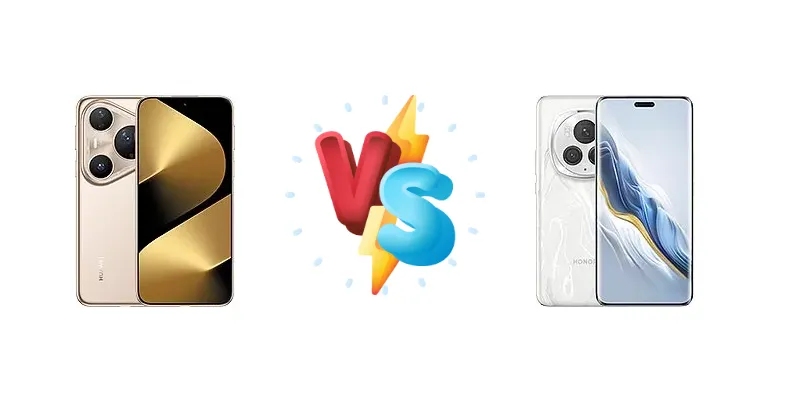
|
🏆 Quick Verdict
For the average user prioritizing all-day battery life and a stunningly bright display, the Honor Magic6 Pro emerges as the winner. Its Snapdragon 8 Gen 3 chipset and 14:06h active use score provide a noticeable advantage in sustained performance and longevity, despite the Pura 80 Ultra’s impressive charging capabilities.
| PHONES | ||
|---|---|---|
| Phone Names | Huawei Pura 80 Ultra | Honor Magic6 Pro |
| Network | ||
|---|---|---|
| 2G bands | GSM 850 / 900 / 1800 / 1900 | GSM 850 / 900 / 1800 / 1900 |
| 3G bands | HSDPA 800 / 850 / 900 / 1700(AWS) / 1900 / 2100 | HSDPA 800 / 850 / 900 / 1700(AWS) / 1900 / 2100 |
| 4G bands | 1, 2, 3, 4, 5, 6, 7, 8, 9, 12, 13, 17, 18, 19, 20, 25, 26, 28, 32, 34, 38, 39, 40, 41, 42, 66 - International | LTE |
| 5G bands | SA/NSA - China only | SA/NSA |
| Speed | HSPA, LTE, 5G (China only) | HSPA, LTE, 5G |
| Technology | GSM / CDMA / HSPA / CDMA2000 / LTE / 5G | GSM / CDMA / HSPA / CDMA2000 / LTE / 5G |
| Launch | ||
|---|---|---|
| Announced | 2025, June 11 | 2024, January 11 |
| Status | Available. Released 2025, June 11 | Available. Released 2024, January 18 |
| Body | ||
|---|---|---|
| Build | Glass front, aluminum frame, glass back | Glass front (NanoCrystal Shield), glass back or silicone polymer back (eco leather) |
| Dimensions | 163 x 76.1 x 8.3 mm (6.42 x 3.00 x 0.33 in) | 162.5 x 75.8 x 8.9 mm (6.40 x 2.98 x 0.35 in) |
| SIM | · Nano-SIM + Nano-SIM + eSIM (max 2 at a time)· Nano-SIM + eSIM | · Nano-SIM + eSIM· Nano-SIM + Nano-SIM |
| Weight | 233.5 g (8.25 oz) | 225 g or 229 g (7.94 oz) |
| Display | ||
|---|---|---|
| Protection | Kunlun Glass 2 (Basalt-tempered) / 2nd-Gen Crystal Armor Kunlun Glass, Mohs level 4 | NanoCrystal Shield |
| Resolution | 1276 x 2848 pixels, 20:9 ratio (~459 ppi density) | 1280 x 2800 pixels, 19.5:9 ratio (~453 ppi density) |
| Size | 6.8 inches, 111.3 cm2 (~89.7% screen-to-body ratio) | 6.8 inches, 112.8 cm2 (~91.6% screen-to-body ratio) |
| Type | LTPO OLED, 1B colors, HDR Vivid, 120Hz, 1440Hz PWM, 3000 nits (peak) | LTPO OLED, 1B colors, 120Hz, Dolby Vision, HDR, 1600 nits (HBM), 5000 nits (peak) |
| Platform | ||
|---|---|---|
| CPU | Octa-core (1x2.5GHz & 3x2.15 GHz & 4x1.6GHz) | Octa-core (1x3.3 GHz Cortex-X4 & 3x3.2 GHz Cortex-A720 & 2x3.0 GHz Cortex-A720 & 2x2.3 GHz Cortex-A520) |
| Chipset | Kirin 9020 (7 nm) | Qualcomm SM8650-AB Snapdragon 8 Gen 3 (4 nm) |
| GPU | Maleoon 920 | Adreno 750 |
| OS | EMUI 15 (International), HarmonyOS 5.1 (China) | Android 14, up to 4 major Android upgrades, MagicOS 8 |
| Memory | ||
|---|---|---|
| Card slot | No | No |
| Internal | 512GB 16GB RAM, 1TB 16GB RAM | 256GB 12GB RAM, 256GB 16GB RAM, 512GB 12GB RAM, 512GB 16GB RAM, 1TB 16GB RAM |
| Main Camera | ||
|---|---|---|
| Features | Laser AF, color spectrum sensor, LED flash, panorama, HDR | Laser AF, color spectrum sensor, LED flash, HDR, panorama |
| Quad | 50 MP, f/1.6-4.0, 23mm (wide), 1.0"-type, dual pixel PDAF, OIS 50 MP, f/2.4, 83mm (periscope telephoto), 1/1.28", PDAF, sensor-shift OIS, 3.7x optical zoom 12.5 MP, f/3.6, 212mm (periscope telephoto), PDAF, sensor-shift OIS, 9.4x optical zoom 40 MP, f/2.2, 13mm (ultrawide), AF * Both telephoto cameras utilize the same camera sensor w/o continuous optical zoom | - |
| Triple | - | 50 MP, f/1.4-2.0, 23mm (wide), 1/1.3", 1.2µm, PDAF, OIS 180 MP, f/2.6, (periscope telephoto), 1/1.49", 0.56µm, PDAF, OIS, 2.5x optical zoom 50 MP, f/2.0, 13mm, 122˚ (ultrawide), 1/2.88", 0.61µm, AF |
| Video | 4K, 1080p, 1080p@960fps (interpolated), HDR Vivid, gyro-EIS, OIS | 4K@24/30/60fps, 1080p@30/60/120/240fps, gyro-EIS, OIS, HDR, 10-bit video |
| Selfie camera | ||
|---|---|---|
| Features | HDR, panorama | - |
| Single | 13 MP, f/2.0, (ultrawide), AF | 50 MP, f/2.0, 22mm (wide), 1/2.93", 0.6µm, AF TOF 3D, (depth/biometrics sensor) |
| Video | 4K, 1080p, 1080p@240fps, HDR Vivid, gyro-EIS | 4K@30fps, 1080p@30/60fps, gyro-EIS |
| Sound | ||
|---|---|---|
| 35mm jack | No | No |
| Loudspeaker | Yes, with stereo speakers | Yes, with stereo speakers |
| Comms | ||
|---|---|---|
| Bluetooth | 5.2, A2DP, LE, L2HC | 5.3, A2DP, LE, aptX HD |
| Infrared port | Yes | Yes |
| NFC | Yes | Yes |
| Positioning | GPS (L1+L5), GLONASS (L1), BDS (B1I+B1c+B2a+B2b), GALILEO (E1+E5a+E5b), QZSS (L1+L5), NavIC | GPS (L1+L5), GLONASS, BDS (B1I+B1c+B2a), GALILEO (E1+E5a) |
| Radio | No | No |
| USB | USB Type-C 3.1, OTG, DisplayPort 1.2 | USB Type-C 3.2, DisplayPort 1.2, OTG |
| WLAN | Wi-Fi 802.11 a/b/g/n/ac/6/7, dual-band, Wi-Fi Direct | Wi-Fi 802.11 a/b/g/n/ac/6/7, dual-band, Wi-Fi Direct |
| Features | ||
|---|---|---|
| Sensors | Fingerprint (side-mounted), accelerometer, gyro, proximity, compass, barometer | Fingerprint (under display, optical), Face ID, accelerometer, gyro, proximity, compass |
| Battery | ||
|---|---|---|
| Charging | 100W wired 80W wireless 20W reverse wireless 18W reverse wired | 80W wired 66W wireless Reverse wireless 5W reverse wired |
| Type | Market-dependent versions:· Li-Po 5170 mAh - International· Li-Po 5700 mAh - China | Si/C Li-Ion 5600 mAh |
| Misc | ||
|---|---|---|
| Colors | Prestige Gold, Golden Black | Black, Green, Blue, Purple, White |
| Models | LMR-AL10, LMU-LX9 | BVL-AN16, BVL-N49 |
| Price | About 1880 EUR | € 455.54 / $ 899.00 / £ 598.99 |
| EU LABEL | ||
|---|---|---|
| Battery | 41:00h endurance, 1000 cycles | - |
| Energy | Class C | - |
| Free fall | Class D (45 falls) | - |
| Repairability | Class C | - |
Huawei Pura 80 Ultra
- Unmatched charging speeds (100W wired, 80W wireless)
- Potentially longer battery lifespan (1000 cycles)
- Huawei ecosystem integration
- Lower active use battery score
- Less powerful chipset compared to Snapdragon 8 Gen 3
- Dimmer display
Honor Magic6 Pro
- Superior performance with Snapdragon 8 Gen 3
- Significantly brighter display (1578 nits)
- Longer battery life (14:06h active use)
- Slower wireless charging (66W)
- Lower reverse wired charging wattage (5W)
- Potential for software bloat (Honor's history)
Display Comparison
The Honor Magic6 Pro’s display is the clear standout, boasting a measured peak brightness of 1578 nits compared to the Pura 80 Ultra’s 1029 nits. This difference translates to significantly improved visibility outdoors. While both likely employ LTPO technology for adaptive refresh rates (not specified in the data), the Magic6 Pro’s brightness advantage is a tangible benefit for users frequently exposed to sunlight. The Pura 80 Ultra’s display, while still excellent, is noticeably dimmer in comparison, potentially impacting outdoor readability.
Camera Comparison
Without detailed camera specifications, a direct comparison is limited. However, the focus should be on image processing. Huawei historically emphasizes vibrant, often saturated colors, while Honor tends towards a more natural look. The chipset plays a role here; the Snapdragon 8 Gen 3’s ISP (Image Signal Processor) is generally considered best-in-class, offering advanced computational photography capabilities. The absence of sensor details makes it difficult to assess low-light performance, but the Snapdragon’s ISP provides a potential edge in noise reduction and dynamic range.
Performance
The core difference lies in the chipsets. The Honor Magic6 Pro’s Qualcomm Snapdragon 8 Gen 3 (4nm) utilizes a more advanced manufacturing process than the Huawei Pura 80 Ultra’s Kirin 9020 (7nm). This 4nm process generally leads to improved thermal efficiency and power consumption. The Snapdragon 8 Gen 3’s CPU configuration – a 1x3.3 GHz Cortex-X4 prime core – is also more aggressive than the Kirin 9020’s 1x2.5GHz core, suggesting superior single-core performance. While the Kirin 9020 is a capable chip, the Snapdragon 8 Gen 3 is expected to deliver a more consistent and sustained performance, particularly during graphically intensive tasks.
Battery Life
The Honor Magic6 Pro demonstrates a clear advantage in battery endurance, achieving an active use score of 14:06h versus the Pura 80 Ultra’s 11:51h. While the Pura 80 Ultra boasts impressive charging speeds – 100W wired, 80W wireless – the Magic6 Pro’s superior efficiency and larger effective battery capacity (implied by the longer active use score) provide a more practical benefit for users who prioritize all-day battery life. The Pura 80 Ultra’s 1000 cycle battery claim is noteworthy for longevity, but the initial endurance is lower.
Buying Guide
Buy the Huawei Pura 80 Ultra if you prioritize extremely fast charging – both wired and wireless – and are invested in the Huawei ecosystem. Its 100W wired and 80W wireless charging are unmatched. Buy the Honor Magic6 Pro if you demand the best possible performance, a brighter, more visible display in direct sunlight, and longer battery life during intensive use. The Snapdragon 8 Gen 3 offers a more robust and efficient platform for demanding tasks.