
Huawei Pura 80 Pro+ vs Xiaomi 14T Pro: A Head-to-Head Flagship Battle
| Phones Images | |||||
|---|---|---|---|---|---|
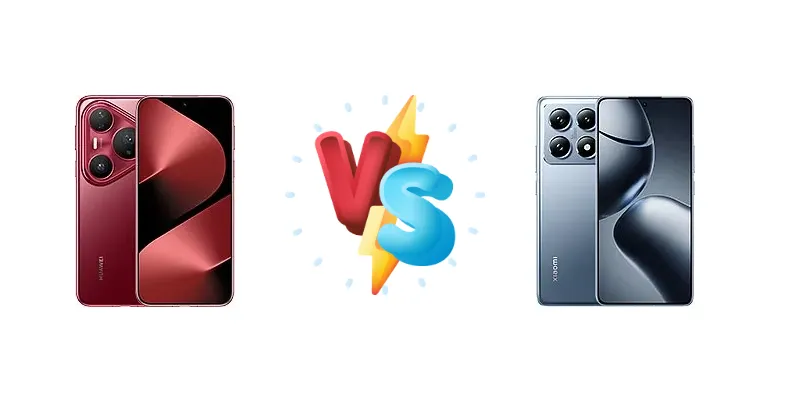
|
🏆 Quick Verdict
For the average user prioritizing raw performance and charging speed, the Xiaomi 14T Pro emerges as the winner. Its Dimensity 9300+ chipset and 120W charging significantly outperform the Pura 80 Pro+'s Kirin 9020 and 100W charging, despite the Huawei offering wireless charging advantages.
| PHONES | ||
|---|---|---|
| Phone Names | Huawei Pura 80 Pro+ | Xiaomi 14T Pro |
| Network | ||
|---|---|---|
| 2G bands | GSM 850 / 900 / 1800 / 1900 | GSM 850 / 900 / 1800 / 1900 |
| 3G bands | HSDPA 800 / 850 / 900 / 1700(AWS) / 1900 / 2100 | HSDPA 800 / 850 / 900 / 1700(AWS) / 1900 / 2100 |
| 4G bands | LTE | 1, 2, 3, 4, 5, 7, 8, 12, 13, 17, 18, 19, 20, 25, 26, 28, 32, 38, 39, 40, 41, 42, 48, 66 |
| 5G bands | SA/NSA - China only | 1, 2, 3, 5, 7, 8, 12, 20, 25, 26, 28, 38, 40, 41, 48, 66, 75, 77, 78 SA/NSA |
| Speed | HSPA, LTE, 5G | HSPA, LTE, 5G |
| Technology | GSM / CDMA / HSPA / CDMA2000 / LTE / 5G | GSM / HSPA / LTE / 5G |
| Launch | ||
|---|---|---|
| Announced | 2025, June 11 | 2024, September 26 |
| Status | Available. Released 2025, June 11 | Available. Released 2024, September 26 |
| Body | ||
|---|---|---|
| Build | Glass front, aluminum frame, glass back | Glass front (Gorilla Glass 5), aluminum frame, glass back (Panda X) |
| Dimensions | 163 x 76.1 x 8.3 mm (6.42 x 3.00 x 0.33 in) | 160.4 x 75.1 x 8.4 mm (6.31 x 2.96 x 0.33 in) |
| SIM | Nano-SIM + Nano-SIM | · Nano-SIM + eSIM· eSIM + eSIM· Nano-SIM + Nano-SIM |
| Weight | 219 g (7.72 oz) | 209 g (7.37 oz) |
| Display | ||
|---|---|---|
| Protection | Kunlun Glass 2 (Basalt-tempered) | Corning Gorilla Glass 5 |
| Resolution | 1276 x 2848 pixels, 20:9 ratio (~459 ppi density) | 1220 x 2712 pixels, 20:9 ratio (~446 ppi density) |
| Size | 6.8 inches, 111.3 cm2 (~89.7% screen-to-body ratio) | 6.67 inches, 107.4 cm2 (~89.1% screen-to-body ratio) |
| Type | LTPO OLED, 1B colors, HDR Vivid, 120Hz, 1440Hz PWM, 3000 nits (peak) | AMOLED, 68B colors, 144Hz, 3840Hz PWM, Dolby Vision, HDR10+, 1600 nits (HBM), 4000 nits (peak) |
| Platform | ||
|---|---|---|
| CPU | Octa-core (1x2.5GHz & 3x2.15GHz & 4x1.6GHz) | Octa-core (1x3.4 GHz Cortex-X4 & 3x2.85 GHz Cortex-X4 & 4x2.0 GHz Cortex-A720) |
| Chipset | Kirin 9020 (7 nm) | Mediatek Dimensity 9300+ (4 nm) |
| GPU | Maleoon 920 | Immortalis-G720 MC12 |
| OS | EMUI (International), HarmonyOS 5.1 (China) | Android 14, HyperOS |
| Memory | ||
|---|---|---|
| Card slot | No | No |
| Internal | 512GB 16GB RAM, 1TB 16GB RAM | 256GB 12GB RAM, 512GB 12GB RAM, 512GB 16GB RAM, 1TB 12GB RAM |
| Main Camera | ||
|---|---|---|
| Features | Laser AF, color spectrum sensor, LED flash, panorama, HDR | Leica lens, Ultra HDR, LED flash, HDR, panorama |
| Triple | 50 MP, f/1.6-4.0, 23mm (wide), 1.0"-type, dual pixel PDAF, OIS 48 MP, f/2.1, 93mm (telephoto), PDAF (5cm - ∞), OIS, 4x optical zoom 40 MP, f/2.2, 13mm (ultrawide), AF | 50 MP, f/1.6, 23mm (wide), 1/1.31", 1.2µm, PDAF, OIS 50 MP, f/2.0, 60mm (telephoto), 1/2.88", 0.61µm, PDAF, 2.6x optical zoom 12 MP, f/2.2, 15mm (ultrawide), 1/3.06", 1.12µm |
| Video | 4K, 1080p, 1080p@960fps (interpolated), HDR Vivid, gyro-EIS, OIS | 8K@24/30fps, 4K@24/30/60fps, 1080p@30/60/120/240/960fps, gyro-EIS, 10-bit Rec. 2020, HDR10+ |
| Selfie camera | ||
|---|---|---|
| Features | HDR, panorama | HDR |
| Single | 13 MP, f/2.0, (ultrawide), AF | 32 MP, f/2.0, 25mm (wide), 1/3.44", 0.64µm |
| Video | 4K, 1080p, 1080p@240fps, HDR Vivid, gyro-EIS | 4K@30fps, 1080p@30/60fps, HDR10+ |
| Sound | ||
|---|---|---|
| 35mm jack | No | No |
| Loudspeaker | Yes, with stereo speakers | Yes, with stereo speakers |
| Comms | ||
|---|---|---|
| Bluetooth | 5.2, A2DP, LE, L2HC | 5.4, A2DP, LE, LHDC |
| Infrared port | Yes | Yes |
| NFC | Yes | Yes (market/region dependent) |
| Positioning | GPS (L1+L5), GLONASS (L1), BDS (B1I+B1c+B2a+B2b), GALILEO (E1+E5a+E5b), QZSS (L1+L5), NavIC | GPS (L1+L5), BDS (B1I+B1C+B2a+B2b), GALILEO (E1+E5a+E5b), QZSS (L1+L5), NavIC (L5), GLONASS |
| Radio | No | No |
| USB | USB Type-C 3.1, OTG, DisplayPort 1.2 | USB Type-C 2.0, OTG |
| WLAN | Wi-Fi 802.11 a/b/g/n/ac/6/7, dual-band, Wi-Fi Direct | Wi-Fi 802.11 a/b/g/n/ac/6e/7, dual-band, Wi-Fi Direct |
| Features | ||
|---|---|---|
| Sensors | Fingerprint (side-mounted), accelerometer, gyro, proximity, compass, barometer | Fingerprint (under display, optical), accelerometer, gyro, proximity, compass |
| Battery | ||
|---|---|---|
| Charging | 100W wired 80W wireless 18W reverse wired Reverse wireless | 120W wired, PD3.0, QC4, 100% in 19 min 50W wireless, 100% in 45 min |
| Type | Li-Po 5700 mAh | Li-Po 5000 mAh |
| Misc | ||
|---|---|---|
| Colors | Black, White, Red, Green | Titan Gray, Titan Blue, Titan Black |
| Models | LMR-AL10 | 2407FPN8EG |
| Price | About 970 EUR | $ 550.00 / £ 498.00 / € 539.99 |
| SAR EU | - | 0.99 W/kg (head) 1.00 W/kg (body) |
Huawei Pura 80 Pro+
- 80W Wireless Charging: Offers convenient and fast wireless power transfer.
- Huawei Ecosystem: Potential benefits for users already invested in Huawei products.
- Potentially Refined Software: Huawei’s EMUI/HarmonyOS may appeal to some users.
- Older Chipset: Kirin 9020 lags behind the Dimensity 9300+ in raw performance.
- Limited Global Availability: Huawei faces restrictions in some markets.
Xiaomi 14T Pro
- Dimensity 9300+ Performance: Industry-leading CPU performance for demanding tasks.
- 120W Wired Charging: Fastest charging speeds currently available.
- Open Android Experience: Less restrictive software environment compared to Huawei.
- No Wireless Charging Advantage: Wireless charging is slower than the Pura 80 Pro+.
- Xiaomi’s MIUI: Can be perceived as bloated or intrusive by some users.
Display Comparison
The Xiaomi 14T Pro boasts a maximum brightness of 1228 nits, measured, suggesting a more visible display in direct sunlight compared to the Pura 80 Pro+, for which brightness data is unavailable. While both likely employ high-refresh-rate OLED panels, the Xiaomi’s higher peak brightness is a tangible advantage. The absence of LTPO information for the Pura 80 Pro+ suggests it may not dynamically adjust refresh rates as efficiently as some competitors, potentially impacting battery life. Bezels and color accuracy are unknown for both, requiring further testing.
Camera Comparison
Without detailed camera specifications for the Pura 80 Pro+, a direct comparison is limited. However, Huawei historically emphasizes computational photography and image processing. The Xiaomi 14T Pro’s camera system, while details are missing, will likely focus on sensor size and aperture for low-light performance. The absence of information regarding OIS on either device makes it difficult to assess stabilization capabilities. It’s crucial to note that the presence of a 2MP macro camera on either device is unlikely to significantly impact overall image quality; these sensors are often included for marketing purposes rather than practical benefit.
Performance
The Xiaomi 14T Pro’s Mediatek Dimensity 9300+ (4nm) is a clear architectural leap over the Huawei Pura 80 Pro+'s Kirin 9020 (7nm). The Dimensity 9300+ features a Cortex-X4 prime core clocked at 3.4 GHz, alongside three more Cortex-X4 cores at 2.85 GHz, and four Cortex-A720 efficiency cores. This configuration, built on a smaller 4nm process, promises significantly improved performance and thermal efficiency compared to the Kirin 9020’s octa-core setup. The Kirin’s split core configuration (2.5GHz, 2.15GHz, 1.6GHz) suggests a focus on balancing performance and power consumption, but it’s unlikely to match the raw processing power of the Dimensity 9300+. The Xiaomi’s LPDDR5x RAM further enhances its performance edge.
Battery Life
The Xiaomi 14T Pro’s 120W wired charging, capable of a full charge in just 19 minutes, is a substantial advantage over the Huawei Pura 80 Pro+'s 100W charging. The Xiaomi also offers 50W wireless charging (45 minutes to full), while the Pura 80 Pro+ provides 80W wireless, a unique selling point. However, the Xiaomi 14T Pro’s active use score of 12:32h suggests excellent battery life optimization, potentially offsetting any capacity differences. The Pura 80 Pro+'s battery capacity is unknown, making a direct comparison challenging, but the Xiaomi’s faster charging and proven endurance are compelling.
Buying Guide
Buy the Huawei Pura 80 Pro+ if you prioritize a potentially more refined software experience within the Huawei ecosystem and value the convenience of 80W wireless charging. Buy the Xiaomi 14T Pro if you demand the fastest possible charging, top-tier CPU performance for demanding tasks, and a more open Android experience.