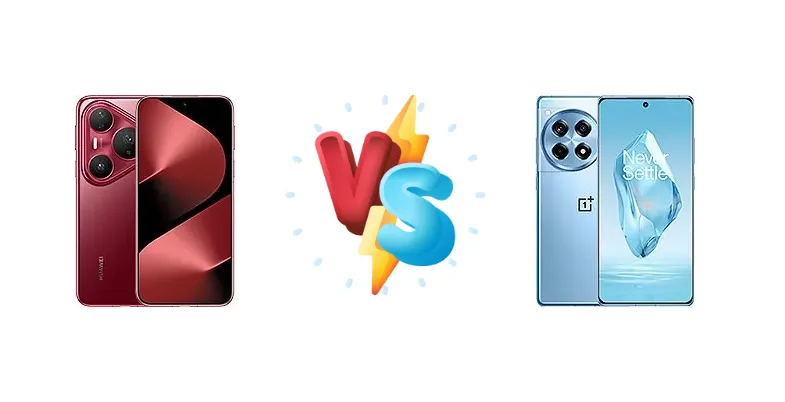
The Huawei Pura 80 Pro+ arrives with a new Kirin chipset and ambitious camera tech, challenging established players like the OnePlus 12R, which leverages the proven Snapdragon 8 Gen 2. This comparison dissects these two Android flagships, focusing on where each excels and who will benefit most from their distinct approaches.
🏆 Quick Verdict
For most users, the OnePlus 12R offers a more compelling package. Its Snapdragon 8 Gen 2 delivers consistently strong performance and excellent thermal management, backed by a solid 14:32 hour active use battery life. While the Pura 80 Pro+ boasts faster charging, the OnePlus 12R’s overall balance and established software ecosystem make it the winner.
| Network |
|---|
| 2G bands | GSM 850 / 900 / 1800 / 1900 | GSM 850 / 900 / 1800 / 1900 |
| 3G bands | HSDPA 800 / 850 / 900 / 1700(AWS) / 1900 / 2100 | HSDPA 850 / 900 / 1700(AWS) / 1900 / 2100 |
| 4G bands | LTE | 1, 2, 3, 4, 5, 7, 8, 12, 17, 18, 19, 20, 26, 28, 32, 38, 39, 40, 41, 66 |
| 5G bands | SA/NSA - China only | 1, 2, 3, 5, 7, 8, 12, 20, 28, 38, 40, 41, 66, 77, 78 SA/NSA |
| Speed | HSPA, LTE, 5G | HSPA, LTE, 5G |
| Technology | GSM / CDMA / HSPA / CDMA2000 / LTE / 5G | GSM / CDMA / HSPA / LTE / 5G |
| Launch |
|---|
| Announced | 2025, June 11 | 2024, January 23 |
| Status | Available. Released 2025, June 11 | Available. Released 2024, February 06 |
| Body |
|---|
| Build | Glass front, aluminum frame, glass back | Glass front (Gorilla Glass Victus 2), aluminum frame, glass back |
| Dimensions | 163 x 76.1 x 8.3 mm (6.42 x 3.00 x 0.33 in) | 163.3 x 75.3 x 8.8 mm (6.43 x 2.96 x 0.35 in) |
| SIM | Nano-SIM + Nano-SIM | · Nano-SIM + Nano-SIM + eSIM (max 2 at a time)· Nano-SIM + Nano-SIM |
| Weight | 219 g (7.72 oz) | 207 g (7.30 oz) |
| Display |
|---|
| Protection | Kunlun Glass 2 (Basalt-tempered) | Corning Gorilla Glass Victus 2 |
| Resolution | 1276 x 2848 pixels, 20:9 ratio (~459 ppi density) | 1264 x 2780 pixels (~450 ppi density) |
| Size | 6.8 inches, 111.3 cm2 (~89.7% screen-to-body ratio) | 6.78 inches, 111.7 cm2 (~90.9% screen-to-body ratio) |
| Type | LTPO OLED, 1B colors, HDR Vivid, 120Hz, 1440Hz PWM, 3000 nits (peak) | LTPO4 AMOLED, 1B colors, 120Hz, HDR10+, Dolby Vision, 1600 nits (HBM), 4500 nits (peak) |
| Platform |
|---|
| CPU | Octa-core (1x2.5GHz & 3x2.15GHz & 4x1.6GHz) | Octa-core (1x3.2 GHz Cortex-X3 & 2x2.8 GHz Cortex-A715 & 2x2.8 GHz Cortex-A710 & 3x2.0 GHz Cortex-A510) |
| Chipset | Kirin 9020 (7 nm) | Qualcomm SM8550-AB Snapdragon 8 Gen 2 (4 nm) |
| GPU | Maleoon 920 | Adreno 740 |
| OS | EMUI (International), HarmonyOS 5.1 (China) | Android 14, up to 3 major Android upgrades, OxygenOS 15 |
| Memory |
|---|
| Card slot | No | No |
| Internal | 512GB 16GB RAM, 1TB 16GB RAM | 128GB 8GB RAM, 256GB 8GB RAM, 256GB 12GB RAM, 256GB 16GB RAM |
| Main Camera |
|---|
| Features | Laser AF, color spectrum sensor, LED flash, panorama, HDR | Laser AF, color spectrum sensor, LED flash, HDR, panorama |
| Triple | 50 MP, f/1.6-4.0, 23mm (wide), 1.0"-type, dual pixel PDAF, OIS
48 MP, f/2.1, 93mm (telephoto), PDAF (5cm - ∞), OIS, 4x optical zoom
40 MP, f/2.2, 13mm (ultrawide), AF | 50 MP, f/1.8, 24mm (wide), 1/1.56", 1.0µm, multi-directional PDAF, OIS
8 MP, f/2.2, 16mm, 112˚ (ultrawide), 1/4.0", 1.12µm
2 MP (macro) |
| Video | 4K, 1080p, 1080p@960fps (interpolated), HDR Vivid, gyro-EIS, OIS | 4K@30/60fps, 1080p@30/60/120/240fps, gyro-EIS, OIS |
| Selfie camera |
|---|
| Features | HDR, panorama | HDR, panorama |
| Single | 13 MP, f/2.0, (ultrawide), AF | 16 MP, f/2.4, 26mm (wide), 1/3", 1.0µm |
| Video | 4K, 1080p, 1080p@240fps, HDR Vivid, gyro-EIS | 1080p@30fps, gyro-EIS |
| Sound |
|---|
| 35mm jack | No | No |
| Loudspeaker | Yes, with stereo speakers | Yes, with stereo speakers |
| Comms |
|---|
| Bluetooth | 5.2, A2DP, LE, L2HC | 5.3, A2DP, LE, aptX HD |
| Infrared port | Yes | Yes |
| NFC | Yes | Yes |
| Positioning | GPS (L1+L5), GLONASS (L1), BDS (B1I+B1c+B2a+B2b), GALILEO (E1+E5a+E5b), QZSS (L1+L5), NavIC | GPS, GALILEO, GLONASS, BDS, QZSS |
| Radio | No | No |
| USB | USB Type-C 3.1, OTG, DisplayPort 1.2 | USB Type-C 2.0 |
| WLAN | Wi-Fi 802.11 a/b/g/n/ac/6/7, dual-band, Wi-Fi Direct | Wi-Fi 802.11 a/b/g/n/ac/6/7, dual-band |
| Features |
|---|
| Sensors | Fingerprint (side-mounted), accelerometer, gyro, proximity, compass, barometer | Fingerprint (under display, optical), accelerometer, gyro, proximity, compass |
| Battery |
|---|
| Charging | 100W wired
80W wireless
18W reverse wired
Reverse wireless | 100W wired, 100% in 26 min |
| Type | Li-Po 5700 mAh | Li-Ion 5500 mAh |
| Misc |
|---|
| Colors | Black, White, Red, Green | Iron Gray, Cool Blue, Electric Violet, Sunset Dune |
| Models | LMR-AL10 | CPH2609, CPH2585, CPH2611 |
| Price | About 970 EUR | € 410.84 / $ 399.95 / £ 649.00 |
| SAR | - | 1.19 W/kg (head) 0.82 W/kg (body) |
Huawei Pura 80 Pro+
- Extremely fast 100W wired and 80W wireless charging
- Potentially superior camera system (based on Huawei's history)
- Reverse wireless charging capability
- Kirin 9020 chipset may suffer from thermal throttling
- Software ecosystem and app availability concerns (Huawei Mobile Services)
OnePlus 12R
- Snapdragon 8 Gen 2 provides excellent performance and efficiency
- Long battery life (14:32h active use)
- Fast 100W wired charging (26 minutes to full)
- Camera system not as cutting-edge as some competitors
- Wireless charging speed is not as fast as Pura 80 Pro+
Display Comparison
The OnePlus 12R boasts a bright display, peaking at 1181 nits, ensuring excellent visibility even outdoors. While the Pura 80 Pro+’s display specs are currently unknown, Huawei typically employs OLED panels with vibrant colors. The 12R’s brightness advantage is significant, and its likely higher refresh rate (based on OnePlus’s history) will contribute to smoother scrolling. Without knowing the Pura 80 Pro+'s panel technology (LTPO or not), it's difficult to assess power efficiency.
Camera Comparison
Huawei has historically excelled in mobile photography, and the Pura 80 Pro+ is expected to continue this trend. However, without specific sensor details, it’s hard to make a direct comparison. The OnePlus 12R, while capable, doesn’t typically prioritize camera innovation to the same degree. The Pura 80 Pro+’s image processing algorithms will be key; Huawei’s computational photography is often aggressive, aiming for highly detailed and vibrant images. The 12R will likely offer a more natural look. Ignoring the likely present 2MP macro sensors on both devices, the main sensor and its accompanying OIS will be the deciding factors.
Performance
The core difference lies in the chipsets. The OnePlus 12R’s Snapdragon 8 Gen 2 (4nm) is a proven performer, featuring a Cortex-X3 prime core clocked at 3.2GHz. This contrasts with the Huawei Pura 80 Pro+'s Kirin 9020 (7nm). The 4nm process of the Snapdragon offers superior power efficiency and thermal headroom, meaning sustained performance during demanding tasks like gaming. The Kirin 9020’s octa-core configuration, while potentially powerful, will likely face more thermal constraints. The 12R’s LPDDR5x RAM further enhances its performance capabilities.
Battery Life
The OnePlus 12R delivers an impressive 14:32 hours of active use, showcasing excellent battery optimization. The Pura 80 Pro+ counters with incredibly fast charging: 100W wired, 80W wireless, and even reverse wireless charging. While the Pura 80 Pro+'s battery capacity is unknown, the 12R’s longevity is a significant advantage. The 12R reaches 100% charge in just 26 minutes with its 100W wired charging, but the Pura 80 Pro+’s wireless charging speed is a unique selling point.
Buying Guide
Buy the Huawei Pura 80 Pro+ if you prioritize cutting-edge camera technology and extremely fast charging speeds, and are comfortable navigating the Huawei ecosystem. Buy the OnePlus 12R if you value consistent, high-end performance for gaming and everyday tasks, coupled with a long-lasting battery and a streamlined Android experience.
Frequently Asked Questions
❓ Does the Kirin 9020 in the Pura 80 Pro+ overheat during extended gaming sessions?
Given the 7nm process node and the Kirin 9020’s core configuration, there's a higher likelihood of thermal throttling compared to the Snapdragon 8 Gen 2’s 4nm process. Expect performance to be sustained for shorter periods under heavy load, potentially requiring more aggressive cooling.
❓ How does Huawei Mobile Services (HMS) impact app availability on the Pura 80 Pro+?
The Pura 80 Pro+ runs on Huawei Mobile Services instead of Google Mobile Services. While HMS has a growing app ecosystem, some popular Google apps may require workarounds or alternative solutions. App compatibility should be carefully considered before purchasing.
❓ Is the 100W wireless charging on the Pura 80 Pro+ significantly faster than the OnePlus 12R's wireless charging?
Yes, the Pura 80 Pro+'s 80W wireless charging is substantially faster than the OnePlus 12R's (spec not provided, but typically around 50W). This allows for quicker top-ups without needing a wired connection, a significant convenience for users who frequently use wireless charging.
❓ What kind of gaming performance can I expect from the OnePlus 12R?
The Snapdragon 8 Gen 2 in the OnePlus 12R delivers excellent gaming performance, capable of running demanding titles at high settings with stable frame rates. The efficient chipset and optimized thermal management minimize throttling, ensuring a smooth and enjoyable gaming experience.