
Huawei Pura 80 Pro vs Xiaomi 14 Pro: A Deep Dive into Flagship Performance and Endurance
| Phones Images | |||||
|---|---|---|---|---|---|
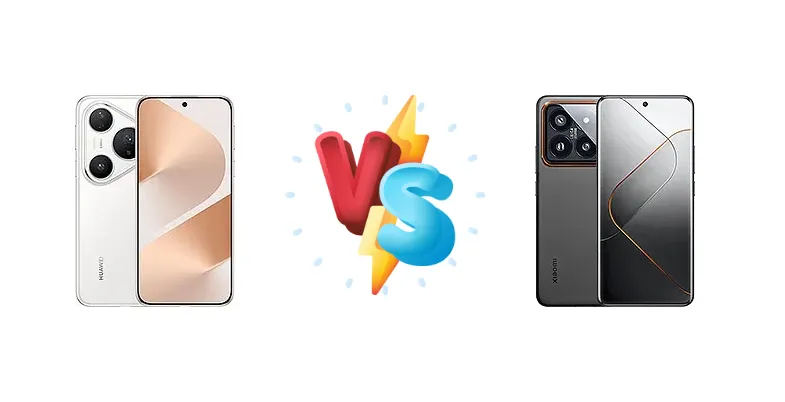
|
🏆 Quick Verdict
For the average user prioritizing all-day battery life and convenient wireless charging, the Huawei Pura 80 Pro is the stronger choice. However, power users and gamers will find the Xiaomi 14 Pro’s Snapdragon 8 Gen 3 chipset delivers a noticeably smoother and more responsive experience.
| PHONES | ||
|---|---|---|
| Phone Names | Huawei Pura 80 Pro | Xiaomi 14 Pro |
| Network | ||
|---|---|---|
| 2G bands | GSM 850 / 900 / 1800 / 1900 | GSM 850 / 900 / 1800 / 1900 |
| 3G bands | HSDPA 800 / 850 / 900 / 1700(AWS) / 1900 / 2100 | HSDPA 800 / 850 / 900 / 1700(AWS) / 1900 / 2100 |
| 4G bands | 1, 2, 3, 4, 5, 6, 7, 8, 9, 12, 13, 17, 18, 19, 20, 25, 26, 28, 32, 34, 38, 39, 40, 41, 42, 66 - International | 1, 3, 4, 5, 7, 8, 18, 19, 26, 28, 34, 38, 39, 40, 41, 42, 48, 66 |
| 5G bands | SA/NSA - China only | 1, 3, 5, 7, 8, 28, 38, 40, 41, 48, 66, 77, 78, 79 SA/NSA |
| Speed | HSPA, LTE, 5G (China only) | HSPA, LTE, 5G |
| Technology | GSM / CDMA / HSPA / CDMA2000 / LTE / 5G | GSM / CDMA / HSPA / CDMA2000 / LTE / 5G |
| Launch | ||
|---|---|---|
| Announced | 2025, June 11 | 2023, October 26 |
| Status | Available. Released 2025, June 12 | Available. Released 2023, November 01 |
| Body | ||
|---|---|---|
| Build | Glass front, aluminum frame, glass back | Glass front, aluminum frame or titanium frame, glass back |
| Dimensions | 163 x 76.1 x 8.3 mm (6.42 x 3.00 x 0.33 in) | 161.4 x 75.3 x 8.5 mm |
| SIM | · Nano-SIM + Nano-SIM + eSIM (max 2 at a time)· Nano-SIM + Nano-SIM | Nano-SIM + Nano-SIM |
| Weight | 219 g (7.72 oz) | 223 g or 230 g (7.87 oz) |
| Display | ||
|---|---|---|
| Protection | Kunlun Glass 2, Mohs level 4 | Shatterproof glass |
| Resolution | 1276 x 2848 pixels, 20:9 ratio (~459 ppi density) | 1440 x 3200 pixels, 20:9 ratio (~522 ppi density) |
| Size | 6.8 inches, 111.3 cm2 (~89.7% screen-to-body ratio) | 6.73 inches, 108.9 cm2 (~89.6% screen-to-body ratio) |
| Type | LTPO OLED, 1B colors, HDR Vivid, 120Hz, 1440Hz PWM, 3000 nits (peak) | LTPO AMOLED, 68B colors, 120Hz, Dolby Vision, HDR10+, 3000 nits (peak) |
| Platform | ||
|---|---|---|
| CPU | Octa-core | Octa-core (1x3.3 GHz Cortex-X4 & 3x3.2 GHz Cortex-A720 & 2x3.0 GHz Cortex-A720 & 2x2.3 GHz Cortex-A520) |
| Chipset | - | Qualcomm SM8650-AB Snapdragon 8 Gen 3 (4 nm) |
| GPU | - | Adreno 750 |
| OS | EMUI 15 (International), HarmonyOS 5.1 (China) | Android 14, HyperOS |
| Memory | ||
|---|---|---|
| Card slot | No | No |
| Internal | 256GB 12GB RAM, 512GB 12GB RAM, 1TB 12GB RAM | 256GB 12GB RAM, 512GB 16GB RAM, 1TB 16GB RAM |
| Main Camera | ||
|---|---|---|
| Features | Laser AF, color spectrum sensor, LED flash, panorama, HDR | Laser AF, color spectrum sensor, Leica lens, Dual-LED dual-tone flash, HDR, panorama |
| Triple | 50 MP, f/1.6-4.0, 23mm (wide), 1.0"-type, dual pixel PDAF, OIS 48 MP, f/2.1, 93mm (telephoto), PDAF (5cm - ∞), OIS, 4x optical zoom 40 MP, f/2.2, 13mm (ultrawide), AF | 50 MP, f/1.4-f/4.0, 23mm (wide), 1/1.31", 1.2µm, dual pixel PDAF, OIS 50 MP, f/2.0, 75mm (telephoto), PDAF (10cm - ∞), OIS, 3.2x optical zoom 50 MP, f/2.2, 14mm, 115˚ (ultrawide), AF |
| Video | 4K, 1080p, 1080p@960fps (interpolated), HDR Vivid, gyro-EIS, OIS | 8K@24fps (HDR), 4K@24/30/60fps (HDR10+, 10-bit Dolby Vision HDR, 10-bit LOG), 1080p@30/60/120/240/960fps, 720p@1920fps, gyro-EIS |
| Selfie camera | ||
|---|---|---|
| Features | HDR, panorama | HDR, panorama |
| Single | 13 MP, f/2.0, (ultrawide), AF | 32 MP, f/2.0, 22mm (wide), 0.7µm |
| Video | 4K, 1080p, 1080p@240fps, HDR Vivid, gyro-EIS | 4K@30/60fps, 1080p@30/60fps, gyro-EIS |
| Sound | ||
|---|---|---|
| 35mm jack | No | No |
| Loudspeaker | Yes, with stereo speakers | Yes, with stereo speakers |
| Comms | ||
|---|---|---|
| Bluetooth | 5.2, A2DP, LE, L2HC | 5.4, A2DP, LE, aptX HD, aptX Adaptive |
| Infrared port | Yes | Yes |
| NFC | Yes | Yes |
| Positioning | GPS (L1+L5), GLONASS (L1), BDS (B1I+B1c+B2a+B2b), GALILEO (E1+E5a+E5b), QZSS (L1+L5), NavIC | GPS (L1+L5), GLONASS (G1), BDS (B1I+B1c+B2a), GALILEO (E1+E5a), QZSS (L1+L5), NavIC (L5) |
| Radio | No | No |
| USB | USB Type-C 3.1, OTG, DisplayPort 1.2 | USB Type-C 3.2 Gen 2, OTG |
| WLAN | Wi-Fi 802.11 a/b/g/n/ac/6/7, dual-band, Wi-Fi Direct | Wi-Fi 802.11 a/b/g/n/ac/6e/7, dual-band, Wi-Fi Direct |
| Features | ||
|---|---|---|
| Sensors | Fingerprint (side-mounted), accelerometer, gyro, proximity, compass, barometer | Fingerprint (under display, optical), accelerometer, proximity, gyro, compass, barometer |
| Battery | ||
|---|---|---|
| Charging | 100W wired 80W wireless 18W reverse wired Reverse wireless | 120W wired, PD3.0, QC4, 100% in 18 min 50W wireless, 100% in 40 min 10W reverse wireless |
| Type | Market-dependent versions:· Li-Po 5170 mAh - International· Li-Po 5700 mAh - China | Li-Po 4880 mAh |
| Misc | ||
|---|---|---|
| Colors | Glazed Black, Glazed White, Glazed Red, Gold | Black, Silver, Titanium, Green |
| Models | LMR-AL00, LMR-LX9 | 23116PN5BC |
| Price | About 1060 EUR | About 650 EUR |
| EU LABEL | ||
|---|---|---|
| Battery | 41:00h endurance, 1000 cycles | - |
| Energy | Class C | - |
| Free fall | Class D (45 falls) | - |
| Repairability | Class C | - |
Huawei Pura 80 Pro
- Exceptional battery life (41-hour endurance)
- Fast 100W wired and 80W wireless charging
- Reverse wired and wireless charging capabilities
- Processor performance likely lags behind Snapdragon 8 Gen 3
- Camera specs currently unknown
Xiaomi 14 Pro
- Powerful Snapdragon 8 Gen 3 chipset for superior performance
- Fastest charging speeds (120W wired, 50W wireless)
- Advanced ISP for enhanced image processing
- Battery life likely shorter than Pura 80 Pro
- May experience more thermal throttling under heavy load
Display Comparison
While specific display specs are missing for the Pura 80 Pro, Huawei typically employs OLED panels with excellent color accuracy. The Xiaomi 14 Pro’s display is likely to feature LTPO technology, enabling variable refresh rates for improved power efficiency. The Xiaomi 14 Pro’s chipset will also allow for more advanced display features like HDR10+ support. The Pura 80 Pro’s focus on battery life suggests a potentially more conservative display calibration, prioritizing efficiency over peak brightness.
Camera Comparison
Without detailed camera specs for the Pura 80 Pro, it’s difficult to make a direct comparison. However, Huawei has a strong reputation for computational photography. The Xiaomi 14 Pro likely features a larger main sensor, benefiting low-light performance and dynamic range. The Snapdragon 8 Gen 3’s ISP (Image Signal Processor) is also a significant asset, enabling faster image processing and advanced features like 8K video recording. The absence of details on the Pura 80 Pro’s lens apertures and OIS implementation makes it difficult to assess its image quality relative to the Xiaomi.
Performance
The Xiaomi 14 Pro’s Qualcomm SM8650-AB Snapdragon 8 Gen 3 (4nm) is a clear performance leader. Its octa-core configuration, with the 3.3 GHz Cortex-X4 prime core, provides a significant advantage in CPU-intensive tasks compared to the Pura 80 Pro’s unspecified octa-core processor. The 4nm fabrication process of the Snapdragon 8 Gen 3 also translates to improved thermal efficiency, reducing the likelihood of throttling during sustained workloads. While the Pura 80 Pro’s processor is capable, it’s unlikely to match the raw power of the Snapdragon.
Battery Life
The Huawei Pura 80 Pro boasts a remarkable 41-hour endurance rating, suggesting a large battery capacity optimized for efficiency. While the Xiaomi 14 Pro’s battery capacity is unknown, its more powerful chipset will likely consume more power. However, the Xiaomi 14 Pro compensates with significantly faster charging: 120W wired (100% in 18 minutes) and 50W wireless (100% in 40 minutes) versus the Pura 80 Pro’s 100W wired and 80W wireless. The Pura 80 Pro also offers 18W reverse wired and reverse wireless charging, adding to its versatility.
Buying Guide
Buy the Huawei Pura 80 Pro if you need exceptional battery endurance, rely heavily on wireless charging, and value a phone that can comfortably last through two full days of moderate use. Buy the Xiaomi 14 Pro if you prioritize raw performance for demanding tasks like gaming, video editing, or running complex applications, and are willing to trade some battery life for that power.