
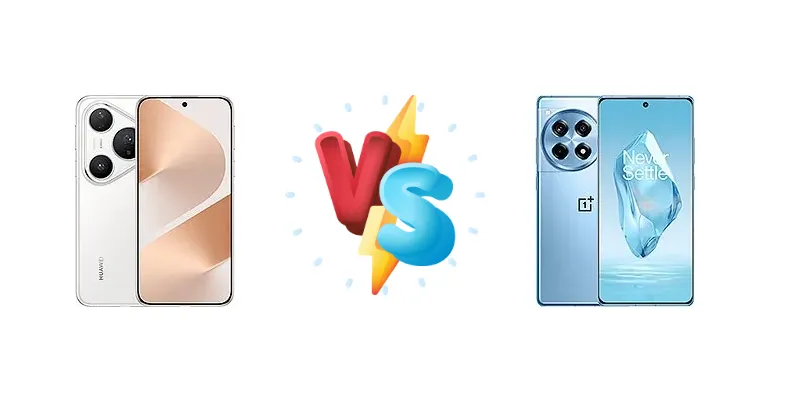
Huawei Pura 80 Pro vs. OnePlus 12R: A Deep Dive into Battery, Performance, and Value
| Phones Images | |||||
|---|---|---|---|---|---|
|
🏆 Quick Verdict
For users prioritizing all-day battery life and convenient wireless charging, the Huawei Pura 80 Pro is the clear winner. However, gamers and power users demanding raw performance will find the OnePlus 12R, powered by the Snapdragon 8 Gen 2, a more compelling choice.
| PHONES | ||
|---|---|---|
| Phone Names | Huawei Pura 80 Pro | OnePlus 12R |
| Network | ||
|---|---|---|
| 2G bands | GSM 850 / 900 / 1800 / 1900 | GSM 850 / 900 / 1800 / 1900 |
| 3G bands | HSDPA 800 / 850 / 900 / 1700(AWS) / 1900 / 2100 | HSDPA 850 / 900 / 1700(AWS) / 1900 / 2100 |
| 4G bands | 1, 2, 3, 4, 5, 6, 7, 8, 9, 12, 13, 17, 18, 19, 20, 25, 26, 28, 32, 34, 38, 39, 40, 41, 42, 66 - International | 1, 2, 3, 4, 5, 7, 8, 12, 17, 18, 19, 20, 26, 28, 32, 38, 39, 40, 41, 66 |
| 5G bands | SA/NSA - China only | 1, 2, 3, 5, 7, 8, 12, 20, 28, 38, 40, 41, 66, 77, 78 SA/NSA |
| Speed | HSPA, LTE, 5G (China only) | HSPA, LTE, 5G |
| Technology | GSM / CDMA / HSPA / CDMA2000 / LTE / 5G | GSM / CDMA / HSPA / LTE / 5G |
| Launch | ||
|---|---|---|
| Announced | 2025, June 11 | 2024, January 23 |
| Status | Available. Released 2025, June 12 | Available. Released 2024, February 06 |
| Body | ||
|---|---|---|
| Build | Glass front, aluminum frame, glass back | Glass front (Gorilla Glass Victus 2), aluminum frame, glass back |
| Dimensions | 163 x 76.1 x 8.3 mm (6.42 x 3.00 x 0.33 in) | 163.3 x 75.3 x 8.8 mm (6.43 x 2.96 x 0.35 in) |
| SIM | · Nano-SIM + Nano-SIM + eSIM (max 2 at a time)· Nano-SIM + Nano-SIM | · Nano-SIM + Nano-SIM + eSIM (max 2 at a time)· Nano-SIM + Nano-SIM |
| Weight | 219 g (7.72 oz) | 207 g (7.30 oz) |
| Display | ||
|---|---|---|
| Protection | Kunlun Glass 2, Mohs level 4 | Corning Gorilla Glass Victus 2 |
| Resolution | 1276 x 2848 pixels, 20:9 ratio (~459 ppi density) | 1264 x 2780 pixels (~450 ppi density) |
| Size | 6.8 inches, 111.3 cm2 (~89.7% screen-to-body ratio) | 6.78 inches, 111.7 cm2 (~90.9% screen-to-body ratio) |
| Type | LTPO OLED, 1B colors, HDR Vivid, 120Hz, 1440Hz PWM, 3000 nits (peak) | LTPO4 AMOLED, 1B colors, 120Hz, HDR10+, Dolby Vision, 1600 nits (HBM), 4500 nits (peak) |
| Platform | ||
|---|---|---|
| CPU | Octa-core | Octa-core (1x3.2 GHz Cortex-X3 & 2x2.8 GHz Cortex-A715 & 2x2.8 GHz Cortex-A710 & 3x2.0 GHz Cortex-A510) |
| Chipset | - | Qualcomm SM8550-AB Snapdragon 8 Gen 2 (4 nm) |
| GPU | - | Adreno 740 |
| OS | EMUI 15 (International), HarmonyOS 5.1 (China) | Android 14, up to 3 major Android upgrades, OxygenOS 15 |
| Memory | ||
|---|---|---|
| Card slot | No | No |
| Internal | 256GB 12GB RAM, 512GB 12GB RAM, 1TB 12GB RAM | 128GB 8GB RAM, 256GB 8GB RAM, 256GB 12GB RAM, 256GB 16GB RAM |
| Main Camera | ||
|---|---|---|
| Features | Laser AF, color spectrum sensor, LED flash, panorama, HDR | Laser AF, color spectrum sensor, LED flash, HDR, panorama |
| Triple | 50 MP, f/1.6-4.0, 23mm (wide), 1.0"-type, dual pixel PDAF, OIS 48 MP, f/2.1, 93mm (telephoto), PDAF (5cm - ∞), OIS, 4x optical zoom 40 MP, f/2.2, 13mm (ultrawide), AF | 50 MP, f/1.8, 24mm (wide), 1/1.56", 1.0µm, multi-directional PDAF, OIS 8 MP, f/2.2, 16mm, 112˚ (ultrawide), 1/4.0", 1.12µm 2 MP (macro) |
| Video | 4K, 1080p, 1080p@960fps (interpolated), HDR Vivid, gyro-EIS, OIS | 4K@30/60fps, 1080p@30/60/120/240fps, gyro-EIS, OIS |
| Selfie camera | ||
|---|---|---|
| Features | HDR, panorama | HDR, panorama |
| Single | 13 MP, f/2.0, (ultrawide), AF | 16 MP, f/2.4, 26mm (wide), 1/3", 1.0µm |
| Video | 4K, 1080p, 1080p@240fps, HDR Vivid, gyro-EIS | 1080p@30fps, gyro-EIS |
| Sound | ||
|---|---|---|
| 35mm jack | No | No |
| Loudspeaker | Yes, with stereo speakers | Yes, with stereo speakers |
| Comms | ||
|---|---|---|
| Bluetooth | 5.2, A2DP, LE, L2HC | 5.3, A2DP, LE, aptX HD |
| Infrared port | Yes | Yes |
| NFC | Yes | Yes |
| Positioning | GPS (L1+L5), GLONASS (L1), BDS (B1I+B1c+B2a+B2b), GALILEO (E1+E5a+E5b), QZSS (L1+L5), NavIC | GPS, GALILEO, GLONASS, BDS, QZSS |
| Radio | No | No |
| USB | USB Type-C 3.1, OTG, DisplayPort 1.2 | USB Type-C 2.0 |
| WLAN | Wi-Fi 802.11 a/b/g/n/ac/6/7, dual-band, Wi-Fi Direct | Wi-Fi 802.11 a/b/g/n/ac/6/7, dual-band |
| Features | ||
|---|---|---|
| Sensors | Fingerprint (side-mounted), accelerometer, gyro, proximity, compass, barometer | Fingerprint (under display, optical), accelerometer, gyro, proximity, compass |
| Battery | ||
|---|---|---|
| Charging | 100W wired 80W wireless 18W reverse wired Reverse wireless | 100W wired, 100% in 26 min |
| Type | Market-dependent versions:· Li-Po 5170 mAh - International· Li-Po 5700 mAh - China | Li-Ion 5500 mAh |
| Misc | ||
|---|---|---|
| Colors | Glazed Black, Glazed White, Glazed Red, Gold | Iron Gray, Cool Blue, Electric Violet, Sunset Dune |
| Models | LMR-AL00, LMR-LX9 | CPH2609, CPH2585, CPH2611 |
| Price | About 1060 EUR | € 410.84 / $ 399.95 / £ 649.00 |
| SAR | - | 1.19 W/kg (head) 0.82 W/kg (body) |
| EU LABEL | ||
|---|---|---|
| Battery | 41:00h endurance, 1000 cycles | - |
| Energy | Class C | - |
| Free fall | Class D (45 falls) | - |
| Repairability | Class C | - |
Huawei Pura 80 Pro
- Exceptional 41-hour battery life
- Fast 100W wired and 80W wireless charging
- Reverse wireless charging capability
- CPU performance likely lags behind Snapdragon 8 Gen 2
- Camera specs currently unknown
OnePlus 12R
- Powerful Snapdragon 8 Gen 2 chipset
- Bright 1181 nit display
- Fast 100W wired charging (26 min to full)
- Significantly shorter battery life (14:32h)
- No wireless charging
Display Comparison
The OnePlus 12R boasts a significantly brighter display, peaking at 1181 nits, making it more visible outdoors under direct sunlight. While the Pura 80 Pro’s display specs are currently unknown, Huawei typically employs high-quality OLED panels. The 12R’s brightness advantage is crucial for users who frequently consume content outdoors. We expect the Pura 80 Pro to focus on color accuracy and potentially a higher PWM dimming rate for eye comfort, but without specific data, it's difficult to assess.
Camera Comparison
Without detailed camera specifications for the Pura 80 Pro, a direct comparison is limited. However, Huawei historically excels in computational photography. The OnePlus 12R’s camera system is expected to be competent, but likely won’t match Huawei’s image processing prowess. The Pura 80 Pro’s potential strengths lie in its ability to extract detail in low-light conditions and deliver vibrant, color-accurate images. We anticipate the Pura 80 Pro to focus on overall image quality, while the 12R will likely prioritize speed and versatility.
Performance
The OnePlus 12R’s Qualcomm Snapdragon 8 Gen 2 (4nm) chipset is a powerhouse, featuring a 1x3.2 GHz Cortex-X3 prime core, 2x2.8 GHz Cortex-A715 performance cores, 2x2.8 GHz Cortex-A710 cores, and 3x2.0 GHz Cortex-A510 efficiency cores. This configuration provides a substantial performance advantage over the Pura 80 Pro’s unspecified octa-core CPU. The 4nm process node of the Snapdragon 8 Gen 2 also translates to superior thermal efficiency, minimizing throttling during extended gaming sessions. The Pura 80 Pro will likely rely on software optimization to compete, but it faces a significant hardware deficit.
Battery Life
The Huawei Pura 80 Pro claims an impressive 41:00h endurance, suggesting exceptional battery life. This is significantly longer than the OnePlus 12R’s 14:32h active use score. While the 12R offers 100W wired charging, reaching 100% in just 26 minutes, the Pura 80 Pro counters with both 100W wired *and* 80W wireless charging, alongside 18W reverse wired and wireless charging. The Pura 80 Pro’s longevity and wireless charging capabilities make it ideal for users who dislike being tethered to a wall.
Buying Guide
Buy the Huawei Pura 80 Pro if you need exceptional battery life, frequent wireless charging, and a phone that can reliably last through two full days of moderate use. Buy the OnePlus 12R if you prioritize gaming performance, fast wired charging, and a more streamlined Android experience with a focus on speed and responsiveness.