
Huawei Pura 80 Pro vs. Google Pixel 8 Pro: A Deep Dive into Battery, AI, and Camera Supremacy
| Phones Images | |||||
|---|---|---|---|---|---|
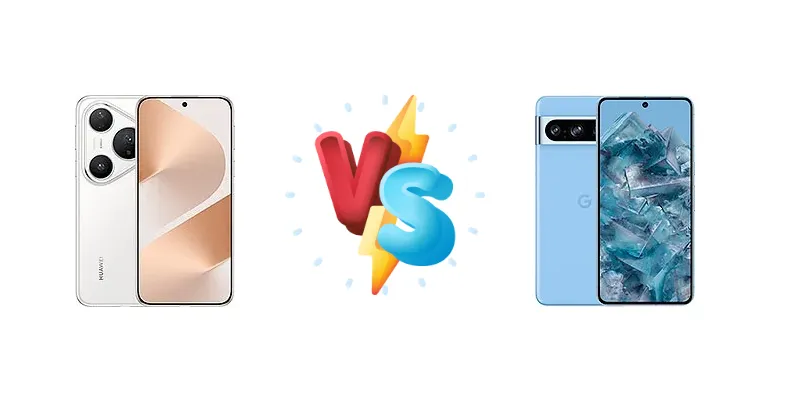
|
🏆 Quick Verdict
For users prioritizing all-day (and beyond) battery life and incredibly fast charging, the Huawei Pura 80 Pro is the clear winner. However, the Google Pixel 8 Pro’s superior image processing, AI features, and brighter display make it the better choice for photography enthusiasts and those deeply integrated into the Google ecosystem.
| PHONES | ||
|---|---|---|
| Phone Names | Huawei Pura 80 Pro | Google Pixel 8 Pro |
| Network | ||
|---|---|---|
| 2G bands | GSM 850 / 900 / 1800 / 1900 | GSM 850 / 900 / 1800 / 1900 |
| 3G bands | HSDPA 800 / 850 / 900 / 1700(AWS) / 1900 / 2100 | HSDPA 800 / 850 / 900 / 1700(AWS) / 1900 / 2100 |
| 4G bands | 1, 2, 3, 4, 5, 6, 7, 8, 9, 12, 13, 17, 18, 19, 20, 25, 26, 28, 32, 34, 38, 39, 40, 41, 42, 66 - International | 1, 2, 3, 4, 5, 7, 8, 12, 13, 14, 17, 18, 19, 20, 25, 26, 28, 29, 30, 38, 39, 40, 41, 46, 48, 66, 71 - G1MNW |
| 5G bands | SA/NSA - China only | 1, 2, 3, 5, 7, 8, 12, 20, 25, 26, 28, 29, 30, 38, 40, 41, 48, 66, 70, 71, 77, 78, 257, 258, 260, 261 SA/NSA/Sub6/mmWave - G1MNW |
| Speed | HSPA, LTE, 5G (China only) | HSPA, LTE, 5G |
| Technology | GSM / CDMA / HSPA / CDMA2000 / LTE / 5G | GSM / HSPA / LTE / 5G |
| Launch | ||
|---|---|---|
| Announced | 2025, June 11 | 2023, October 04 |
| Status | Available. Released 2025, June 12 | Available. Released 2023, October 12 |
| Body | ||
|---|---|---|
| Build | Glass front, aluminum frame, glass back | Glass front (Gorilla Glass Victus 2), glass back (Gorilla Glass Victus 2), aluminum frame |
| Dimensions | 163 x 76.1 x 8.3 mm (6.42 x 3.00 x 0.33 in) | 162.6 x 76.5 x 8.8 mm (6.40 x 3.01 x 0.35 in) |
| SIM | · Nano-SIM + Nano-SIM + eSIM (max 2 at a time)· Nano-SIM + Nano-SIM | Nano-SIM + eSIM |
| Weight | 219 g (7.72 oz) | 213 g (7.51 oz) |
| Display | ||
|---|---|---|
| Protection | Kunlun Glass 2, Mohs level 4 | Corning Gorilla Glass Victus 2 |
| Resolution | 1276 x 2848 pixels, 20:9 ratio (~459 ppi density) | 1344 x 2992 pixels, 20:9 ratio (~489 ppi density) |
| Size | 6.8 inches, 111.3 cm2 (~89.7% screen-to-body ratio) | 6.7 inches, 108.7 cm2 (~87.4% screen-to-body ratio) |
| Type | LTPO OLED, 1B colors, HDR Vivid, 120Hz, 1440Hz PWM, 3000 nits (peak) | LTPO OLED, 120Hz, HDR10+, 1600 nits (HBM), 2400 nits (peak) |
| Platform | ||
|---|---|---|
| CPU | Octa-core | Nona-core (1x3.0 GHz Cortex-X3 & 4x2.45 GHz Cortex-A715 & 4x2.15 GHz Cortex-A510) |
| Chipset | - | Google Tensor G3 (4 nm) |
| GPU | - | Immortalis-G715s MC10 |
| OS | EMUI 15 (International), HarmonyOS 5.1 (China) | Android 14, upgradable to Android 16, up to 7 major Android upgrades |
| Memory | ||
|---|---|---|
| Card slot | No | No |
| Internal | 256GB 12GB RAM, 512GB 12GB RAM, 1TB 12GB RAM | 128GB 12GB RAM, 256GB 12GB RAM, 512GB 12GB RAM, 1TB 12GB RAM |
| Main Camera | ||
|---|---|---|
| Features | Laser AF, color spectrum sensor, LED flash, panorama, HDR | Multi-zone Laser AF, Dual-LED flash, Pixel Shift, Ultra-HDR, panorama, Best Take, Zoom Enhance |
| Triple | 50 MP, f/1.6-4.0, 23mm (wide), 1.0"-type, dual pixel PDAF, OIS 48 MP, f/2.1, 93mm (telephoto), PDAF (5cm - ∞), OIS, 4x optical zoom 40 MP, f/2.2, 13mm (ultrawide), AF | 50 MP, f/1.7, 25mm (wide), 1/1.31", 1.2µm, dual pixel PDAF, OIS 48 MP, f/2.8, 113mm (periscope telephoto), 1/2.55", 0.7µm, dual pixel PDAF, OIS, 5x optical zoom 48 MP, f/2.0, 126˚ (ultrawide), 1/2.0", 0.8µm, dual pixel PDAF |
| Video | 4K, 1080p, 1080p@960fps (interpolated), HDR Vivid, gyro-EIS, OIS | 4K@30/60fps, 1080p@24/30/60/120/240fps; gyro-EIS, OIS, 10-bit HDR |
| Selfie camera | ||
|---|---|---|
| Features | HDR, panorama | HDR, panorama |
| Single | 13 MP, f/2.0, (ultrawide), AF | 10.5 MP, f/2.2, 20mm (ultrawide), 1/3.1", 1.22µm, PDAF |
| Video | 4K, 1080p, 1080p@240fps, HDR Vivid, gyro-EIS | 4K@24/30/60fps, 1080p@30/60fps |
| Sound | ||
|---|---|---|
| 35mm jack | No | No |
| Loudspeaker | Yes, with stereo speakers | Yes, with stereo speakers |
| Comms | ||
|---|---|---|
| Bluetooth | 5.2, A2DP, LE, L2HC | 5.3, A2DP, LE, aptX HD |
| Infrared port | Yes | - |
| NFC | Yes | Yes |
| Positioning | GPS (L1+L5), GLONASS (L1), BDS (B1I+B1c+B2a+B2b), GALILEO (E1+E5a+E5b), QZSS (L1+L5), NavIC | GPS (L1+L5), GLONASS (G1), GALILEO (E1+E5a), QZSS (L1+L5) |
| Radio | No | No |
| USB | USB Type-C 3.1, OTG, DisplayPort 1.2 | USB Type-C 3.2 |
| WLAN | Wi-Fi 802.11 a/b/g/n/ac/6/7, dual-band, Wi-Fi Direct | Wi-Fi 802.11 a/b/g/n/ac/6e/7, tri-band, Wi-Fi Direct |
| Features | ||
|---|---|---|
| Sensors | Fingerprint (side-mounted), accelerometer, gyro, proximity, compass, barometer | Fingerprint (under display, optical), accelerometer, gyro, proximity, compass, barometer, thermometer (skin temperature) |
| Battery | ||
|---|---|---|
| Charging | 100W wired 80W wireless 18W reverse wired Reverse wireless | 30W wired, PD3.0, PPS, 50% in 30 min 23W wireless Reverse wireless Bypass charging |
| Type | Market-dependent versions:· Li-Po 5170 mAh - International· Li-Po 5700 mAh - China | Li-Ion 5050 mAh |
| Misc | ||
|---|---|---|
| Colors | Glazed Black, Glazed White, Glazed Red, Gold | Obsidian, Porcelain, Bay, Mint |
| Models | LMR-AL00, LMR-LX9 | GC3VE, G1MNW |
| Price | About 1060 EUR | € 362.00 / $ 289.97 / £ 329.95 / ₹ 54,999 |
| EU LABEL | ||
|---|---|---|
| Battery | 41:00h endurance, 1000 cycles | - |
| Energy | Class C | - |
| Free fall | Class D (45 falls) | - |
| Repairability | Class C | - |
Huawei Pura 80 Pro
- Exceptional battery life (41-hour endurance)
- Ultra-fast 100W wired charging
- 80W wireless charging
- Reverse charging capabilities
- CPU specifications are vague
- Camera details are limited
Google Pixel 8 Pro
- Bright 1600 nit display
- Powerful Google Tensor G3 processor with AI focus
- Excellent computational photography
- Seamless Google ecosystem integration
- Shorter battery life compared to Pura 80 Pro
- Slower charging speeds (30W wired, 23W wireless)
Display Comparison
The Google Pixel 8 Pro boasts a significantly brighter display, peaking at 1600 nits, ensuring excellent visibility even in direct sunlight. While the Pura 80 Pro’s display specs are not provided, Huawei typically employs OLED panels with excellent color accuracy. The Pixel 8 Pro’s brightness advantage is a tangible benefit for outdoor users. The Pixel 8 Pro likely utilizes LTPO technology for variable refresh rates, contributing to power efficiency, a detail absent from the Pura 80 Pro’s specifications.
Camera Comparison
Both phones prioritize camera performance, but approach it differently. The Pixel 8 Pro’s strength lies in its computational photography, leveraging Google’s AI algorithms for exceptional image processing. While sensor details are not provided for the Pura 80 Pro, Huawei has a history of utilizing large sensors and advanced optics. The Pixel 8 Pro’s video capabilities are also likely to be superior, benefiting from the Tensor G3’s dedicated image signal processor. The absence of details regarding the Pura 80 Pro’s camera system makes a definitive comparison challenging, but the Pixel 8 Pro’s established reputation in computational photography gives it a significant advantage.
Performance
The Google Pixel 8 Pro’s Tensor G3 (4nm) is a nona-core processor designed for on-device AI tasks. Its Cortex-X3 prime core offers strong single-core performance, while the A715 and A510 cores handle background tasks efficiently. The Pura 80 Pro utilizes an octa-core CPU, but lacks specific core details. The Tensor G3’s 4nm fabrication process suggests better thermal efficiency compared to older nodes, potentially mitigating throttling during sustained workloads. However, without detailed CPU specs for the Pura 80 Pro, a direct performance comparison is difficult, but the Pixel 8 Pro’s dedicated AI processing unit gives it an edge in machine learning tasks.
Battery Life
The Huawei Pura 80 Pro’s 41-hour endurance rating is a standout feature, dwarfing the Pixel 8 Pro’s 11:14h active use score and older 90-hour endurance rating. This suggests the Pura 80 Pro can easily last a full day of heavy use, and potentially two days of moderate use. The Pura 80 Pro also supports 100W wired charging, significantly faster than the Pixel 8 Pro’s 30W charging, allowing for a full charge in under 30 minutes. Furthermore, the Pura 80 Pro offers 80W wireless charging, exceeding the Pixel 8 Pro’s 23W wireless charging. The Pura 80 Pro also supports reverse wired and wireless charging, offering added versatility.
Buying Guide
Buy the Huawei Pura 80 Pro if you need a phone that can reliably last through two full days of moderate use and charges from 0 to 100% in under an hour. It’s ideal for travelers, power users, or anyone who dislikes battery anxiety. Buy the Google Pixel 8 Pro if you prefer a phone with a class-leading camera system, seamless Google integration, and cutting-edge AI features, even if it means more frequent charging.