
Huawei Pura 70 Ultra vs vivo X100 Pro: A Deep Dive into Flagship Power
| Phones Images | |||||
|---|---|---|---|---|---|
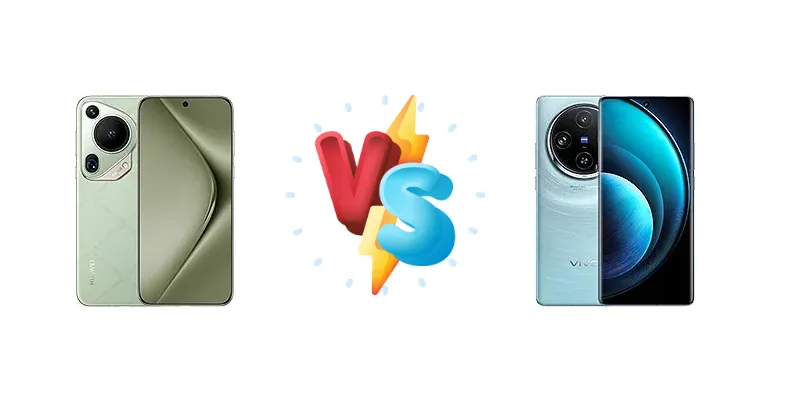
|
🏆 Quick Verdict
For the average user prioritizing all-around performance and battery life, the vivo X100 Pro emerges as the stronger contender. Its Dimensity 9300 chipset and superior battery endurance provide a smoother, longer-lasting experience. However, the Pura 70 Ultra’s camera system offers a unique photographic style that may appeal to enthusiasts.
| PHONES | ||
|---|---|---|
| Phone Names | Huawei Pura 70 Ultra | vivo X100 Pro |
| Network | ||
|---|---|---|
| 2G bands | GSM 850 / 900 / 1800 / 1900 | GSM 850 / 900 / 1800 / 1900 |
| 3G bands | HSDPA 800 / 850 / 900 / 1700(AWS) / 1900 / 2100 | HSDPA 800 / 850 / 900 / 1700(AWS) / 1900 / 2100 |
| 4G bands | 1, 2, 3, 4, 5, 6, 7, 8, 9, 12, 17, 18, 19, 20, 26, 28, 34, 38, 39, 40, 41, 42 | 1, 2, 3, 4, 5, 7, 8, 12, 17, 18, 19, 20, 26, 28, 32, 38, 39, 40, 41, 42, 66 - International |
| 5G bands | SA/NSA - China only | 1, 3, 5, 7, 8, 20, 28, 38, 40, 41, 66, 75, 77, 78, 79 SA/NSA - International |
| Speed | HSPA, LTE, 5G | HSPA, LTE, 5G |
| Technology | GSM / CDMA / HSPA / CDMA2000 / LTE / 5G | GSM / CDMA / HSPA / LTE / 5G |
| Launch | ||
|---|---|---|
| Announced | 2024, April 18 | 2023, November 13 |
| Status | Available. Released 2024, April 29 | Available. Released 2023, November 21 |
| Body | ||
|---|---|---|
| Build | Glass front, aluminum frame, silicone polymer back (eco leather) | Glass front, aluminum frame, glass back |
| Dimensions | 162.6 x 75.1 x 8.4 mm (6.40 x 2.96 x 0.33 in) | 164.1 x 75.3 x 8.9 mm or 9.1 mm |
| SIM | Nano-SIM + Nano-SIM | · Nano-SIM + eSIM· Nano-SIM + Nano-SIM |
| Weight | 226 g (7.97 oz) | 221 g or 225 g (7.80 oz) |
| Display | ||
|---|---|---|
| Protection | Kunlun Glass (Basalt-tempered) | - |
| Resolution | 1260 x 2844 pixels (~460 ppi density) | 1260 x 2800 pixels, 20:9 ratio (~452 ppi density) |
| Size | 6.8 inches, 109.0 cm2 (~89.3% screen-to-body ratio) | 6.78 inches, 111.5 cm2 (~90.2% screen-to-body ratio) |
| Type | LTPO OLED, 1B colors, HDR, 120Hz, 1440Hz PWM, 2500 nits (peak) | LTPO AMOLED, 1B colors, 120Hz, HDR10+, 3000 nits (peak) |
| Platform | ||
|---|---|---|
| CPU | Octa-core (1x2.3 GHz Taishan Big & 3x2.18 GHz Taishan Mid & 4x1.55 GHz Cortex-A510) | Octa-core (1x3.25 GHz Cortex-X4 & 3x2.85 GHz Cortex-X4 & 4x2.0 GHz Cortex-A720) |
| Chipset | Kirin 9010 (7 nm) | Mediatek Dimensity 9300 (4 nm) |
| GPU | - | Immortalis-G720 MC12 |
| OS | EMUI 14.2 (International), HarmonyOS 4.2 (China) | Android 14, upgradable to Android 15, Funtouch 15 (International), OriginOS 4 (China) |
| Memory | ||
|---|---|---|
| Card slot | No | No |
| Internal | 512GB 12GB RAM, 512GB 16GB RAM, 1TB 16GB RAM | 256GB 12GB RAM, 256GB 16GB RAM, 512GB 16GB RAM, 1TB 16GB RAM |
| Main Camera | ||
|---|---|---|
| Features | Laser AF, color spectrum sensor, LED flash, panorama, HDR | Laser AF, color spectrum sensor, Zeiss optics, Zeiss T* lens coating, LED flash, panorama, HDR, 3D LUT import |
| Triple | 50 MP, f/1.6-4.0, 23mm (wide), 1.0"-type, dual pixel PDAF, sensor-shift OIS, retractable lens 50 MP, f/2.1, 90mm (telephoto), PDAF (5cm - ∞), OIS, 3.5x optical zoom 40 MP, f/2.2, 13mm (ultrawide), AF | 50 MP, f/1.8, 23mm (wide), 1/0.98", 1.6µm, dual pixel PDAF, OIS 50 MP, f/2.5, 100mm (periscope telephoto), 1/2.51", 0.7µm, PDAF (18cm - ∞), OIS, 4.3x optical zoom 50 MP, f/2.0, 15mm, 119˚ (ultrawide), 1/2.76", 0.64µm, AF |
| Video | 4K, 1080p, HDR, gyro-EIS, OIS | 8K@30fps, 4K@30/60fps, 1080p, gyro-EIS |
| Selfie camera | ||
|---|---|---|
| Features | HDR, panorama | HDR |
| Single | 13 MP, f/2.4, (ultrawide), AF | 32 MP, f/2.0, 20mm (ultrawide) |
| Video | Yes, HDR | 4K@30/60fps, 1080p@30/60fps |
| Sound | ||
|---|---|---|
| 35mm jack | No | No |
| Loudspeaker | Yes, with stereo speakers | Yes, with stereo speakers |
| Comms | ||
|---|---|---|
| Bluetooth | 5.2, A2DP, LE, L2HC | 5.4, A2DP, LE, aptX HD, LHDC |
| Infrared port | Yes | Yes |
| NFC | Yes | Yes |
| Positioning | GPS (L1+L5), GLONASS (L1), BDS (B1I+B1c+B2a+B2b), GALILEO (E1+E5a+E5b), QZSS (L1+L5), NavIC | GPS (L1+L5), GLONASS (L1), BDS (B1I+B1c+B2a+B2b), GALILEO (E1+E5a+E5b), QZSS (L1+L5), NavIC (L5) |
| Radio | No | No |
| USB | USB Type-C 3.1, OTG, DisplayPort 1.2 | USB Type-C 3.2, OTG |
| WLAN | Wi-Fi 802.11 a/b/g/n/ac/6, dual-band, Wi-Fi Direct | Wi-Fi 802.11 a/b/g/n/ac/6/7, tri-band, Wi-Fi Direct |
| Features | ||
|---|---|---|
| Sensors | Fingerprint (under display, optical), accelerometer, proximity, gyro, compass | Fingerprint (under display, optical), accelerometer, gyro, proximity, compass |
| Battery | ||
|---|---|---|
| Charging | 100W wired 80W wireless 20W reverse wireless 18W reverse wired | 100W wired, 50% in 14 min 50W wireless Reverse wired |
| Type | Li-Po 5200 mAh | Li-Ion 5400 mAh |
| Misc | ||
|---|---|---|
| Colors | Black, White, Brown, Green | Startrail Blue, Asteroid Black, Sunset Orange, White |
| Models | HBP-LX9, HBP-AL00 | V2324A, V2309 |
| Price | € 1,239.99 | ₹ 59,999 |
| SAR EU | - | 0.99 W/kg (head) 1.19 W/kg (body) |
Huawei Pura 70 Ultra
- Unique camera processing style
- Fast 80W wireless charging
- Reverse wired charging capability
- Less powerful chipset compared to Dimensity 9300
- Shorter battery life in active use
vivo X100 Pro
- Superior performance with Dimensity 9300
- Longer battery life
- Faster wired charging (claimed 50% in 14 min)
- Less versatile charging options (no 20W reverse wired)
- Potentially less distinctive camera aesthetic
Display Comparison
The vivo X100 Pro boasts a significantly brighter display, reaching 1472 nits compared to the Pura 70 Ultra’s 1231 nits. This translates to better visibility under direct sunlight. While both likely utilize LTPO technology for adaptive refresh rates (though not explicitly stated), the X100 Pro’s higher peak brightness is a clear advantage for outdoor use. The Pura 70 Ultra’s display, while still excellent, falls behind in sheer luminance.
Camera Comparison
While both phones are expected to have excellent camera systems, the available data focuses on the overall capability rather than specific sensor details. The Pura 70 Ultra’s camera is likely to emphasize Huawei’s signature computational photography style, known for its vibrant colors and aggressive sharpening. The X100 Pro, while also employing advanced image processing, may lean towards a more natural look. Without detailed sensor size information, it’s difficult to definitively declare a winner, but the Pura 70 Ultra’s marketing heavily emphasizes its camera prowess, suggesting a strong focus on image quality and unique features.
Performance
The core difference lies in the chipsets. The vivo X100 Pro’s MediaTek Dimensity 9300, fabricated on a 4nm process, offers a substantial architectural advantage over the Huawei Pura 70 Ultra’s 7nm Kirin 9010. The Dimensity 9300’s Cortex-X4 prime core clocked at 3.25 GHz, combined with its three additional Cortex-X4 cores, provides a significant performance uplift in CPU-intensive tasks. The Kirin 9010’s Taishan cores, while capable, are less efficient and offer lower peak performance. This difference will be most noticeable in demanding games and video editing. The X100 Pro also benefits from potentially faster LPDDR5x RAM, further enhancing responsiveness.
Battery Life
The vivo X100 Pro demonstrates a clear advantage in battery endurance, achieving an active use score of 13:53h compared to the Pura 70 Ultra’s 12:29h. This nearly 1 hour and 24 minute difference is significant for all-day users. Both support 100W wired charging, but the X100 Pro claims a 50% charge in just 14 minutes, suggesting a faster charging curve. The Pura 70 Ultra also offers 80W wireless and 20W reverse wireless charging, providing greater versatility, while the X100 Pro offers 50W wireless and reverse wired charging.
Buying Guide
Buy the Huawei Pura 70 Ultra if you prioritize a distinctive camera experience with a focus on artistic image processing and are comfortable with the Huawei ecosystem. Buy the vivo X100 Pro if you demand top-tier performance for gaming and demanding applications, coupled with excellent battery life and faster charging speeds, and prefer a more mainstream Android experience.