
Huawei Pura 70 Ultra vs Samsung Galaxy S24 Ultra: A Deep Dive Comparison
| Phones Images | |||||
|---|---|---|---|---|---|
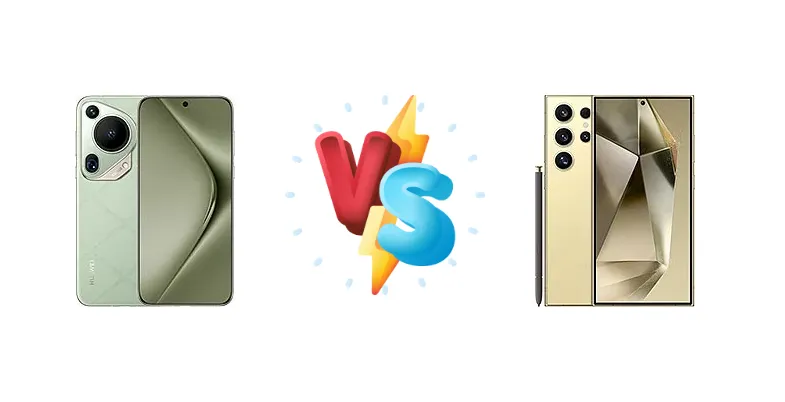
|
🏆 Quick Verdict
For the average user prioritizing all-around performance and ecosystem integration, the Samsung Galaxy S24 Ultra emerges as the stronger choice. Its Snapdragon 8 Gen 3 chipset delivers superior processing power and efficiency, coupled with a brighter display and slightly longer battery life. However, the Pura 70 Ultra’s 100W charging and unique design appeal to a specific audience.
| PHONES | ||
|---|---|---|
| Phone Names | Huawei Pura 70 Ultra | Samsung Galaxy S24 Ultra |
| Network | ||
|---|---|---|
| 2G bands | GSM 850 / 900 / 1800 / 1900 | GSM 850 / 900 / 1800 / 1900 |
| 3G bands | HSDPA 800 / 850 / 900 / 1700(AWS) / 1900 / 2100 | HSDPA 850 / 900 / 1700(AWS) / 1900 / 2100 |
| 4G bands | 1, 2, 3, 4, 5, 6, 7, 8, 9, 12, 17, 18, 19, 20, 26, 28, 34, 38, 39, 40, 41, 42 | 1, 2, 3, 4, 5, 7, 8, 12, 13, 17, 18, 19, 20, 25, 26, 28, 32, 38, 39, 40, 41, 66 - International |
| 5G bands | SA/NSA - China only | 1, 2, 3, 5, 7, 8, 12, 20, 25, 26, 28, 38, 40, 41, 66, 75, 77, 78 SA/NSA/Sub6 - International |
| Speed | HSPA, LTE, 5G | HSPA, LTE (up to 7CA), 5G |
| Technology | GSM / CDMA / HSPA / CDMA2000 / LTE / 5G | GSM / CDMA / HSPA / EVDO / LTE / 5G |
| Launch | ||
|---|---|---|
| Announced | 2024, April 18 | 2024, January 17 |
| Status | Available. Released 2024, April 29 | Available. Released 2024, January 24 |
| Body | ||
|---|---|---|
| Build | Glass front, aluminum frame, silicone polymer back (eco leather) | Glass front (Corning Gorilla Armor), glass back (Corning Gorilla Armor), titanium frame (grade 2) |
| Dimensions | 162.6 x 75.1 x 8.4 mm (6.40 x 2.96 x 0.33 in) | 162.3 x 79 x 8.6 mm (6.39 x 3.11 x 0.34 in) |
| SIM | Nano-SIM + Nano-SIM | · Nano-SIM + Nano-SIM + eSIM + eSIM (max 2 at a time) - INT· Nano-SIM + eSIM + eSIM (max 2 at a time) - USA· Nano-SIM + Nano-SIM - CN |
| Weight | 226 g (7.97 oz) | 232 g or 233 g (8.18 oz) |
| Display | ||
|---|---|---|
| Protection | Kunlun Glass (Basalt-tempered) | Corning Gorilla Armor |
| Resolution | 1260 x 2844 pixels (~460 ppi density) | 1440 x 3120 pixels, 19.5:9 ratio (~505 ppi density) |
| Size | 6.8 inches, 109.0 cm2 (~89.3% screen-to-body ratio) | 6.8 inches, 113.5 cm2 (~88.5% screen-to-body ratio) |
| Type | LTPO OLED, 1B colors, HDR, 120Hz, 1440Hz PWM, 2500 nits (peak) | Dynamic LTPO AMOLED 2X, 120Hz, HDR10+, 2600 nits (peak) |
| Platform | ||
|---|---|---|
| CPU | Octa-core (1x2.3 GHz Taishan Big & 3x2.18 GHz Taishan Mid & 4x1.55 GHz Cortex-A510) | 8-core (1x3.39GHz Cortex-X4 & 3x3.1GHz Cortex-A720 & 2x2.9GHz Cortex-A720 & 2x2.2GHz Cortex-A520) |
| Chipset | Kirin 9010 (7 nm) | Qualcomm SM8650-AC Snapdragon 8 Gen 3 (4 nm) |
| GPU | - | Adreno 750 (1 GHz) |
| OS | EMUI 14.2 (International), HarmonyOS 4.2 (China) | Android 14, up to 7 major Android upgrades, One UI 8.0 |
| Memory | ||
|---|---|---|
| Card slot | No | No |
| Internal | 512GB 12GB RAM, 512GB 16GB RAM, 1TB 16GB RAM | 256GB 12GB RAM, 512GB 12GB RAM, 1TB 12GB RAM |
| Main Camera | ||
|---|---|---|
| Features | Laser AF, color spectrum sensor, LED flash, panorama, HDR | Laser AF, LED flash, auto-HDR, panorama |
| Quad | - | 200 MP, f/1.7, 24mm (wide), 1/1.3", 0.6µm, multi-directional PDAF, OIS 10 MP, f/2.4, 67mm (telephoto), 1/3.52", 1.12µm, PDAF, OIS, 3x optical zoom 50 MP, f/3.4, 111mm (periscope telephoto), 1/2.52", 0.7µm, PDAF, OIS, 5x optical zoom 12 MP, f/2.2, 13mm, 120˚ (ultrawide), 1/2.55", 1.4µm, dual pixel PDAF, Super Steady video |
| Triple | 50 MP, f/1.6-4.0, 23mm (wide), 1.0"-type, dual pixel PDAF, sensor-shift OIS, retractable lens 50 MP, f/2.1, 90mm (telephoto), PDAF (5cm - ∞), OIS, 3.5x optical zoom 40 MP, f/2.2, 13mm (ultrawide), AF | - |
| Video | 4K, 1080p, HDR, gyro-EIS, OIS | 8K@24/30fps, 4K@30/60/120fps, 1080p@30/60/120/240fps, HDR10+, stereo sound rec., gyro-EIS |
| Selfie camera | ||
|---|---|---|
| Features | HDR, panorama | HDR, HDR10+ |
| Single | 13 MP, f/2.4, (ultrawide), AF | 12 MP, f/2.2, 26mm (wide), 1/3.2", 1.12µm, dual pixel PDAF |
| Video | Yes, HDR | 4K@30/60fps, 1080p@30fps |
| Sound | ||
|---|---|---|
| 35mm jack | No | No |
| Loudspeaker | Yes, with stereo speakers | Yes, with stereo speakers |
| Comms | ||
|---|---|---|
| Bluetooth | 5.2, A2DP, LE, L2HC | 5.3, A2DP, LE |
| Infrared port | Yes | - |
| NFC | Yes | Yes |
| Positioning | GPS (L1+L5), GLONASS (L1), BDS (B1I+B1c+B2a+B2b), GALILEO (E1+E5a+E5b), QZSS (L1+L5), NavIC | GPS, GLONASS, BDS, GALILEO, QZSS |
| Radio | No | No |
| USB | USB Type-C 3.1, OTG, DisplayPort 1.2 | USB Type-C 3.2, DisplayPort 1.2, OTG |
| WLAN | Wi-Fi 802.11 a/b/g/n/ac/6, dual-band, Wi-Fi Direct | Wi-Fi 802.11 a/b/g/n/ac/6e/7, tri-band, Wi-Fi Direct |
| Features | ||
|---|---|---|
| Sensors | Fingerprint (under display, optical), accelerometer, proximity, gyro, compass | Fingerprint (under display, ultrasonic), accelerometer, gyro, proximity, compass, barometer |
| Battery | ||
|---|---|---|
| Charging | 100W wired 80W wireless 20W reverse wireless 18W reverse wired | 45W wired, PD3.0, 65% in 30 min 15W wireless (Qi) 4.5W reverse wireless |
| Type | Li-Po 5200 mAh | Li-Ion 5000 mAh |
| Misc | ||
|---|---|---|
| Colors | Black, White, Brown, Green | Titanium Black, Titanium Gray, Titanium Violet, Titanium Yellow, Titanium Blue, Titanium Green, Titanium Orange |
| Models | HBP-LX9, HBP-AL00 | SM-S928B, SM-S928B/DS, SM-S928U, SM-S928U1, SM-S928W, SM-S928N, SM-S9280, SM-S928E, SM-S928E/DS |
| Price | € 1,239.99 | $ 514.94 / C$ 929.99 / £ 630.00 / € 658.53 / ₹ 84,999 |
| SAR | - | 1.26 W/kg (head) 0.62 W/kg (body) |
| SAR EU | - | 1.06 W/kg (head) 1.30 W/kg (body) |
Huawei Pura 70 Ultra
- Incredibly fast 100W wired charging
- 80W wireless charging offers convenience
- Unique and distinctive design language
- Kirin 9010 chipset is less powerful than Snapdragon 8 Gen 3
- Display brightness is lower than the S24 Ultra
Samsung Galaxy S24 Ultra
- Snapdragon 8 Gen 3 delivers superior performance
- Brighter and more color-accurate display
- Longer battery life during active use
- Slower charging speeds compared to Pura 70 Ultra
- Less innovative charging technology
Display Comparison
The Samsung Galaxy S24 Ultra boasts a significantly brighter display, reaching 1447 nits measured, compared to the Huawei Pura 70 Ultra’s 1231 nits. This translates to better visibility under direct sunlight. While both likely utilize LTPO technology for adaptive refresh rates, Samsung’s panel benefits from its higher peak brightness and potentially superior color calibration. The impact is most noticeable for users who frequently consume HDR content or work outdoors.
Camera Comparison
While detailed camera analysis requires sample images, the hardware specifications suggest a slight edge for the S24 Ultra. The larger sensor size (assumed, based on Samsung’s history with Ultra models) combined with advanced image processing algorithms likely results in better low-light performance and dynamic range. The Pura 70 Ultra’s camera system is undoubtedly sophisticated, but the Snapdragon’s ISP (Image Signal Processor) is generally considered best-in-class for computational photography. The absence of detailed camera specs for the Pura 70 Ultra makes a definitive comparison difficult, but Samsung’s established camera prowess is a significant factor.
Performance
The core of the performance difference lies in the chipsets. The Samsung Galaxy S24 Ultra’s Snapdragon 8 Gen 3 (4nm) utilizes a more advanced fabrication process than the Huawei Pura 70 Ultra’s Kirin 9010 (7nm). This 4nm process provides better thermal efficiency, reducing throttling during sustained workloads. The Snapdragon’s CPU configuration – a 1x3.39GHz Cortex-X4 prime core – is also architecturally superior to the Kirin’s 1x2.3 GHz Taishan Big core, resulting in faster single-core performance. While the Kirin 9010 is a capable chip, the Snapdragon 8 Gen 3 offers a clear advantage for demanding tasks and gaming.
Battery Life
The Samsung Galaxy S24 Ultra edges out the Huawei Pura 70 Ultra in battery life, achieving 13:49 hours of active use compared to the Pura 70 Ultra’s 12:29 hours. This difference, while not massive, is noticeable for heavy users. However, the Pura 70 Ultra compensates with significantly faster charging speeds: 100W wired, 80W wireless, and even 20W reverse wireless, compared to the S24 Ultra’s 45W wired and 15W wireless. This means the Pura 70 Ultra can replenish its battery much faster, minimizing downtime.
Buying Guide
Buy the Huawei Pura 70 Ultra if you prioritize exceptionally fast charging (100W wired, 80W wireless) and a distinctive design aesthetic, and are comfortable operating within Huawei’s ecosystem. Buy the Samsung Galaxy S24 Ultra if you demand the highest sustained performance for demanding tasks like gaming and video editing, a brighter and more color-accurate display, and seamless integration with the broader Android and Samsung ecosystem.