
Huawei Pura 70 Ultra vs. iPhone 15 Pro Max: A Deep Dive into Flagship Power
| Phones Images | |||||
|---|---|---|---|---|---|
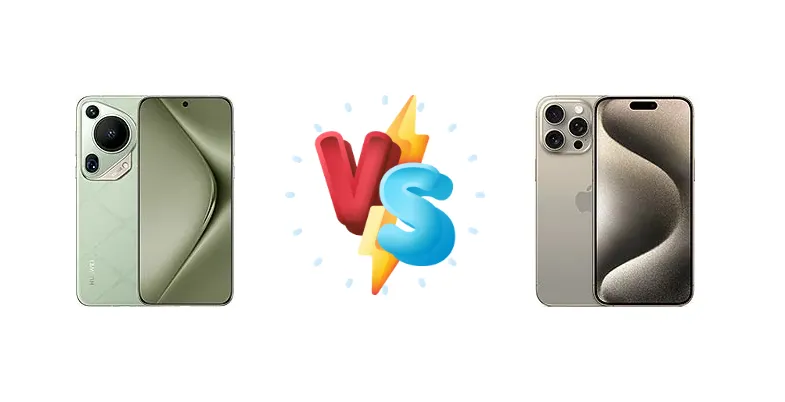
|
🏆 Quick Verdict
For the average user prioritizing longevity and a polished ecosystem, the iPhone 15 Pro Max wins out, thanks to its superior battery life (16:01h active use) and the efficiency of the A17 Pro. However, the Pura 70 Ultra’s blazing-fast 100W charging and impressive display brightness offer compelling advantages for power users.
| PHONES | ||
|---|---|---|
| Phone Names | Huawei Pura 70 Ultra | Apple iPhone 15 Pro Max |
| Network | ||
|---|---|---|
| 2G bands | GSM 850 / 900 / 1800 / 1900 | GSM 850 / 900 / 1800 / 1900 |
| 3G bands | HSDPA 800 / 850 / 900 / 1700(AWS) / 1900 / 2100 | HSDPA 850 / 900 / 1700(AWS) / 1900 / 2100 |
| 4G bands | 1, 2, 3, 4, 5, 6, 7, 8, 9, 12, 17, 18, 19, 20, 26, 28, 34, 38, 39, 40, 41, 42 | 1, 2, 3, 4, 5, 7, 8, 12, 13, 17, 18, 19, 20, 25, 26, 28, 30, 32, 34, 38, 39, 40, 41, 42, 46, 48, 53, 66 - A3106 |
| 5G bands | SA/NSA - China only | 1, 2, 3, 5, 7, 8, 12, 20, 25, 26, 28, 30, 38, 40, 41, 48, 53, 66, 70, 77, 78, 79 SA/NSA/Sub6 - A3106 |
| Speed | HSPA, LTE, 5G | HSPA, LTE, 5G, EV-DO Rev.A 3.1 Mbps |
| Technology | GSM / CDMA / HSPA / CDMA2000 / LTE / 5G | GSM / CDMA / HSPA / EVDO / LTE / 5G |
| Launch | ||
|---|---|---|
| Announced | 2024, April 18 | 2023, September 12 |
| Status | Available. Released 2024, April 29 | Available. Released 2023, September 22 |
| Body | ||
|---|---|---|
| Build | Glass front, aluminum frame, silicone polymer back (eco leather) | Glass front, glass back, titanium frame (grade 5) |
| Dimensions | 162.6 x 75.1 x 8.4 mm (6.40 x 2.96 x 0.33 in) | 159.9 x 76.7 x 8.3 mm (6.30 x 3.02 x 0.33 in) |
| SIM | Nano-SIM + Nano-SIM | · Nano-SIM + eSIM + eSIM (max 2 at a time; International)· eSIM + eSIM (8 or more, max 2 at a time; USA)· Nano-SIM + Nano-SIM (China) |
| Weight | 226 g (7.97 oz) | 221 g (7.80 oz) |
| Display | ||
|---|---|---|
| Protection | Kunlun Glass (Basalt-tempered) | Ceramic Shield glass |
| Resolution | 1260 x 2844 pixels (~460 ppi density) | 1290 x 2796 pixels, 19.5:9 ratio (~460 ppi density) |
| Size | 6.8 inches, 109.0 cm2 (~89.3% screen-to-body ratio) | 6.7 inches, 110.2 cm2 (~89.8% screen-to-body ratio) |
| Type | LTPO OLED, 1B colors, HDR, 120Hz, 1440Hz PWM, 2500 nits (peak) | LTPO Super Retina XDR OLED, 120Hz, HDR10, Dolby Vision, 1000 nits (typ), 2000 nits (HBM) |
| Platform | ||
|---|---|---|
| CPU | Octa-core (1x2.3 GHz Taishan Big & 3x2.18 GHz Taishan Mid & 4x1.55 GHz Cortex-A510) | Hexa-core (2x3.78 GHz + 4x2.11 GHz) |
| Chipset | Kirin 9010 (7 nm) | Apple A17 Pro (3 nm) |
| GPU | - | Apple GPU (6-core graphics) |
| OS | EMUI 14.2 (International), HarmonyOS 4.2 (China) | iOS 17, upgradable to iOS 26.1 |
| Memory | ||
|---|---|---|
| Card slot | No | No |
| Internal | 512GB 12GB RAM, 512GB 16GB RAM, 1TB 16GB RAM | 256GB 8GB RAM, 512GB 8GB RAM, 1TB 8GB RAM |
| Main Camera | ||
|---|---|---|
| Features | Laser AF, color spectrum sensor, LED flash, panorama, HDR | Dual-LED dual-tone flash, HDR (photo/panorama) |
| Triple | 50 MP, f/1.6-4.0, 23mm (wide), 1.0"-type, dual pixel PDAF, sensor-shift OIS, retractable lens 50 MP, f/2.1, 90mm (telephoto), PDAF (5cm - ∞), OIS, 3.5x optical zoom 40 MP, f/2.2, 13mm (ultrawide), AF | 48 MP, f/1.8, 24mm (wide), 1/1.28", 1.22µm, dual pixel PDAF, sensor-shift OIS 12 MP, f/2.8, 120mm (periscope telephoto), 1/3.06", 1.12µm, dual pixel PDAF, 3D sensor‑shift OIS, 5x optical zoom 12 MP, f/2.2, 13mm, 120˚ (ultrawide), 1/2.55", 1.4µm, dual pixel PDAF TOF 3D LiDAR scanner (depth) |
| Video | 4K, 1080p, HDR, gyro-EIS, OIS | 4K@24/25/30/60fps, 1080p@25/30/60/120/240fps, 10-bit HDR, Dolby Vision HDR (up to 60fps), ProRes, 3D (spatial) video, stereo sound rec. |
| Selfie camera | ||
|---|---|---|
| Features | HDR, panorama | HDR, Dolby Vision HDR |
| Single | 13 MP, f/2.4, (ultrawide), AF | 12 MP, f/1.9, 23mm (wide), 1/3.6", 1.0µm, PDAF, OIS SL 3D, (depth/biometrics sensor) |
| Video | Yes, HDR | 4K@24/25/30/60fps, 1080p@25/30/60/120fps, gyro-EIS |
| Sound | ||
|---|---|---|
| 35mm jack | No | No |
| Loudspeaker | Yes, with stereo speakers | Yes, with stereo speakers |
| Comms | ||
|---|---|---|
| Bluetooth | 5.2, A2DP, LE, L2HC | 5.3, A2DP, LE |
| Infrared port | Yes | - |
| NFC | Yes | Yes |
| Positioning | GPS (L1+L5), GLONASS (L1), BDS (B1I+B1c+B2a+B2b), GALILEO (E1+E5a+E5b), QZSS (L1+L5), NavIC | GPS (L1+L5), GLONASS, GALILEO, BDS, QZSS, NavIC |
| Radio | No | No |
| USB | USB Type-C 3.1, OTG, DisplayPort 1.2 | USB Type-C 3.2 Gen 2, DisplayPort |
| WLAN | Wi-Fi 802.11 a/b/g/n/ac/6, dual-band, Wi-Fi Direct | Wi-Fi 802.11 a/b/g/n/ac/6e, tri-band, hotspot |
| Features | ||
|---|---|---|
| Sensors | Fingerprint (under display, optical), accelerometer, proximity, gyro, compass | Face ID, accelerometer, gyro, proximity, compass, barometer |
| Battery | ||
|---|---|---|
| Charging | 100W wired 80W wireless 20W reverse wireless 18W reverse wired | Wired, PD2.0, 50% in 30 min 15W wireless (MagSafe) 15W wireless (Qi2) - requires iOS 17.2 update 4.5W reverse wired |
| Type | Li-Po 5200 mAh | Li-Ion 4441 mAh |
| Misc | ||
|---|---|---|
| Colors | Black, White, Brown, Green | Black Titanium, White Titanium, Blue Titanium, Natural Titanium |
| Models | HBP-LX9, HBP-AL00 | A2849, A3105, A3106, A3108, iPhone16,2 |
| Price | € 1,239.99 | € 758.79 / $ 579.87 / £ 628.29 |
| SAR | - | 1.07 W/kg (head) 1.11 W/kg (body) |
| SAR EU | - | 0.98 W/kg (head) 0.98 W/kg (body) |
Huawei Pura 70 Ultra
- Blazing-fast 100W wired charging
- Impressive 80W wireless charging
- High display brightness (1231 nits)
- Potentially innovative camera processing
- Shorter battery life (12:29h active use)
- 7nm chipset may throttle under sustained load
- Ecosystem limitations compared to Apple
Apple iPhone 15 Pro Max
- Exceptional battery life (16:01h active use)
- Powerful and efficient A17 Pro chipset
- Brighter display (1787 nits)
- Seamless integration with Apple ecosystem
- Slower charging speeds (15W wireless, 4.5W reverse)
- Higher price point
- Less customizable software experience
Display Comparison
The iPhone 15 Pro Max boasts a significantly brighter display, reaching 1787 nits measured, compared to the Pura 70 Ultra’s 1231 nits. This translates to better visibility in direct sunlight. While both likely employ LTPO technology for adaptive refresh rates (not specified in data), the iPhone’s higher peak brightness is a clear advantage. The Pura 70 Ultra’s display, while still excellent, will appear less vibrant in challenging lighting conditions. The impact of panel technology (OLED vs. other) isn't specified, but both are expected to deliver excellent contrast ratios.
Camera Comparison
The provided data doesn’t offer granular camera details, but the focus should be on image processing philosophies. Apple typically aims for natural-looking images, while Huawei often employs more aggressive processing for vibrant, saturated results. The absence of sensor size information makes a direct comparison difficult, but the Pura 70 Ultra’s marketing emphasizes its camera capabilities, suggesting a strong focus on computational photography. Without further details, it’s difficult to assess low-light performance or video quality beyond general expectations for flagship devices.
Performance
The core architectural difference lies in the chipsets: Apple’s 3nm A17 Pro versus Huawei’s 7nm Kirin 9010. The A17 Pro’s hexa-core configuration (2x3.78 GHz + 4x2.11 GHz) prioritizes peak performance, while the Kirin 9010’s octa-core setup (1x2.3 GHz Taishan Big & 3x2.18 GHz Taishan Mid & 4x1.55 GHz Cortex-A510) aims for a balance of power and efficiency. The smaller process node of the A17 Pro inherently offers better thermal efficiency, potentially leading to less throttling during sustained workloads. While raw clock speeds don't tell the whole story, the A17 Pro is expected to deliver superior GPU performance, crucial for gaming and demanding applications.
Battery Life
The iPhone 15 Pro Max demonstrably outperforms the Pura 70 Ultra in battery endurance, achieving 16:01 hours of active use compared to the Pura 70 Ultra’s 12:29 hours. However, the Pura 70 Ultra compensates with significantly faster charging: 100W wired, 80W wireless, and even 20W reverse wireless. The iPhone 15 Pro Max offers 15W wireless charging (MagSafe/Qi2) and a slow 4.5W reverse wired. This means the Pura 70 Ultra can replenish its battery much quicker, mitigating the difference in overall capacity. The iPhone’s older endurance rating of 118h is less relevant than the active use score.
Buying Guide
Buy the Huawei Pura 70 Ultra if you need exceptionally fast charging, prioritize display brightness, and are comfortable within the Huawei ecosystem. Its 100W wired and 80W wireless charging are unmatched. Buy the Apple iPhone 15 Pro Max if you value long-term software support, seamless integration with other Apple devices, and consistently excellent battery endurance, even if charging speeds are comparatively slower.