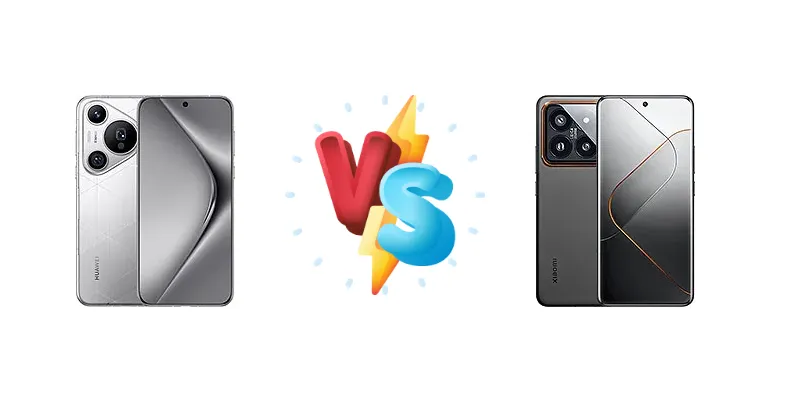
The Huawei Pura 70 Pro+ and the Xiaomi 14 Pro represent the pinnacle of Android smartphone technology, but they approach it from different angles. The Pura 70 Pro+, constrained by geopolitical factors, relies on its in-house Kirin 9010 chipset, while the Xiaomi 14 Pro leverages the cutting-edge Qualcomm Snapdragon 8 Gen 3. This comparison dissects their strengths and weaknesses to determine which device delivers the best overall experience.
🏆 Quick Verdict
For most users, the Xiaomi 14 Pro emerges as the stronger contender. The Snapdragon 8 Gen 3’s 4nm process provides superior power efficiency and sustained performance, crucial for demanding tasks and gaming. While the Pura 70 Pro+ boasts impressive charging speeds, the 14 Pro’s overall package is more compelling.
| Network |
|---|
| 2G bands | GSM 850 / 900 / 1800 / 1900 | GSM 850 / 900 / 1800 / 1900 |
| 3G bands | HSDPA 850 / 900 / 1700(AWS) / 1900 / 2100 | HSDPA 800 / 850 / 900 / 1700(AWS) / 1900 / 2100 |
| 4G bands | LTE | 1, 3, 4, 5, 7, 8, 18, 19, 26, 28, 34, 38, 39, 40, 41, 42, 48, 66 |
| 5G bands | SA/NSA | 1, 3, 5, 7, 8, 28, 38, 40, 41, 48, 66, 77, 78, 79 SA/NSA |
| Speed | HSPA, LTE, 5G | HSPA, LTE, 5G |
| Technology | GSM / CDMA / HSPA / CDMA2000 / LTE / 5G | GSM / CDMA / HSPA / CDMA2000 / LTE / 5G |
| Launch |
|---|
| Announced | 2024, April 18 | 2023, October 26 |
| Status | Available. Released 2024, April 29 | Available. Released 2023, November 01 |
| Body |
|---|
| Build | Glass front, aluminum frame, silicone polymer back (eco leather) | Glass front, aluminum frame or titanium frame, glass back |
| Dimensions | 162.6 x 75.1 x 8.4 mm (6.40 x 2.96 x 0.33 in) | 161.4 x 75.3 x 8.5 mm |
| SIM | Nano-SIM + Nano-SIM | Nano-SIM + Nano-SIM |
| Weight | 220 g (7.76 oz) | 223 g or 230 g (7.87 oz) |
| Display |
|---|
| Protection | Kunlun Glass (Xuanwu tempered) | Shatterproof glass |
| Resolution | 1260 x 2844 pixels (~460 ppi density) | 1440 x 3200 pixels, 20:9 ratio (~522 ppi density) |
| Size | 6.8 inches, 109.0 cm2 (~89.3% screen-to-body ratio) | 6.73 inches, 108.9 cm2 (~89.6% screen-to-body ratio) |
| Type | LTPO OLED, 1B colors, HDR, 120Hz, 1440Hz PWM, 2500 nits (peak) | LTPO AMOLED, 68B colors, 120Hz, Dolby Vision, HDR10+, 3000 nits (peak) |
| Platform |
|---|
| CPU | Octa-core (1x2.3 GHz Taishan Big & 3x2.18 GHz Taishan Mid & 4x1.55 GHz Cortex-A510) | Octa-core (1x3.3 GHz Cortex-X4 & 3x3.2 GHz Cortex-A720 & 2x3.0 GHz Cortex-A720 & 2x2.3 GHz Cortex-A520) |
| Chipset | Kirin 9010 (7 nm) | Qualcomm SM8650-AB Snapdragon 8 Gen 3 (4 nm) |
| GPU | - | Adreno 750 |
| OS | HarmonyOS 4.2 | Android 14, HyperOS |
| Memory |
|---|
| Card slot | No | No |
| Internal | 512GB 16GB RAM, 1TB 16GB RAM | 256GB 12GB RAM, 512GB 16GB RAM, 1TB 16GB RAM |
| Main Camera |
|---|
| Features | Laser AF, color spectrum sensor, LED flash, panorama, HDR | Laser AF, color spectrum sensor, Leica lens, Dual-LED dual-tone flash, HDR, panorama |
| Triple | 50 MP, f/1.4-4.0, 25mm (wide), 1/1.3", PDAF, OIS
48 MP, f/2.1, 93mm (telephoto), PDAF (5cm - ∞), OIS, 3.5x optical zoom
12.5 MP, f/2.2, 13mm (ultrawide) | 50 MP, f/1.4-f/4.0, 23mm (wide), 1/1.31", 1.2µm, dual pixel PDAF, OIS
50 MP, f/2.0, 75mm (telephoto), PDAF (10cm - ∞), OIS, 3.2x optical zoom
50 MP, f/2.2, 14mm, 115˚ (ultrawide), AF |
| Video | 4K, 1080p, HDR, gyro-EIS, OIS | 8K@24fps (HDR), 4K@24/30/60fps (HDR10+, 10-bit Dolby Vision HDR, 10-bit LOG), 1080p@30/60/120/240/960fps, 720p@1920fps, gyro-EIS |
| Selfie camera |
|---|
| Features | HDR, panorama | HDR, panorama |
| Single | 13 MP, f/2.4, (ultrawide), AF | 32 MP, f/2.0, 22mm (wide), 0.7µm |
| Video | Yes, HDR | 4K@30/60fps, 1080p@30/60fps, gyro-EIS |
| Sound |
|---|
| 35mm jack | No | No |
| Loudspeaker | Yes, with stereo speakers | Yes, with stereo speakers |
| Comms |
|---|
| Bluetooth | 5.2, A2DP, LE, L2HC | 5.4, A2DP, LE, aptX HD, aptX Adaptive |
| Infrared port | Yes | Yes |
| NFC | Yes | Yes |
| Positioning | GPS (L1+L5), GLONASS (L1), BDS (B1I+B1c+B2a+B2b), GALILEO (E1+E5a+E5b), QZSS (L1+L5), NavIC | GPS (L1+L5), GLONASS (G1), BDS (B1I+B1c+B2a), GALILEO (E1+E5a), QZSS (L1+L5), NavIC (L5) |
| Radio | No | No |
| USB | USB Type-C 3.1, OTG, DisplayPort 1.2 | USB Type-C 3.2 Gen 2, OTG |
| WLAN | Wi-Fi 802.11 a/b/g/n/ac/6, dual-band, Wi-Fi Direct | Wi-Fi 802.11 a/b/g/n/ac/6e/7, dual-band, Wi-Fi Direct |
| Features |
|---|
| Sensors | Fingerprint (under display, optical), accelerometer, proximity, gyro, compass | Fingerprint (under display, optical), accelerometer, proximity, gyro, compass, barometer |
| Battery |
|---|
| Charging | 100W wired
80W wireless
20W reverse wireless
18W reverse wired | 120W wired, PD3.0, QC4, 100% in 18 min
50W wireless, 100% in 40 min
10W reverse wireless |
| Type | Li-Po 5050 mAh | Li-Po 4880 mAh |
| Misc |
|---|
| Colors | Black, White, Silver | Black, Silver, Titanium, Green |
| Models | HBN-AL10, HBN-AL80 | 23116PN5BC |
| Price | About 1050 EUR | About 650 EUR |
Huawei Pura 70 Pro+
- Extremely fast 100W wired and 80W wireless charging
- Unique and potentially striking design language
- Strong Huawei ecosystem integration
- Kirin 9010 chipset is less efficient than Snapdragon 8 Gen 3
- Potential software limitations due to geopolitical constraints
- Limited global availability
Xiaomi 14 Pro
- Industry-leading Snapdragon 8 Gen 3 performance
- Excellent power efficiency and thermal management
- Globally accessible software and updates
- Wireless charging is slower than Pura 70 Pro+
- Design may be considered less distinctive
- Reverse wireless charging is limited to 10W
Display Comparison
While both devices likely feature high-quality OLED panels, specific details like peak brightness and color calibration are missing for the Pura 70 Pro+. The Xiaomi 14 Pro, typical of Xiaomi flagships, is expected to deliver exceptional brightness, potentially exceeding 3000 nits, for excellent outdoor visibility. The Snapdragon 8 Gen 3’s ISP also contributes to superior display processing. The Pura 70 Pro+’s display quality will likely be very good, but the 14 Pro has a clear advantage in expected peak performance.
Camera Comparison
Without detailed sensor specifications for the Pura 70 Pro+, a direct comparison is challenging. However, Huawei historically excels in computational photography. The Xiaomi 14 Pro is expected to feature a large 50MP main sensor with advanced OIS, capable of capturing detailed images in various lighting conditions. The Snapdragon 8 Gen 3’s ISP is a key enabler, offering improved image processing and low-light performance. The Pura 70 Pro+ will likely rely heavily on software algorithms to compensate for any hardware limitations, but the 14 Pro’s superior processing power gives it an edge in dynamic range and detail retention. We can assume both phones will have excellent camera systems, but the Xiaomi 14 Pro's hardware is more likely to deliver consistently high-quality results.
Performance
The core difference lies in the chipsets. The Xiaomi 14 Pro’s Snapdragon 8 Gen 3 (4nm) is a significant leap forward in efficiency compared to the Huawei Pura 70 Pro+’s Kirin 9010 (7nm). The Snapdragon’s Cortex-X4 prime core, clocked at 3.3 GHz, offers substantial performance gains over the Kirin’s Taishan architecture. The 4nm node translates to less heat generation under sustained load, minimizing throttling during extended gaming sessions. While the Kirin 9010 is a capable chip, the Snapdragon 8 Gen 3 provides a more future-proof and consistently powerful experience. The Xiaomi 14 Pro also benefits from faster LPDDR5x RAM, further enhancing responsiveness.
Battery Life
The Xiaomi 14 Pro’s 120W wired charging is significantly faster than the Pura 70 Pro+’s 100W, promising a full charge in approximately 18 minutes. The Pura 70 Pro+ compensates with 80W wireless charging, exceeding the 14 Pro’s 50W, and adds 20W reverse wireless charging. However, the Snapdragon 8 Gen 3’s superior efficiency means the Xiaomi 14 Pro will likely offer comparable or better real-world battery life despite potentially having a similar capacity battery. The faster wired charging of the 14 Pro is a significant convenience factor.
Buying Guide
Buy the Huawei Pura 70 Pro+ if you prioritize unique design aesthetics, are deeply embedded in the Huawei ecosystem, and value the fastest possible wired and wireless charging. Buy the Xiaomi 14 Pro if you demand top-tier performance, a consistently smooth user experience, and a more globally accessible software ecosystem. The 14 Pro is the better choice for gamers and power users.
Frequently Asked Questions
❓ Does the Kirin 9010 in the Pura 70 Pro+ suffer from significant thermal throttling during prolonged gaming sessions?
The Kirin 9010, built on a 7nm process, is more prone to thermal throttling compared to the Snapdragon 8 Gen 3’s 4nm architecture. While Huawei employs cooling solutions, expect performance to dip slightly during extended, graphically intensive gaming. The Snapdragon 8 Gen 3 in the Xiaomi 14 Pro will maintain higher sustained performance.
❓ How does the 80W wireless charging on the Pura 70 Pro+ compare to the 50W wireless charging on the Xiaomi 14 Pro in real-world usage?
The Pura 70 Pro+’s 80W wireless charging is considerably faster, reducing charging times by a significant margin. While 50W is still respectable, the Pura 70 Pro+ can top up its battery much more quickly wirelessly, offering a convenience advantage for users who frequently utilize wireless charging.
❓ Is the lack of Google Mobile Services (GMS) on the Pura 70 Pro+ a major limitation for users accustomed to Android's standard app ecosystem?
Yes, the absence of GMS is a significant consideration. While Huawei’s AppGallery has expanded, it still lacks some popular apps. Users may need to rely on workarounds to access Google services, which can be inconvenient and potentially compromise security.
❓ What kind of gaming performance can I expect from the Xiaomi 14 Pro, and does it support high refresh rates in popular titles like PUBG Mobile?
The Xiaomi 14 Pro, powered by the Snapdragon 8 Gen 3, delivers exceptional gaming performance. It should easily handle PUBG Mobile at maximum settings with high frame rates (90fps or higher), depending on the game's optimization. The Adreno 750 GPU provides ample graphical horsepower for a smooth and immersive gaming experience.