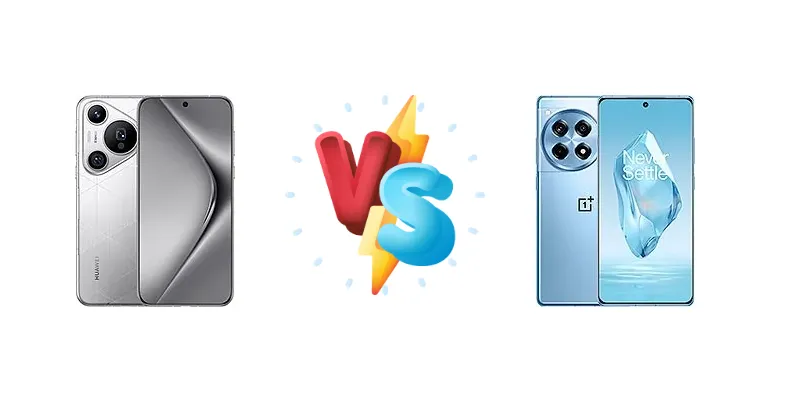
The Huawei Pura 70 Pro+ arrives with a focus on camera innovation and a proprietary Kirin chipset, while the OnePlus 12R aims to deliver flagship performance at a more accessible price point with the Snapdragon 8 Gen 2. This comparison dissects the core differences between these two Android contenders, focusing on performance, battery, and camera capabilities.
🏆 Quick Verdict
For the average user prioritizing raw performance and sustained gaming, the OnePlus 12R emerges as the stronger choice. Its Snapdragon 8 Gen 2, built on a 4nm process, offers superior efficiency and thermal management compared to the 7nm Kirin 9010. However, the Pura 70 Pro+’s advanced charging capabilities and potentially unique camera processing may appeal to specific users.
| Network |
|---|
| 2G bands | GSM 850 / 900 / 1800 / 1900 | GSM 850 / 900 / 1800 / 1900 |
| 3G bands | HSDPA 850 / 900 / 1700(AWS) / 1900 / 2100 | HSDPA 850 / 900 / 1700(AWS) / 1900 / 2100 |
| 4G bands | LTE | 1, 2, 3, 4, 5, 7, 8, 12, 17, 18, 19, 20, 26, 28, 32, 38, 39, 40, 41, 66 |
| 5G bands | SA/NSA | 1, 2, 3, 5, 7, 8, 12, 20, 28, 38, 40, 41, 66, 77, 78 SA/NSA |
| Speed | HSPA, LTE, 5G | HSPA, LTE, 5G |
| Technology | GSM / CDMA / HSPA / CDMA2000 / LTE / 5G | GSM / CDMA / HSPA / LTE / 5G |
| Launch |
|---|
| Announced | 2024, April 18 | 2024, January 23 |
| Status | Available. Released 2024, April 29 | Available. Released 2024, February 06 |
| Body |
|---|
| Build | Glass front, aluminum frame, silicone polymer back (eco leather) | Glass front (Gorilla Glass Victus 2), aluminum frame, glass back |
| Dimensions | 162.6 x 75.1 x 8.4 mm (6.40 x 2.96 x 0.33 in) | 163.3 x 75.3 x 8.8 mm (6.43 x 2.96 x 0.35 in) |
| SIM | Nano-SIM + Nano-SIM | · Nano-SIM + Nano-SIM + eSIM (max 2 at a time)· Nano-SIM + Nano-SIM |
| Weight | 220 g (7.76 oz) | 207 g (7.30 oz) |
| Display |
|---|
| Protection | Kunlun Glass (Xuanwu tempered) | Corning Gorilla Glass Victus 2 |
| Resolution | 1260 x 2844 pixels (~460 ppi density) | 1264 x 2780 pixels (~450 ppi density) |
| Size | 6.8 inches, 109.0 cm2 (~89.3% screen-to-body ratio) | 6.78 inches, 111.7 cm2 (~90.9% screen-to-body ratio) |
| Type | LTPO OLED, 1B colors, HDR, 120Hz, 1440Hz PWM, 2500 nits (peak) | LTPO4 AMOLED, 1B colors, 120Hz, HDR10+, Dolby Vision, 1600 nits (HBM), 4500 nits (peak) |
| Platform |
|---|
| CPU | Octa-core (1x2.3 GHz Taishan Big & 3x2.18 GHz Taishan Mid & 4x1.55 GHz Cortex-A510) | Octa-core (1x3.2 GHz Cortex-X3 & 2x2.8 GHz Cortex-A715 & 2x2.8 GHz Cortex-A710 & 3x2.0 GHz Cortex-A510) |
| Chipset | Kirin 9010 (7 nm) | Qualcomm SM8550-AB Snapdragon 8 Gen 2 (4 nm) |
| GPU | - | Adreno 740 |
| OS | HarmonyOS 4.2 | Android 14, up to 3 major Android upgrades, OxygenOS 15 |
| Memory |
|---|
| Card slot | No | No |
| Internal | 512GB 16GB RAM, 1TB 16GB RAM | 128GB 8GB RAM, 256GB 8GB RAM, 256GB 12GB RAM, 256GB 16GB RAM |
| Main Camera |
|---|
| Features | Laser AF, color spectrum sensor, LED flash, panorama, HDR | Laser AF, color spectrum sensor, LED flash, HDR, panorama |
| Triple | 50 MP, f/1.4-4.0, 25mm (wide), 1/1.3", PDAF, OIS
48 MP, f/2.1, 93mm (telephoto), PDAF (5cm - ∞), OIS, 3.5x optical zoom
12.5 MP, f/2.2, 13mm (ultrawide) | 50 MP, f/1.8, 24mm (wide), 1/1.56", 1.0µm, multi-directional PDAF, OIS
8 MP, f/2.2, 16mm, 112˚ (ultrawide), 1/4.0", 1.12µm
2 MP (macro) |
| Video | 4K, 1080p, HDR, gyro-EIS, OIS | 4K@30/60fps, 1080p@30/60/120/240fps, gyro-EIS, OIS |
| Selfie camera |
|---|
| Features | HDR, panorama | HDR, panorama |
| Single | 13 MP, f/2.4, (ultrawide), AF | 16 MP, f/2.4, 26mm (wide), 1/3", 1.0µm |
| Video | Yes, HDR | 1080p@30fps, gyro-EIS |
| Sound |
|---|
| 35mm jack | No | No |
| Loudspeaker | Yes, with stereo speakers | Yes, with stereo speakers |
| Comms |
|---|
| Bluetooth | 5.2, A2DP, LE, L2HC | 5.3, A2DP, LE, aptX HD |
| Infrared port | Yes | Yes |
| NFC | Yes | Yes |
| Positioning | GPS (L1+L5), GLONASS (L1), BDS (B1I+B1c+B2a+B2b), GALILEO (E1+E5a+E5b), QZSS (L1+L5), NavIC | GPS, GALILEO, GLONASS, BDS, QZSS |
| Radio | No | No |
| USB | USB Type-C 3.1, OTG, DisplayPort 1.2 | USB Type-C 2.0 |
| WLAN | Wi-Fi 802.11 a/b/g/n/ac/6, dual-band, Wi-Fi Direct | Wi-Fi 802.11 a/b/g/n/ac/6/7, dual-band |
| Features |
|---|
| Sensors | Fingerprint (under display, optical), accelerometer, proximity, gyro, compass | Fingerprint (under display, optical), accelerometer, gyro, proximity, compass |
| Battery |
|---|
| Charging | 100W wired
80W wireless
20W reverse wireless
18W reverse wired | 100W wired, 100% in 26 min |
| Type | Li-Po 5050 mAh | Li-Ion 5500 mAh |
| Misc |
|---|
| Colors | Black, White, Silver | Iron Gray, Cool Blue, Electric Violet, Sunset Dune |
| Models | HBN-AL10, HBN-AL80 | CPH2609, CPH2585, CPH2611 |
| Price | About 1050 EUR | € 410.84 / $ 399.95 / £ 649.00 |
| SAR | - | 1.19 W/kg (head) 0.82 W/kg (body) |
Huawei Pura 70 Pro+
- Industry-leading charging speeds (100W wired, 80W wireless)
- Potentially superior camera image processing
- Unique Huawei ecosystem features
- Kirin 9010 may throttle under sustained load
- Software ecosystem limitations due to geopolitical factors
OnePlus 12R
- Snapdragon 8 Gen 2 offers excellent performance and efficiency
- Long battery life (14:32h active use)
- Fast 100W wired charging
- Globally accessible software experience
- Camera image processing may not appeal to all users
- Lacks the advanced charging versatility of the Pura 70 Pro+
Display Comparison
The OnePlus 12R boasts a measured peak brightness of 1181 nits, ensuring excellent visibility even in direct sunlight. While the Pura 70 Pro+’s display specifications are not provided, Huawei typically employs high-quality OLED panels. The 12R’s panel is likely to benefit from the Snapdragon 8 Gen 2’s optimized display engine. Without knowing the Pura 70 Pro+'s refresh rate or panel technology (LTPO would be a significant advantage), the 12R currently holds an edge in confirmed display performance.
Camera Comparison
Without detailed camera specifications for the Pura 70 Pro+, it’s difficult to make a definitive comparison. However, Huawei has a strong reputation for computational photography. The Pura 70 Pro+ likely features a sophisticated image processing pipeline. The OnePlus 12R’s camera system, while capable, is unlikely to match Huawei’s expertise in this area. The absence of detailed sensor information for the Pura 70 Pro+ makes a direct sensor size comparison impossible, but larger sensors generally perform better in low light. The 12R’s image processing prioritizes natural colors, while Huawei often leans towards more vibrant, processed images.
Performance
The core difference lies in the chipsets. The OnePlus 12R’s Snapdragon 8 Gen 2 (4nm) utilizes a Cortex-X3 prime core clocked at 3.2GHz, alongside Cortex-A715 and A710 performance cores, and efficient A510 cores. This configuration, built on a smaller 4nm node, provides a significant advantage in power efficiency and sustained performance compared to the Huawei Pura 70 Pro+'s Kirin 9010 (7nm). The Kirin 9010’s Taishan architecture, while powerful, is likely to exhibit more thermal throttling under prolonged heavy loads. The 12R’s LPDDR5x RAM further contributes to faster data access and smoother multitasking.
Battery Life
The OnePlus 12R delivers an impressive 14 hours and 32 minutes of active use, demonstrating excellent battery life. The Pura 70 Pro+ offers a versatile charging solution with 100W wired, 80W wireless, and even 20W/18W reverse wireless/wired charging. While the Pura 70 Pro+'s battery capacity is unknown, the 12R’s longevity is a significant advantage. The 12R achieves a full charge in just 26 minutes with its 100W wired charging, rivaling the Pura 70 Pro+'s speed.
Buying Guide
Buy the Huawei Pura 70 Pro+ if you prioritize cutting-edge charging technology (100W wired and 80W wireless) and are invested in Huawei’s camera ecosystem, potentially valuing its distinct image processing style. Buy the OnePlus 12R if you demand consistent, high-end performance for gaming and everyday tasks, coupled with excellent battery life and a more globally accessible software experience.
Frequently Asked Questions
❓ Does the Kirin 9010 in the Pura 70 Pro+ overheat during extended gaming sessions?
The Kirin 9010, built on a 7nm process, is more prone to thermal throttling compared to the Snapdragon 8 Gen 2’s 4nm architecture. While Huawei employs cooling solutions, expect performance to decrease slightly during prolonged, graphically intensive gaming. The OnePlus 12R will likely maintain higher sustained performance.
❓ How does the OnePlus 12R's charging compare to the Pura 70 Pro+'s wireless charging capabilities?
The Pura 70 Pro+ offers 80W wireless charging, a significant advantage over the OnePlus 12R’s lack of wireless charging. However, the 12R’s 100W wired charging is incredibly fast, reaching 100% in just 26 minutes. The Pura 70 Pro+ also offers reverse wireless and wired charging, adding to its versatility.
❓ Is the difference in chipset architecture (Kirin vs Snapdragon) noticeable in everyday tasks?
For typical daily use like browsing, social media, and video streaming, the difference between the Kirin 9010 and Snapdragon 8 Gen 2 will be minimal. However, the Snapdragon 8 Gen 2’s superior efficiency will translate to slightly better battery life and smoother performance during demanding tasks like video editing or heavy multitasking.