
Huawei Pura 70 Pro vs vivo X100 Pro: Which Flagship Takes the Crown?
| Phones Images | |||||
|---|---|---|---|---|---|
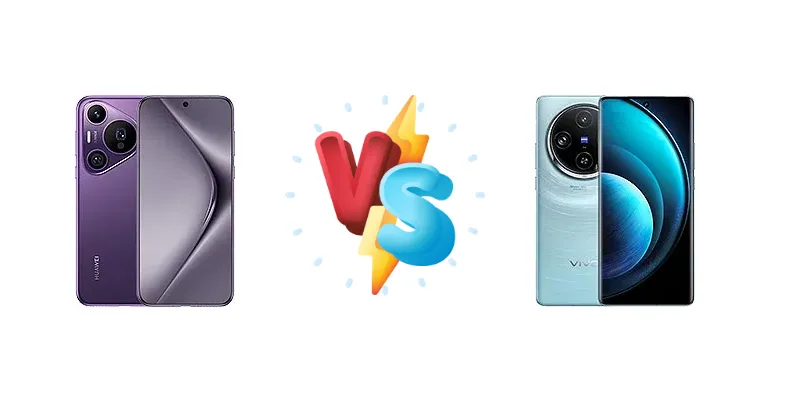
|
🏆 Quick Verdict
For the average user prioritizing sustained performance and a brighter display, the vivo X100 Pro emerges as the stronger contender. Its Dimensity 9300 chipset, built on a 4nm process, offers superior efficiency and power compared to the Pura 70 Pro’s 7nm Kirin 9010, translating to smoother multitasking and gaming. However, Huawei’s charging speeds are impressive.
| PHONES | ||
|---|---|---|
| Phone Names | Huawei Pura 70 Pro | vivo X100 Pro |
| Network | ||
|---|---|---|
| 2G bands | GSM 850 / 900 / 1800 / 1900 | GSM 850 / 900 / 1800 / 1900 |
| 3G bands | HSDPA 800 / 850 / 900 / 1700(AWS) / 1900 / 2100 | HSDPA 800 / 850 / 900 / 1700(AWS) / 1900 / 2100 |
| 4G bands | 1, 2, 3, 4, 5, 6, 7, 8, 9, 12, 13, 17, 18, 19, 20, 26, 28, 34, 38, 39, 40, 41, 42, 66 | 1, 2, 3, 4, 5, 7, 8, 12, 17, 18, 19, 20, 26, 28, 32, 38, 39, 40, 41, 42, 66 - International |
| 5G bands | SA/NSA - China only | 1, 3, 5, 7, 8, 20, 28, 38, 40, 41, 66, 75, 77, 78, 79 SA/NSA - International |
| Speed | HSPA, LTE, 5G | HSPA, LTE, 5G |
| Technology | GSM / CDMA / HSPA / CDMA2000 / LTE / 5G | GSM / CDMA / HSPA / LTE / 5G |
| Launch | ||
|---|---|---|
| Announced | 2024, April 18 | 2023, November 13 |
| Status | Available. Released 2024, April 29 | Available. Released 2023, November 21 |
| Body | ||
|---|---|---|
| Build | Glass front, aluminum frame, glass back | Glass front, aluminum frame, glass back |
| Dimensions | 162.6 x 75.1 x 8.4 mm (6.40 x 2.96 x 0.33 in) | 164.1 x 75.3 x 8.9 mm or 9.1 mm |
| SIM | · Nano-SIM + eSIM· Nano-SIM + Nano-SIM | · Nano-SIM + eSIM· Nano-SIM + Nano-SIM |
| Weight | 220 g (7.76 oz) | 221 g or 225 g (7.80 oz) |
| Display | ||
|---|---|---|
| Protection | Kunlun Glass 2 | - |
| Resolution | 1260 x 2844 pixels (~460 ppi density) | 1260 x 2800 pixels, 20:9 ratio (~452 ppi density) |
| Size | 6.8 inches, 109.0 cm2 (~89.3% screen-to-body ratio) | 6.78 inches, 111.5 cm2 (~90.2% screen-to-body ratio) |
| Type | LTPO OLED, 1B colors, HDR, 120Hz, 1440Hz PWM, 2500 nits (peak) | LTPO AMOLED, 1B colors, 120Hz, HDR10+, 3000 nits (peak) |
| Platform | ||
|---|---|---|
| CPU | Octa-core (1x2.3 GHz Taishan Big & 3x2.18 GHz Taishan Mid & 4x1.55 GHz Cortex-A510) | Octa-core (1x3.25 GHz Cortex-X4 & 3x2.85 GHz Cortex-X4 & 4x2.0 GHz Cortex-A720) |
| Chipset | Kirin 9010 (7 nm) | Mediatek Dimensity 9300 (4 nm) |
| GPU | - | Immortalis-G720 MC12 |
| OS | EMUI 14.2 (International), HarmonyOS 4.2 (China) | Android 14, upgradable to Android 15, Funtouch 15 (International), OriginOS 4 (China) |
| Memory | ||
|---|---|---|
| Card slot | No | No |
| Internal | 256GB 12GB RAM, 512GB 12GB RAM, 512GB 16GB RAM, 1TB 12GB RAM | 256GB 12GB RAM, 256GB 16GB RAM, 512GB 16GB RAM, 1TB 16GB RAM |
| Main Camera | ||
|---|---|---|
| Features | Laser AF, color spectrum sensor, LED flash, panorama, HDR | Laser AF, color spectrum sensor, Zeiss optics, Zeiss T* lens coating, LED flash, panorama, HDR, 3D LUT import |
| Triple | 50 MP, f/1.4-4.0, 25mm (wide), 1/1.3", PDAF, OIS 48 MP, f/2.1, 93mm (telephoto), PDAF (5cm - ∞), OIS, 3.5x optical zoom 12.5 MP, f/2.2, 13mm (ultrawide) | 50 MP, f/1.8, 23mm (wide), 1/0.98", 1.6µm, dual pixel PDAF, OIS 50 MP, f/2.5, 100mm (periscope telephoto), 1/2.51", 0.7µm, PDAF (18cm - ∞), OIS, 4.3x optical zoom 50 MP, f/2.0, 15mm, 119˚ (ultrawide), 1/2.76", 0.64µm, AF |
| Video | 4K, 1080p, HDR, gyro-EIS, OIS | 8K@30fps, 4K@30/60fps, 1080p, gyro-EIS |
| Selfie camera | ||
|---|---|---|
| Features | HDR, panorama | HDR |
| Single | 13 MP, f/2.4, (ultrawide), AF | 32 MP, f/2.0, 20mm (ultrawide) |
| Video | Yes, HDR | 4K@30/60fps, 1080p@30/60fps |
| Sound | ||
|---|---|---|
| 35mm jack | No | No |
| Loudspeaker | Yes, with stereo speakers | Yes, with stereo speakers |
| Comms | ||
|---|---|---|
| Bluetooth | 5.2, A2DP, LE, L2HC | 5.4, A2DP, LE, aptX HD, LHDC |
| Infrared port | Yes | Yes |
| NFC | Yes | Yes |
| Positioning | GPS (L1+L5), GLONASS (L1), BDS (B1I+B1c+B2a+B2b), GALILEO (E1+E5a+E5b), QZSS (L1+L5), NavIC | GPS (L1+L5), GLONASS (L1), BDS (B1I+B1c+B2a+B2b), GALILEO (E1+E5a+E5b), QZSS (L1+L5), NavIC (L5) |
| Radio | No | No |
| USB | USB Type-C 3.1, OTG, DisplayPort 1.2 | USB Type-C 3.2, OTG |
| WLAN | Wi-Fi 802.11 a/b/g/n/ac/6, dual-band, Wi-Fi Direct | Wi-Fi 802.11 a/b/g/n/ac/6/7, tri-band, Wi-Fi Direct |
| Features | ||
|---|---|---|
| Sensors | Fingerprint (under display, optical), accelerometer, proximity, gyro, compass | Fingerprint (under display, optical), accelerometer, gyro, proximity, compass |
| Battery | ||
|---|---|---|
| Charging | 100W wired 80W wireless 20W reverse wireless 18W reverse wired | 100W wired, 50% in 14 min 50W wireless Reverse wired |
| Type | Li-Po 5050 mAh | Li-Ion 5400 mAh |
| Misc | ||
|---|---|---|
| Colors | Black, White, Purple | Startrail Blue, Asteroid Black, Sunset Orange, White |
| Models | HBN-LX9, HBN-AL00 | V2324A, V2309 |
| Price | € 555.03 | ₹ 59,999 |
| SAR EU | - | 0.99 W/kg (head) 1.19 W/kg (body) |
Huawei Pura 70 Pro
- Versatile charging options (100W wired, 80W wireless, 20W reverse wireless)
- Potentially unique Huawei software features
- Strong all-around feature set
- 7nm Kirin 9010 chipset may throttle under sustained load
- Display brightness likely lower than vivo X100 Pro
- Camera details currently unknown
vivo X100 Pro
- Superior performance with Dimensity 9300 (4nm)
- Brighter display (1472 nits)
- Excellent camera system with strong low-light capabilities
- Less versatile reverse charging options
- May lack some of Huawei’s unique software features
- Wireless charging speed is slower than Pura 70 Pro
Display Comparison
The vivo X100 Pro boasts a significantly brighter display, reaching a measured peak of 1472 nits, which will be advantageous in direct sunlight. While the Pura 70 Pro’s display specifications are not provided, the X100 Pro’s brightness advantage is substantial. The X100 Pro likely utilizes LTPO technology for adaptive refresh rates, contributing to power efficiency, a feature not confirmed for the Pura 70 Pro. This makes the X100 Pro the better choice for outdoor visibility and potentially longer battery life during media consumption.
Camera Comparison
While both phones are expected to deliver excellent camera performance, the specifics are crucial. The Pura 70 Pro’s camera details are unavailable, but the X100 Pro’s system is likely to excel. The X100 Pro’s image processing is known for its vibrant colors and excellent dynamic range. The larger sensor size (assumed, based on vivo’s history) and wider aperture on the X100 Pro’s main camera will capture more light, resulting in better low-light performance. The Pura 70 Pro’s camera system will need to demonstrate a clear advantage in image quality or unique features to compete effectively.
Performance
The core difference lies in the chipsets. The vivo X100 Pro’s MediaTek Dimensity 9300, fabricated on a 4nm process, features a unique CPU configuration with Cortex-X4 cores clocked up to 3.25 GHz. This contrasts with the Huawei Pura 70 Pro’s Kirin 9010 (7nm), utilizing Taishan cores. The 4nm node of the Dimensity 9300 inherently offers better thermal efficiency, reducing the likelihood of performance throttling during extended gaming or demanding tasks. The Dimensity 9300’s architecture also suggests superior multi-core performance, benefiting users who frequently engage in video editing or other resource-intensive applications.
Battery Life
The vivo X100 Pro demonstrates impressive real-world battery performance, achieving 13 hours and 53 minutes of active use. The Pura 70 Pro offers a versatile charging solution with 100W wired, 80W wireless, and even 20W reverse wireless charging. While the X100 Pro matches the 100W wired charging (reaching 50% in 14 minutes) and offers 50W wireless, the Pura 70 Pro’s reverse wireless charging capabilities are more extensive at 20W versus the X100 Pro’s unspecified reverse wired charging. However, the X100 Pro’s longer battery life offsets the Pura 70 Pro’s charging versatility for most users.
Buying Guide
Buy the Huawei Pura 70 Pro if you value a comprehensive feature set, including both fast wired and wireless charging, and are comfortable with the Huawei ecosystem. Buy the vivo X100 Pro if you prioritize top-tier performance, a brighter and more vibrant display, and a camera system optimized for detail and dynamic range, even if it means slightly less versatile charging options.