
Huawei Pocket S vs. OnePlus Open: A Detailed Foldable Phone Comparison
| Phones Images | |||||
|---|---|---|---|---|---|
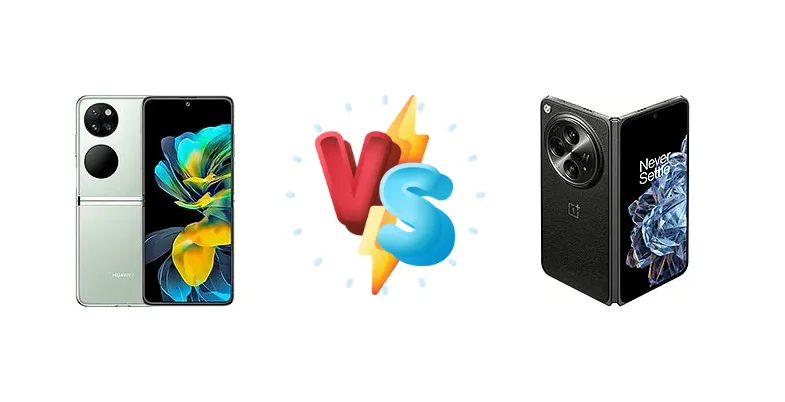
|
🏆 Quick Verdict
For the average user prioritizing raw performance and a longer-lasting battery, the OnePlus Open is the clear winner. Its Snapdragon 8 Gen 2 chipset and impressive 11:59h active use battery life significantly outperform the Pocket S. However, the Pocket S offers a compelling value proposition for those seeking a foldable experience without the flagship price tag.
| PHONES | ||
|---|---|---|
| Phone Names | Huawei Pocket S | OnePlus Open |
| Network | ||
|---|---|---|
| 2G bands | GSM 850 / 900 / 1800 / 1900 | GSM 850 / 900 / 1800 / 1900 |
| 3G bands | HSDPA 800 / 850 / 900 / 1700(AWS) / 1900 / 2100 | HSDPA 800 / 850 / 900 / 1700(AWS) / 1900 / 2100 |
| 4G bands | 1, 2, 3, 4, 5, 7, 8, 12, 17, 18, 19, 20, 26, 28, 34, 38, 39, 40, 41 | 1, 2, 3, 4, 5, 7, 8, 12, 13, 17, 18, 19, 20, 25, 26, 28, 30, 32, 38, 39, 40, 41, 46, 48, 66, 71 |
| 5G bands | - | 1, 2, 3, 5, 7, 8, 12, 20, 25, 28, 30, 38, 40, 41, 66, 71, 75, 77, 78 SA/NSA |
| Speed | HSPA, LTE | HSPA, LTE, 5G |
| Technology | GSM / CDMA / HSPA / CDMA2000 / LTE | GSM / HSPA / LTE / 5G |
| CDMA2000 1x | - | |
| Launch | ||
|---|---|---|
| Announced | 2022, November 02 | 2023, October 19 |
| Status | Available. Released 2022, November 11 | Available. Released 2023, October 26 |
| Body | ||
|---|---|---|
| Build | - | Glass front (Ceramic Guard) (folded), plastic front (unfolded), glass back or eco leather back, aluminum frame |
| Dimensions | Unfolded: 170 x 75.5 x 7.2 mmFolded: 87.3 x 75.5 x 15.2 mm | Unfolded: 153.4 x 143.1 x 5.8 mmFolded: 153.4 x 73.3 x 11.7 mm |
| SIM | Nano-SIM + Nano-SIM | Nano-SIM + Nano-SIM + eSIM (max 2 at a time) |
| Weight | 190 g (6.70 oz) | 239 g or 245 g (8.43 oz) |
| Display | ||
|---|---|---|
| Resolution | 1188 x 2790 pixels, 21:9 ratio (~442 ppi density) | 2268 x 2440 pixels (~426 ppi density) |
| Size | 6.9 inches, 109.2 cm2 (~85.1% screen-to-body ratio) | 7.82 inches, 196.7 cm2 (~89.6% screen-to-body ratio) |
| Type | Foldable OLED, 1B colors, 120Hz | Foldable LTPO3 Flexi-fluid AMOLED, 1B colors, Dolby Vision, 120Hz, 2800 nits (peak) |
| Cover display: OLED, 1.04 inch, 340 x 340 pixels, 328 ppi | - | |
| Platform | ||
|---|---|---|
| CPU | Octa-core (4x2.4 GHz Kryo 670 & 4x1.8 GHz Kryo 670) | Octa-core (1x3.2 GHz Cortex-X3 & 2x2.8 GHz Cortex-A715 & 2x2.8 GHz Cortex-A710 & 3x2.0 GHz Cortex-A510) |
| Chipset | Qualcomm SM7325 Snapdragon 778G 4G (6 nm) | Qualcomm SM8550-AB Snapdragon 8 Gen 2 (4 nm) |
| GPU | Adreno 642L | Adreno 740 |
| OS | HarmonyOS 3.0 | Android 13, upgradable to Android 15, OxygenOS 15 |
| Memory | ||
|---|---|---|
| Card slot | Nano Memory (uses shared SIM slot) | No |
| Internal | 128GB 8GB RAM, 256GB 8GB RAM, 512GB 8GB RAM | 512GB 16GB RAM, 1TB 16GB RAM |
| Main Camera | ||
|---|---|---|
| Dual | 40 MP, f/1.8, (wide), PDAF 13 MP, f/2.2, 120˚ (ultrawide), AF | - |
| Features | Laser AF, color spectrum sensor, LED flash, HDR, panorama | Hasselblad Color Calibration, LED flash, HDR, panorama |
| Single | 10.7 MP, f/2.2, (ultrawide) | - |
| Triple | - | 48 MP, f/1.7, 24mm (wide), 1/1.43", 1.12µm, multi-directional PDAF, OIS 64 MP, f/2.6, 70mm (telephoto), 1/2.0", 0.7µm, PDAF, OIS, 3x optical zoom 48 MP, f/2.2, 14mm, 114˚ (ultrawide), 1/2.0", 0.8µm, PDAF |
| Video | 4K, 1080p | 4K@30/60fps, 1080p@30/60/120/240/480fps gyro-EIS, HDR10+, Dolby Vision |
| Selfie camera | ||
|---|---|---|
| Features | HDR, panorama | HDR |
| Single | 10.7 MP, f/2.2, (ultrawide) | 20MP, f/2.2, 20mm (ultrawide), 1/4.0", 0.7µm Cover camera: 32MP, f/2.4, 22mm (ultrawide), 1/3.14", 0.7µm |
| Video | 4K, 1080p | 4K@30fps, 1080p@30fps, gyro-EIS |
| Sound | ||
|---|---|---|
| 3.5mm jack | No | - |
| 35mm jack | No | No |
| Loudspeaker | Yes | Yes, with stereo speakers (Dolby Atmos enhanced) |
| Comms | ||
|---|---|---|
| Bluetooth | 5.2, A2DP, LE | 5.3, A2DP, LE, aptX HD |
| Infrared port | - | Yes |
| NFC | Yes | Yes |
| Positioning | GPS (L1+L5), GLONASS (L1), BDS (B1I+B1c+B2a), GALILEO (E1+E5a), QZSS (L1+L5), NavIC | GPS (L1+L5), GLONASS, BDS, GALILEO (E1+E5a), QZSS |
| Radio | No | No |
| USB | USB Type-C 2.0, OTG | USB Type-C 3.1, OTG |
| WLAN | Wi-Fi 802.11 a/b/g/n/ac/6, dual-band, Wi-Fi Direct | Wi-Fi 802.11 a/b/g/n/ac/6e/7, tri-band |
| Features | ||
|---|---|---|
| Sensors | Fingerprint (side-mounted), gyro, accelerometer, proximity, compass, barometer | Fingerprint (side-mounted), accelerometer, gyro, proximity, compass |
| Battery | ||
|---|---|---|
| Charging | 40W wired, 52% in 20 min 5W reverse wired | 67W wired, PD, 100% in 42 min Reverse wired |
| Type | Li-Po 4000 mAh | Li-Po 4805 mAh |
| Misc | ||
|---|---|---|
| Colors | Blue, Pink, Gren, Silver, Gold, Black | Emerald Dusk, Voyager Black, Apex Edition |
| Models | BAL-AL60 | CPH2551 |
| Price | About 830 EUR | $ 1,059.99 / € 926.54 |
| SAR | - | 0.98 W/kg (head) 0.76 W/kg (body) |
Huawei Pocket S
- More affordable price point
- Compact and stylish design
- Potentially lighter weight
- Significantly weaker processor
- Inferior battery life
- Likely less capable camera system
OnePlus Open
- Flagship-level performance with Snapdragon 8 Gen 2
- Exceptional battery life and fast charging
- Superior camera capabilities
- Higher price tag
- Larger and heavier form factor
- May be less pocketable
Display Comparison
The OnePlus Open boasts a significantly brighter display, reaching a measured 1238 nits, ensuring excellent visibility even in direct sunlight. While the Pocket S’s display specs are not provided, its positioning suggests a lower peak brightness. The OnePlus Open’s panel likely utilizes LTPO technology, dynamically adjusting the refresh rate for improved power efficiency, a feature not confirmed for the Pocket S. The larger display real estate of the Open also benefits content consumption and multitasking.
Camera Comparison
While both phones feature camera systems, the OnePlus Open is expected to offer a more versatile and higher-quality experience. The Pocket S’s camera specs are not detailed, but given its price point, it likely features a less sophisticated sensor and image processing pipeline. The OnePlus Open benefits from a flagship-tier sensor and advanced computational photography, resulting in superior image quality, especially in low-light conditions. The Open’s video capabilities are also expected to be more robust, offering features like 8K recording and advanced stabilization.
Performance
The performance gap is substantial. The OnePlus Open’s Snapdragon 8 Gen 2 (4nm) is a generational leap ahead of the Pocket S’s Snapdragon 778G 4G (6nm). The 8 Gen 2’s Cortex-X3 prime core, clocked at 3.2 GHz, delivers significantly faster processing speeds for demanding tasks. The 4nm process node also translates to better thermal efficiency, minimizing throttling during prolonged gaming or video editing. The Pocket S’s 778G is capable for everyday tasks, but will struggle with graphically intensive applications compared to the Open.
Battery Life
The OnePlus Open’s battery life is a clear advantage. The reported 11:59h active use score and 96h endurance rating demonstrate exceptional longevity. While the Pocket S’s battery capacity is unknown, its 40W wired charging (52% in 20 minutes) is slower than the Open’s 67W wired charging (100% in 42 minutes). The Open’s faster charging minimizes downtime, while its larger battery ensures all-day usage even with heavy workloads. The Pocket S’s 5W reverse wired charging is a niche feature, while the Open also offers reverse wired charging.
Buying Guide
Buy the Huawei Pocket S if you need a stylish, compact foldable that prioritizes portability and design over ultimate performance. It’s ideal for users who primarily use their phones for social media, light browsing, and casual photography. Buy the OnePlus Open if you prefer a no-compromise experience with flagship-level speed, a superior camera system, and all-day battery life, making it perfect for power users, gamers, and content creators.