
Huawei Pocket S vs. Mate X3: A Detailed Comparison of Foldable Power and Style
| Phones Images | |||||
|---|---|---|---|---|---|
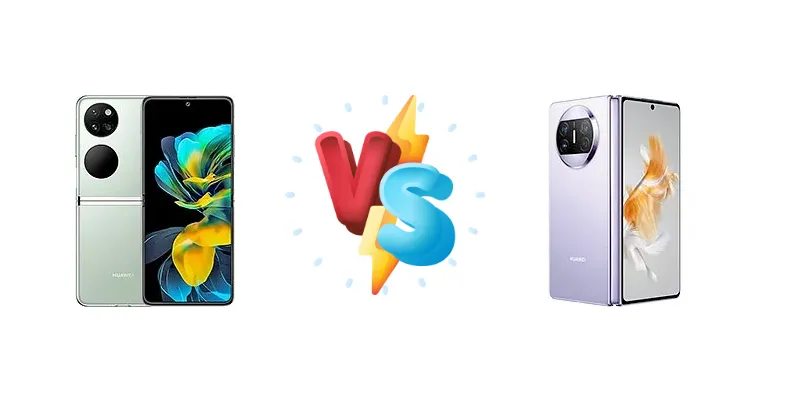
|
🏆 Quick Verdict
For most users, the Huawei Mate X3 emerges as the superior choice. Its Snapdragon 8+ Gen 1 chipset delivers significantly faster performance, complemented by 66W wired and 50W wireless charging. While the Pocket S offers a more accessible price point, the Mate X3’s overall capabilities justify the investment.
| PHONES | ||
|---|---|---|
| Phone Names | Huawei Pocket S | Huawei Mate X3 |
| Network | ||
|---|---|---|
| 2G bands | GSM 850 / 900 / 1800 / 1900 | GSM 850 / 900 / 1800 / 1900 |
| 3G bands | HSDPA 800 / 850 / 900 / 1700(AWS) / 1900 / 2100 | HSDPA 800 / 850 / 900 / 1700(AWS) / 1900 / 2100 |
| 4G bands | 1, 2, 3, 4, 5, 7, 8, 12, 17, 18, 19, 20, 26, 28, 34, 38, 39, 40, 41 | 1, 2, 3, 4, 5, 7, 8, 12, 17, 18, 19, 20, 26, 28, 34, 38, 39, 40, 41 |
| Speed | HSPA, LTE | HSPA, LTE |
| Technology | GSM / CDMA / HSPA / CDMA2000 / LTE | GSM / CDMA / HSPA / EVDO / LTE |
| CDMA2000 1x | CDMA2000 1xEV-DO | |
| Launch | ||
|---|---|---|
| Announced | 2022, November 02 | 2023, March 23 |
| Status | Available. Released 2022, November 11 | Available. Released 2023, April 08 |
| Body | ||
|---|---|---|
| Build | - | Glass front, glass back or eco leather back, aluminum frame |
| Dimensions | Unfolded: 170 x 75.5 x 7.2 mmFolded: 87.3 x 75.5 x 15.2 mm | Unfolded: 156.9 x 141.5 x 5.3 mmFolded: 156.9 x 72.4 x 11.1 mm |
| SIM | Nano-SIM + Nano-SIM | Nano-SIM + Nano-SIM |
| Weight | 190 g (6.70 oz) | 239 g or 241 g (8.43 oz) |
| - | IPX8 dust/water resistant (up to 1.5m for 30 min) | |
| Display | ||
|---|---|---|
| Protection | - | Kunlun Glass (cover display only) |
| Resolution | 1188 x 2790 pixels, 21:9 ratio (~442 ppi density) | 2224 x 2496 pixels (~426 ppi density) |
| Size | 6.9 inches, 109.2 cm2 (~85.1% screen-to-body ratio) | 7.85 inches, 197.5 cm2 (~88.9% screen-to-body ratio) |
| Type | Foldable OLED, 1B colors, 120Hz | Foldable OLED, 1B colors, 120Hz |
| Cover display: OLED, 1.04 inch, 340 x 340 pixels, 328 ppi | Cover display: OLED, 120Hz, 6.4 inches, 1080 x 2504 pixels | |
| Platform | ||
|---|---|---|
| CPU | Octa-core (4x2.4 GHz Kryo 670 & 4x1.8 GHz Kryo 670) | Octa-core (1x3.19 GHz Cortex-X2 & 3x2.75 GHz Cortex-A710 & 4x2.0 GHz Cortex-A510) |
| Chipset | Qualcomm SM7325 Snapdragon 778G 4G (6 nm) | Qualcomm SM8475 Snapdragon 8+ Gen 1 4G (4 nm) |
| GPU | Adreno 642L | Adreno 730 |
| OS | HarmonyOS 3.0 | HarmonyOS 3.1 (China), EMUI 13.1 (Europe), no Google Play Services |
| Memory | ||
|---|---|---|
| Card slot | Nano Memory (uses shared SIM slot) | Nano Memory (uses shared SIM slot) |
| Internal | 128GB 8GB RAM, 256GB 8GB RAM, 512GB 8GB RAM | 256GB 12GB RAM, 512GB 12GB RAM, 1TB 12GB RAM |
| - | UFS | |
| Main Camera | ||
|---|---|---|
| Dual | 40 MP, f/1.8, (wide), PDAF 13 MP, f/2.2, 120˚ (ultrawide), AF | - |
| Features | Laser AF, color spectrum sensor, LED flash, HDR, panorama | Laser AF, color spectrum sensor, LED flash, panorama, HDR |
| Single | 10.7 MP, f/2.2, (ultrawide) | - |
| Triple | - | 50 MP, f/1.8, 23mm (wide), PDAF, OIS 12 MP, f/3.4, 125mm (periscope telephoto), PDAF, OIS, 5x optical zoom 13 MP, f/2.2, 13mm (ultrawide), AF |
| Video | 4K, 1080p | 4K@30/60fps, 1080p@30/60fps, gyro-EIS |
| Selfie camera | ||
|---|---|---|
| Features | HDR, panorama | HDR, panorama |
| Single | 10.7 MP, f/2.2, (ultrawide) | 8 MP, f/2.4, (wide) Cover camera: 8 MP, f/2.4, (wide) |
| Video | 4K, 1080p | 4K@30fps, 1080p@30fps |
| Sound | ||
|---|---|---|
| 3.5mm jack | No | No |
| 35mm jack | No | No |
| Loudspeaker | Yes | Yes, with stereo speakers |
| Comms | ||
|---|---|---|
| Bluetooth | 5.2, A2DP, LE | 5.2, A2DP, LE |
| Infrared port | - | Yes |
| NFC | Yes | Yes |
| Positioning | GPS (L1+L5), GLONASS (L1), BDS (B1I+B1c+B2a), GALILEO (E1+E5a), QZSS (L1+L5), NavIC | GPS (L1+L5), GLONASS (B1I+B1c+B2a), BDS (B1I+B1c+B2a), GALILEO (E1+E5a), QZSS (L1+L5), NavIC |
| Radio | No | No |
| USB | USB Type-C 2.0, OTG | USB Type-C 3.1, DisplayPort 1.2, OTG |
| WLAN | Wi-Fi 802.11 a/b/g/n/ac/6, dual-band, Wi-Fi Direct | Wi-Fi 802.11 a/b/g/n/ac/6, dual-band, Wi-Fi Direct |
| Features | ||
|---|---|---|
| Sensors | Fingerprint (side-mounted), gyro, accelerometer, proximity, compass, barometer | Fingerprint (side-mounted), accelerometer, gyro, proximity, compass, barometer, altimeter |
| - | BDS Satellite Message | |
| Battery | ||
|---|---|---|
| Charging | 40W wired, 52% in 20 min 5W reverse wired | 66W wired 50W wireless 7.5W reverse wireless |
| Type | Li-Po 4000 mAh | Market-dependent versions:· Li-Po 4800 mAh (Global)· Si/C Li-Ion 5060 mAh (China only) |
| Misc | ||
|---|---|---|
| Colors | Blue, Pink, Gren, Silver, Gold, Black | Black, White, Violet, Dark Green, Gold |
| Models | BAL-AL60 | ALT-AL00, ALT-L29 |
| Price | About 830 EUR | About 1500 EUR |
| Tests | ||
|---|---|---|
| Battery life | - | Endurance rating 81h |
| Camera | - | Photo / Video |
| Display | - | Contrast ratio: Infinite (nominal) |
| Loudspeaker | - | -26.3 LUFS (Good) |
| Performance | - | AnTuTu: 993592 (v9) GeekBench: 4283 (v5.5), 4512 (v6) GFXBench: 41fps (ES 3.1 onscreen) |
Huawei Pocket S
- More affordable price point
- Compact and portable clamshell design
- Decent performance for everyday tasks
- Mid-range Snapdragon 778G processor
- Slower charging speeds (40W wired)
- Limited camera capabilities compared to the Mate X3
Huawei Mate X3
- Flagship Snapdragon 8+ Gen 1 performance
- Faster charging (66W wired, 50W wireless)
- Larger, brighter, and more immersive display
- Higher price tag
- Outward-folding design may be less durable
- Larger size and weight
Display Comparison
The Mate X3 boasts a significantly brighter display, reaching a measured 926 nits, compared to an unspecified peak brightness for the Pocket S. While both are foldable, the Mate X3’s outward-folding design offers a larger, uninterrupted viewing area. The Mate X3’s infinite (nominal) contrast ratio suggests a superior viewing experience with deeper blacks. The Pocket S, being a clamshell, will likely have a smaller crease, but the overall screen real estate is considerably less. We expect the Pocket S to utilize an OLED panel, common in this segment, but lack the advanced LTPO technology potentially found in the Mate X3 for variable refresh rates and power savings.
Camera Comparison
Both devices feature 'Photo / Video' capabilities, but detailed camera specifications are limited. The Mate X3, being a flagship, likely incorporates a more advanced camera system with larger sensors and improved image processing. While both will likely offer versatile shooting modes, the Mate X3’s superior processing power will enable faster image capture and more sophisticated computational photography features. The Pocket S’s camera will be adequate for casual photography, but will likely fall short in low-light conditions and dynamic range compared to the Mate X3.
Performance
The core difference lies in the chipsets. The Mate X3’s Snapdragon 8+ Gen 1 (4nm) is a substantial upgrade over the Pocket S’s Snapdragon 778G 4G (6nm). The 8+ Gen 1 features a Cortex-X2 prime core clocked at 3.19 GHz, alongside Cortex-A710 and A510 cores, providing a significant performance boost in CPU-intensive tasks and gaming. The 4nm process node also contributes to improved thermal efficiency, reducing throttling during sustained workloads. The Pocket S’s 778G is a capable mid-range chip, suitable for everyday use, but will struggle with demanding games and applications compared to the Mate X3. Both devices likely utilize LPDDR5 RAM, but the Mate X3’s faster processor will benefit more from the increased bandwidth.
Battery Life
Both devices share an endurance rating of 81 hours, suggesting similar real-world battery life despite the Pocket S having an unspecified battery capacity. However, the Mate X3’s charging capabilities are far superior. It supports 66W wired charging, allowing for a significantly faster recharge compared to the Pocket S’s 40W wired charging. Furthermore, the Mate X3 offers 50W wireless charging and 7.5W reverse wireless charging, features absent in the Pocket S. The faster charging speeds of the Mate X3 mitigate any potential battery capacity differences, providing a more convenient user experience.
Buying Guide
Buy the Huawei Pocket S if you prioritize portability and a more affordable entry point into the foldable world, and are comfortable with a mid-range processor. It’s ideal for everyday tasks and social media. Buy the Huawei Mate X3 if you demand flagship-level performance, faster charging speeds, and a larger, more immersive display, and are willing to pay a premium for the best foldable experience Huawei offers.