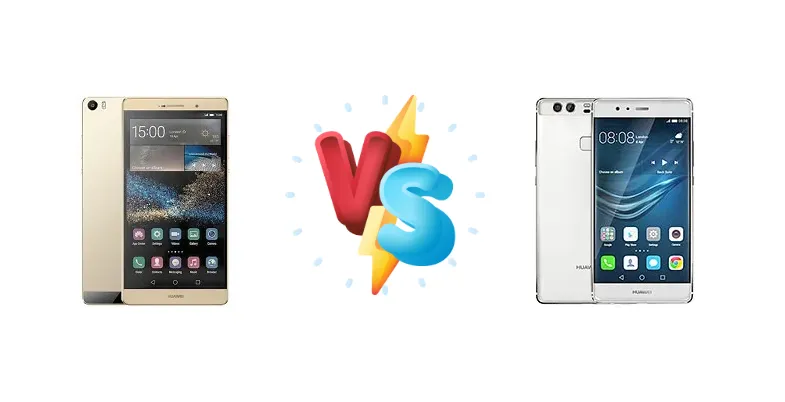
Huawei's P series has always been known for its impressive features and sleek designs. Today, we're pitting two contenders against each other: the P8max, a large-screen powerhouse, and the P9 Plus, boasting enhanced camera capabilities and a more modern chipset. Let's dive into a comprehensive comparison to see which phone emerges victorious.
🏆 Quick Verdict
The Huawei P9 Plus is the clear winner. While the P8max offered a large display, the P9 Plus's Kirin 955 chipset, improved camera, faster charging, and refined design provide a significantly better overall experience. It's a worthwhile upgrade.
| Network |
|---|
| 2G bands | GSM 850 / 900 / 1800 / 1900 - SIM 1 & SIM 2 | GSM 850 / 900 / 1800 / 1900 - SIM 1 & SIM 2 (dual-SIM model only) |
| 3G bands | HSDPA 850 / 900 / 1900 / 2100 | HSDPA 850 / 900 / 1900 / 2100 - VIE-L09, VIE-L29 |
| 4G bands | LTE | 1, 2, 3, 4, 5, 6, 7, 8, 12, 17, 18, 19, 20, 26, 28, 38, 39, 40 - VIE-L09 |
| Speed | HSPA 42.2/5.76 Mbps, LTE (2CA) Cat6 300/50 Mbps | HSPA 42.2/5.76 Mbps, LTE (2CA) Cat6 300/50 Mbps |
| Technology | GSM / HSPA / LTE | GSM / HSPA / LTE |
| | - | 1, 2, 3, 4, 5, 6, 7, 8, 12, 17, 18, 19, 20, 26, 28, 38, 39, 40, 41 - VIE-L29 |
| Launch |
|---|
| Announced | 2015, April. Released 2015, July | 2016, April. Released 2016, May |
| Status | Discontinued | Discontinued |
| Body |
|---|
| Build | - | Glass front (Gorilla Glass 3), aluminum back, aluminum frame |
| Dimensions | 182.7 x 93 x 6.8 mm (7.19 x 3.66 x 0.27 in) | 152.3 x 75.3 x 7 mm (6.00 x 2.96 x 0.28 in) |
| SIM | Nano-SIM + Micro-SIM | · Nano-SIM· Nano-SIM + Nano-SIM |
| Weight | 228 g (8.04 oz) | 162 g (5.71 oz) |
| Display |
|---|
| Protection | Corning Gorilla Glass 3 | Corning Gorilla Glass 3 |
| Resolution | 1080 x 1920 pixels, 16:9 ratio (~326 ppi density) | 1080 x 1920 pixels, 16:9 ratio (~401 ppi density) |
| Size | 6.8 inches, 125.9 cm2 (~74.1% screen-to-body ratio) | 5.5 inches, 83.4 cm2 (~72.7% screen-to-body ratio) |
| Type | IPS LCD | Super AMOLED |
| | - | 3D Touch display |
| Platform |
|---|
| CPU | Octa-core (4x2.2 GHz Cortex-A53 & 4x1.5 GHz Cortex-A53) | Octa-core (4x2.5 GHz Cortex-A72 & 4x1.8 GHz Cortex-A53) |
| Chipset | Kirin 935 (28 nm) | Kirin 955 (16 nm) |
| GPU | Mali-T628 MP4 | Mali-T880 MP4 |
| OS | Android 5.0.2/5.1.1 (Lollipop), upgradable to 6.0 (Marshmallow), EMUI | Android 6 (Marshmallow), upgradable to 7 (Nougat), EMUI 5 |
| Memory |
|---|
| Card slot | microSDXC (uses shared SIM slot) | microSDXC (uses shared SIM slot) |
| Internal | 64GB 3GB RAM | 32GB 4GB RAM, 64GB 4GB RAM |
| Main Camera |
|---|
| Features | Dual-LED dual-tone flash, panorama, HDR | Laser AF, Leica optics, dual-LED dual-tone flash, panorama, HDR |
| Single | 13 MP, f/2.0, AF, OIS | 12 MP, f/2.2, 27mm (wide), 1/2.9", 1.25µm, PDAF
12 MP B/W, f/2.2, 27mm (wide), 1/2.9", 1.25µm |
| Video | 1080p@30fps | 1080p@30fps |
| Selfie camera |
|---|
| Single | 5 MP | 8 MP, f/1.9, AF |
| Video | - | 1080p@30fps |
| Sound |
|---|
| 3.5mm jack | Yes | Yes |
| 35mm jack | Yes | Yes |
| Loudspeaker | Yes | Yes, with stereo speakers |
| | 24-bit/192kHz audio
| 24-bit/192kHz audio
|
| Comms |
|---|
| Bluetooth | 4.0, A2DP | 4.2, A2DP, LE |
| Infrared port | - | Yes |
| NFC | No | Yes |
| Positioning | GPS, GLONASS, BDS | GPS, GLONASS/ BDS (market dependant) |
| Radio | FM radio | No |
| USB | microUSB 2.0, OTG | USB Type-C |
| WLAN | Wi-Fi 802.11 a/b/g/n/ac, dual-band, DLNA, Wi-Fi Direct | Wi-Fi 802.11 a/b/g/n/ac, dual-band, DLNA, Wi-Fi Direct |
| Features |
|---|
| Sensors | Accelerometer, gyro, proximity, compass | Fingerprint (rear-mounted), accelerometer, gyro, proximity, compass |
| Battery |
|---|
| Charging | - | 18W wired, 38% in 30 min |
| Type | Li-Po 4360 mAh, non-removable | Li-Po 3400 mAh, non-removable |
| Misc |
|---|
| Colors | Luxurious Gold, Mystic Champagne, Titanium Grey | Haze Gold, Quartz Grey, Ceramic White |
| Models | DAV-701L, P8max | VIE-L09, VIE-L29, VIE-AL10 |
| Price | About 400 EUR | About 430 EUR |
| SAR EU | - | 1.48 W/kg (head) 1.49 W/kg (body) |
| Tests |
|---|
| Audio quality | - |
Noise -97.4dB / Crosstalk -96.9dB |
| Battery life | - |
Endurance rating 69h
|
| Camera | - |
Photo / Video |
| Display | - |
Contrast ratio: Infinite (nominal), 3.956 (sunlight) |
| Loudspeaker | - |
Voice 71dB / Noise 73dB / Ring 81dB
|
| Performance | - |
Basemark OS II 2.0: 2099Basemark X: 15058 |
Huawei P8max
- Large Display
- Potentially Lower Price (if available)
- Decent Battery Life
- Outdated Chipset
- Slower Performance
- Less Advanced Camera
- No Fast Charging
- Limited Software Support
Huawei P9 Plus
- Faster Performance (Kirin 955)
- Improved Camera
- Fast Charging (18W)
- More Modern Design
- Better Software Support (potentially)
- Older Model
- Potentially Higher Price (if available)
Display Comparison
Both phones feature large displays, but the P9 Plus likely has slightly better color accuracy and brightness due to its more modern panel. The P8max's display, while large, may lack the vibrancy and sharpness of the P9 Plus. Contrast ratio data suggests similar performance in sunlight.
Camera Comparison
The P9 Plus's camera system is a major upgrade. While both offer Photo/Video capabilities, the P9 Plus likely features improved sensors, image processing algorithms, and potentially dual-lens capabilities (common in P9 series) for better low-light performance and depth-of-field effects. The P8max's camera is adequate but lacks the sophistication of the P9 Plus.
Performance
The P9 Plus's Kirin 955 chipset, built on a 16nm process, offers a substantial performance boost over the P8max's 28nm Kirin 935. The Cortex-A72 cores in the P9 Plus provide significantly faster processing speeds, resulting in smoother multitasking and gaming. The P8max will feel noticeably slower by comparison.
Battery Life
Both phones boast impressive endurance ratings (69h), suggesting similar battery life in typical usage. However, the P9 Plus's 18W fast charging provides a significant advantage, allowing for a 38% charge in just 30 minutes – a feature absent in the P8max.
Buying Guide
Who should buy the Huawei P8max? Those seeking a large-screen phone on a tight budget might consider the P8max, but availability and software support are concerns. The Huawei P9 Plus is ideal for users prioritizing camera quality, performance, and a more modern smartphone experience, even if it's an older model.
Frequently Asked Questions
❓ Is the Huawei P8max still worth buying?
Unless you're on a very tight budget and need a large screen, the P9 Plus offers a much better overall experience. Software support for the P8max is likely limited.
❓ What is the main difference between the P8max and P9 Plus?
The Kirin 955 chipset in the P9 Plus provides a significant performance boost, along with an improved camera and faster charging capabilities compared to the P8max.