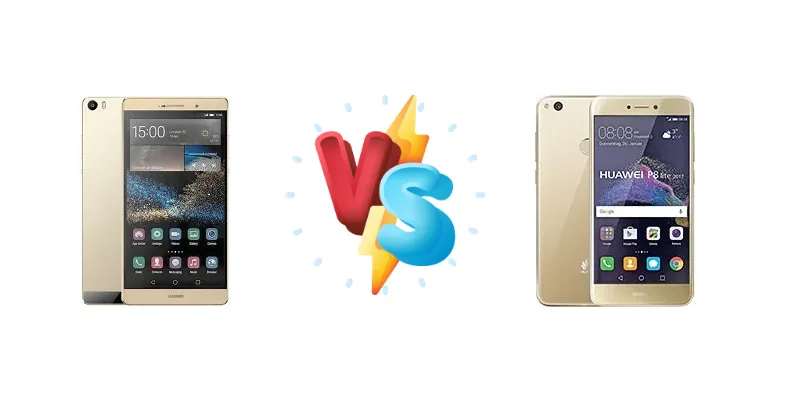
Huawei offered a range of devices catering to different needs. The P8max was a powerhouse, while the P8 Lite (2017) aimed for affordability and efficiency. But which one holds up best today? Let's dive into a comprehensive comparison to help you decide.
🏆 Quick Verdict
The Huawei P8max wins on raw power thanks to its Kirin 935 chipset and larger RAM. However, the P8 Lite (2017) offers a more modern software experience and potentially better battery efficiency. Ultimately, the P8max is for performance seekers, while the P8 Lite is a solid budget choice.
| Network |
|---|
| 2G bands | GSM 850 / 900 / 1800 / 1900 - SIM 1 & SIM 2 | GSM 850 / 900 / 1800 / 1900 - SIM 1 & SIM 2 |
| 3G bands | HSDPA 850 / 900 / 1900 / 2100 | HSDPA 850 / 900 / 1900 / 2100 |
| 4G bands | LTE | 1, 3, 7, 8, 20 |
| Speed | HSPA 42.2/5.76 Mbps, LTE (2CA) Cat6 300/50 Mbps | HSPA 42.2/5.76 Mbps, LTE Cat4 150/50 Mbps |
| Technology | GSM / HSPA / LTE | GSM / HSPA / LTE |
| Launch |
|---|
| Announced | 2015, April. Released 2015, July | 2017, January. Released 2017, January |
| Status | Discontinued | Discontinued |
| Body |
|---|
| Build | - | Glass front, glass back, aluminum frame |
| Dimensions | 182.7 x 93 x 6.8 mm (7.19 x 3.66 x 0.27 in) | 147.2 x 72.9 x 7.6 mm (5.80 x 2.87 x 0.30 in) |
| SIM | Nano-SIM + Micro-SIM | Nano-SIM + Nano-SIM |
| Weight | 228 g (8.04 oz) | 147 g (5.19 oz) |
| Display |
|---|
| Protection | Corning Gorilla Glass 3 | - |
| Resolution | 1080 x 1920 pixels, 16:9 ratio (~326 ppi density) | 1080 x 1920 pixels, 16:9 ratio (~424 ppi density) |
| Size | 6.8 inches, 125.9 cm2 (~74.1% screen-to-body ratio) | 5.2 inches, 74.5 cm2 (~69.5% screen-to-body ratio) |
| Type | IPS LCD | IPS LCD |
| Platform |
|---|
| CPU | Octa-core (4x2.2 GHz Cortex-A53 & 4x1.5 GHz Cortex-A53) | Octa-core (4x2.1 GHz Cortex-A53 & 4x1.7 GHz Cortex-A53) |
| Chipset | Kirin 935 (28 nm) | Kirin 655 (16 nm) |
| GPU | Mali-T628 MP4 | Mali-T830MP2 |
| OS | Android 5.0.2/5.1.1 (Lollipop), upgradable to 6.0 (Marshmallow), EMUI | Android 7.0 (Nougat), upgradable to Android 8.0 (Oreo), EMUI 9 |
| Memory |
|---|
| Card slot | microSDXC (uses shared SIM slot) | microSDXC (uses shared SIM slot) |
| Internal | 64GB 3GB RAM | 16GB 3GB RAM, 32GB 4GB RAM, 64GB 4GB RAM |
| Main Camera |
|---|
| Features | Dual-LED dual-tone flash, panorama, HDR | LED flash, panorama, HDR |
| Single | 13 MP, f/2.0, AF, OIS | 12 MP, AF |
| Video | 1080p@30fps | 1080p@30fps |
| Selfie camera |
|---|
| Single | 5 MP | 8 MP, f/2.0 |
| Video | - | 1080p@30fps |
| Sound |
|---|
| 3.5mm jack | Yes | Yes |
| 35mm jack | Yes | Yes |
| Loudspeaker | Yes | Yes |
| | 24-bit/192kHz audio
| - |
| Comms |
|---|
| Bluetooth | 4.0, A2DP | 4.1, A2DP, EDR, LE |
| NFC | No | Yes (market dependent) |
| Positioning | GPS, GLONASS, BDS | GPS, GLONASS |
| Radio | FM radio | FM radio |
| USB | microUSB 2.0, OTG | microUSB 2.0, OTG |
| WLAN | Wi-Fi 802.11 a/b/g/n/ac, dual-band, DLNA, Wi-Fi Direct | Wi-Fi 802.11 b/g/n, Wi-Fi Direct |
| Features |
|---|
| Sensors | Accelerometer, gyro, proximity, compass | Fingerprint (rear-mounted), accelerometer, proximity, compass |
| Battery |
|---|
| Type | Li-Po 4360 mAh, non-removable | Li-Ion 3000 mAh, non-removable |
| Misc |
|---|
| Colors | Luxurious Gold, Mystic Champagne, Titanium Grey | Black, White, Gold, Blue |
| Models | DAV-701L, P8max | PRA-TL10, PRA-TL20, PRA-LA1, PRA-LX1, PRA-LX2, TAG-L21, PRA-AL00X, TAG-L32, PRA-LX3, PRA-AL00 |
| Price | About 400 EUR | About 170 EUR |
Huawei P8max
- Massive 6.8-inch display
- Powerful Kirin 935 chipset
- Larger battery capacity
- Good for media consumption
- Larger size can be unwieldy
- Older software
- Potentially slower updates
- 28nm process less efficient
Huawei P8 Lite (2017)
- More compact and easier to handle
- Likely better camera image quality
- More modern software experience
- Potentially better battery efficiency
- Less powerful chipset
- Smaller display
- Lower performance in demanding tasks
- Smaller battery
Display Comparison
The P8max boasts a massive 6.8-inch display, significantly larger than the P8 Lite (2017)'s 5.45-inch screen. While both use IPS LCD technology, the P8max's size makes it better for watching videos and gaming, though the P8 Lite's smaller size offers better one-handed usability. Resolution is likely similar, around 1080p, but the P8max's sheer size provides a more immersive experience.
Camera Comparison
The P8 Lite (2017) likely has a slightly more modern camera sensor and image processing algorithms. While the P8max may have higher megapixel counts, the P8 Lite (2017) often produces better images in various lighting conditions due to software optimizations. Both phones offer decent camera capabilities for their time, but the P8 Lite (2017) likely edges out the P8max in image quality.
Performance
Here's where the P8max truly shines. The Kirin 935 chipset, built on a 28nm process, is considerably more powerful than the Kirin 655 (16nm) found in the P8 Lite (2017). The P8max's CPU and GPU offer noticeably faster performance in demanding tasks and games. The P8 Lite (2017) is adequate for everyday use, but struggles with heavier applications.
Battery Life
The P8max's larger size allows for a larger battery, likely around 4360mAh. The P8 Lite (2017) has a smaller battery, around 3000mAh. Despite the P8max's larger battery, the Kirin 655's efficiency on the P8 Lite (2017) might result in comparable or even slightly better battery life in some scenarios, depending on usage.
Buying Guide
The Huawei P8max is ideal for users who prioritize performance and a large display for media consumption. It's a good choice if you can find one in good condition. The Huawei P8 Lite (2017) is best suited for budget-conscious buyers who want a reliable smartphone with a decent camera and a more contemporary Android experience.
Frequently Asked Questions
❓ Is the Huawei P8max still worth buying?
If you prioritize a large screen and raw power and can find one in good condition, the P8max can still be a decent option. However, be aware of its age and potential software limitations.
❓ Which phone has better software support?
The Huawei P8 Lite (2017) likely received more software updates and has a more modern Android version, although both are now quite outdated.