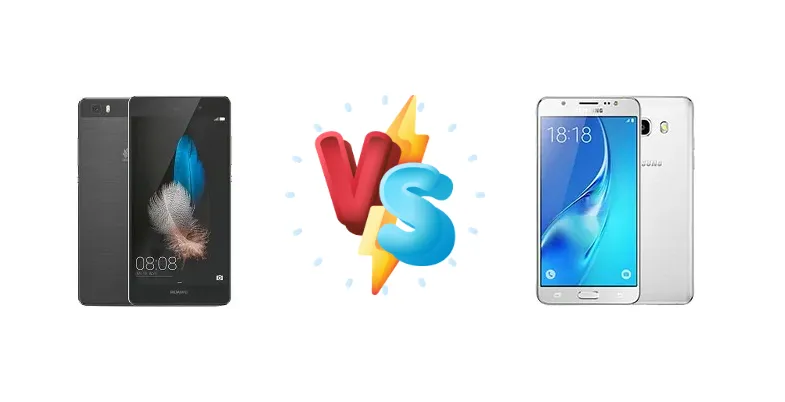
The Huawei P8lite and Samsung Galaxy J5 (2016) were popular budget contenders, offering a taste of Android without breaking the bank. But which one truly delivered the best experience? We're diving deep into their specs, performance, and features to help you decide which phone was the better choice.
🏆 Quick Verdict
The Samsung Galaxy J5 (2016) edges out the Huawei P8lite thanks to its superior sunlight display contrast and slightly longer battery life. While both offer decent performance for their price point, the J5's screen visibility and endurance give it a slight advantage.
| Network |
|---|
| 2G bands | GSM 850 / 900 / 1800 / 1900 - SIM 1 & SIM 2 | GSM 850 / 900 / 1800 / 1900 - SIM 1 & SIM 2 (dual-SIM model only) |
| 3G bands | HSDPA 900 / 1900 / 2100 | HSDPA 850 / 900 / 1900 / 2100 |
| 4G bands | 3, 7, 8, 20 | 1, 3, 5, 7, 8, 20 |
| Speed | HSPA 42.2/5.76 Mbps, LTE Cat4 150/50 Mbps | HSPA 21.1/5.76 Mbps, LTE Cat4 150/50 Mbps |
| Technology | GSM / HSPA / LTE | GSM / HSPA / LTE |
| Launch |
|---|
| Announced | 2015, April. Released 2015, May | 2016, March. Released 2016, April |
| Status | Discontinued | Discontinued |
| Body |
|---|
| Build | Glass front (Gorilla Glass 3), plastic back, plastic frame | Glass front, plastic back, aluminum frame |
| Dimensions | 143 x 70.6 x 7.7 mm (5.63 x 2.78 x 0.30 in) | 145.8 x 72.3 x 8.1 mm (5.74 x 2.85 x 0.32 in) |
| SIM | Nano-SIM + Micro-SIM | Single SIM (Micro-SIM) or Dual SIM (Micro-SIM, dual stand-by) |
| Weight | 131 g (4.62 oz) | 159 g (5.61 oz) |
| Display |
|---|
| Protection | Corning Gorilla Glass 3 | - |
| Resolution | 720 x 1280 pixels, 16:9 ratio (~294 ppi density) | 720 x 1280 pixels, 16:9 ratio (~282 ppi density) |
| Size | 5.0 inches, 68.9 cm2 (~68.3% screen-to-body ratio) | 5.2 inches, 74.5 cm2 (~70.7% screen-to-body ratio) |
| Type | IPS LCD | Super AMOLED |
| Platform |
|---|
| CPU | Octa-core 1.2 GHz Cortex-A53 | Quad-core 1.2 GHz Cortex-A53 |
| Chipset | Kirin 620 (28 nm) | Qualcomm MSM8916 Snapdragon 410 (28 nm) |
| GPU | Mali-450MP4 | Adreno 306 |
| OS | Android 5.0.2 (Lollipop), upgradable to 6.0 (Marshmallow), EMUI 3.1 | Android 6.0.1 (Marshmallow), upgradable to 7.1.1 (Nougat) |
| Memory |
|---|
| Card slot | microSDXC (uses shared SIM slot) | microSDXC (dedicated slot) |
| Internal | 16GB 2GB RAM | 16GB 2GB RAM |
| | - | eMMC 4.5 |
| Main Camera |
|---|
| Features | Dual-LED flash, panorama, HDR | LED flash |
| Single | 13 MP, f/2.0, 27mm (wide), AF | 13 MP, f/1.9, 28mm (wide), AF |
| Video | 1080p@30fps | 1080p@30fps |
| Selfie camera |
|---|
| Features | - | LED flash |
| Single | 5 MP | 5 MP, f/1.9 |
| Video | 720p | - |
| Sound |
|---|
| 3.5mm jack | Yes | Yes |
| 35mm jack | Yes | Yes |
| Loudspeaker | Yes | Yes |
| Comms |
|---|
| Bluetooth | 4.0, A2DP, EDR, LE | 4.1, A2DP |
| Infrared port | Yes | - |
| NFC | Yes | Yes (market dependant) |
| Positioning | GPS, GLONASS | GPS, GLONASS |
| Radio | FM radio | FM radio, RDS, recording |
| USB | microUSB 2.0 | microUSB 2.0, OTG |
| WLAN | Wi-Fi 802.11 b/g/n, Wi-Fi Direct | Wi-Fi 802.11 b/g/n, Wi-Fi Direct |
| Features |
|---|
| Sensors | Accelerometer, proximity, compass | Accelerometer, proximity |
| | - | ANT+ |
| Battery |
|---|
| Charging | 10W wired
Reverse wired | - |
| Stand-by | Up to 380 h (3G) | - |
| Talk time | Up to 11 h (3G) | - |
| Type | Li-Ion 2200 mAh, non-removable | Li-Ion 3100 mAh, removable |
| Misc |
|---|
| Colors | Black, White, Gold | White, Black, Gold, Rose Gold |
| Models | ALE-L21, ALE-L02, hi6210sft, ALE-L23, ALE-UL00, ALE-21, ALE-CL00 | SM-J510F, SM-J510G, SM-J510FN, SM-J510Y, SM-J510M, SM-J510GN, SM-J510H, SM-J510MN, SM-J5108, SM-J510UN, SM-J510L, SM-J510S, SM-J510FQ, SM-J510K |
| Price | About 170 EUR | About 190 EUR |
| SAR EU | 0.39 W/kg (head) 1.02 W/kg (body) | 0.45 W/kg (head) 1.17 W/kg (body) |
| Tests |
|---|
| Audio quality |
Noise-89.0dB / Crosstalk -74.2dB |
Noise -92.4dB / Crosstalk -95.4dB |
| Battery life |
Endurance rating 53h
| Endurance rating 66h |
| Camera |
Photo / Video |
Photo / Video |
| Display |
Contrast ratio: 802 (nominal), 2.078 (sunlight) |
Contrast ratio: Infinite (nominal), 3.378 (sunlight) |
| Loudspeaker |
Voice 66dB / Noise 66dB / Ring 75dB
|
Voice 66dB / Noise 64dB / Ring 70dB |
| Performance |
Basemark OS II 2.0: 691Basemark X: 3648 |
Basemark OS II 2.0: 2180 |
Huawei P8lite
- Slightly more premium design
- Octa-core processor (potentially better multitasking)
- Decent camera performance
- Lower sunlight display contrast
- Shorter battery life
- Older software support
Samsung Galaxy J5 (2016)
- Excellent sunlight display contrast
- Longer battery life
- Reliable performance for everyday tasks
- Less premium design
- Quad-core processor (can struggle with demanding tasks)
- Older software support
Display Comparison
Both phones feature Super AMOLED displays, but the Galaxy J5 (2016) boasts a significantly higher contrast ratio, advertised as 'Infinite' (nominal) compared to the P8lite's 802 (nominal). Sunlight readability is also notably better on the J5 (3.378 vs 2.078). This translates to a more vibrant and easily viewable screen, especially in bright conditions.
Camera Comparison
Camera performance was generally similar on both devices, offering acceptable results for casual photography. Both featured Photo/Video capabilities. The P8lite's Kirin chipset sometimes offered slightly better image processing, but the J5's camera was often considered more consistent.
Performance
The P8lite has an octa-core Kirin 620 chipset, while the J5 (2016) uses a quad-core Snapdragon 410. While the P8lite has more cores, the Snapdragon's efficiency and optimization often resulted in comparable real-world performance for everyday tasks. Both phones will struggle with demanding games.
Battery Life
The Galaxy J5 (2016) holds a slight advantage in battery life, achieving an endurance rating of 66h compared to the P8lite's 53h. This difference translates to noticeably longer usage between charges, a crucial factor for many users.
Buying Guide
The Huawei P8lite is a good choice for users prioritizing a slightly more premium design and potentially better software support (though both are dated now). The Samsung Galaxy J5 (2016) is ideal for those needing a phone that's easily viewable outdoors and offers a bit more battery longevity.
Frequently Asked Questions
❓ Which phone is better for taking photos?
Both phones offer decent photo quality for their price range. The P8lite sometimes produced slightly better processed images, but the J5 was more consistent.
❓ Can I play demanding games on either of these phones?
Neither phone is ideal for demanding games. Both struggle with high graphics settings and may experience lag.
❓ Are these phones still receiving software updates?
Both phones are quite old and are unlikely to receive further official software updates. Security patches are also unlikely.