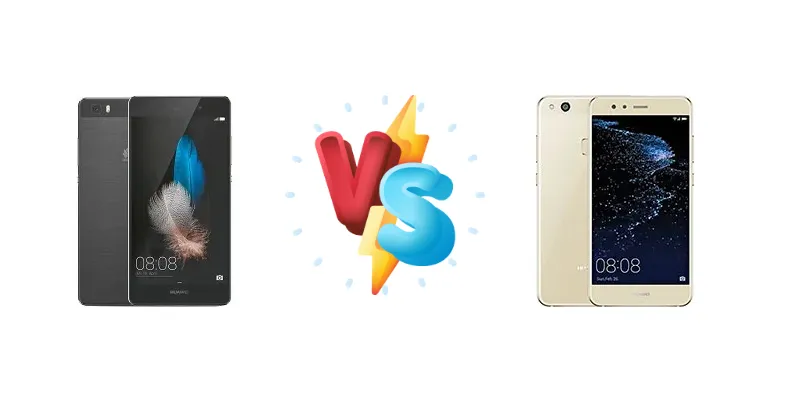
Huawei's P series has consistently offered compelling mid-range smartphones. The P8 Lite and P10 Lite were popular choices, but which one holds up better today? This comprehensive comparison dives deep into their features to help you decide which phone is right for you.
🏆 Quick Verdict
The Huawei P10 Lite is the clear winner. Its improved chipset, significantly better display, faster charging, and slightly longer battery life offer a noticeable upgrade over the P8 Lite, making it a more modern and capable device despite both being older models.
| Network |
|---|
| 2G bands | GSM 850 / 900 / 1800 / 1900 - SIM 1 & SIM 2 | GSM 850 / 900 / 1800 / 1900 - SIM 1 & SIM 2 (dual-SIM model only) |
| 3G bands | HSDPA 900 / 1900 / 2100 | HSDPA 850 / 900 / 1900 / 2100 |
| 4G bands | 3, 7, 8, 20 | 1, 3, 7, 8, 20 |
| Speed | HSPA 42.2/5.76 Mbps, LTE Cat4 150/50 Mbps | HSPA 42.2/5.76 Mbps, LTE (2CA) Cat6 300/50 Mbps |
| Technology | GSM / HSPA / LTE | GSM / HSPA / LTE |
| Launch |
|---|
| Announced | 2015, April. Released 2015, May | 2017, February. Released 2017, March |
| Status | Discontinued | Discontinued |
| Body |
|---|
| Build | Glass front (Gorilla Glass 3), plastic back, plastic frame | Glass front, glass back, aluminum frame |
| Dimensions | 143 x 70.6 x 7.7 mm (5.63 x 2.78 x 0.30 in) | 146.5 x 72 x 7.2 mm (5.77 x 2.83 x 0.28 in) |
| SIM | Nano-SIM + Micro-SIM | · Nano-SIM· Nano-SIM + Nano-SIM |
| Weight | 131 g (4.62 oz) | 146 g (5.15 oz) |
| Display |
|---|
| Protection | Corning Gorilla Glass 3 | - |
| Resolution | 720 x 1280 pixels, 16:9 ratio (~294 ppi density) | 1080 x 1920 pixels, 16:9 ratio (~424 ppi density) |
| Size | 5.0 inches, 68.9 cm2 (~68.3% screen-to-body ratio) | 5.2 inches, 74.5 cm2 (~70.7% screen-to-body ratio) |
| Type | IPS LCD | IPS LCD |
| Platform |
|---|
| CPU | Octa-core 1.2 GHz Cortex-A53 | Octa-core (4x2.1 GHz Cortex-A53 & 4x1.7 GHz Cortex-A53) |
| Chipset | Kirin 620 (28 nm) | Kirin 658 (16 nm) |
| GPU | Mali-450MP4 | Mali-T830 MP2 |
| OS | Android 5.0.2 (Lollipop), upgradable to 6.0 (Marshmallow), EMUI 3.1 | Android 7.0 (Nougat), upgradable to Android 8.0 (Oreo), EMUI 8 |
| Memory |
|---|
| Card slot | microSDXC (uses shared SIM slot) | microSDXC (uses shared SIM slot) |
| Internal | 16GB 2GB RAM | 32GB 3GB RAM, 32GB 4GB RAM, 64GB 4GB RAM |
| | - | eMMC 5.1 |
| Main Camera |
|---|
| Features | Dual-LED flash, panorama, HDR | LED flash, HDR, panorama |
| Single | 13 MP, f/2.0, 27mm (wide), AF | 12 MP, f/2.2, 1/2.8", 1.25µm, PDAF |
| Video | 1080p@30fps | 1080p@30fps |
| Selfie camera |
|---|
| Single | 5 MP | 8 MP, f/2.0, AF |
| Video | 720p | 1080p@30fps |
| Sound |
|---|
| 3.5mm jack | Yes | Yes |
| 35mm jack | Yes | Yes |
| Loudspeaker | Yes | Yes |
| Comms |
|---|
| Bluetooth | 4.0, A2DP, EDR, LE | 4.1, A2DP, EDR, LE |
| Infrared port | Yes | - |
| NFC | Yes | Yes (WAS-LX1A, WAS-LX1) |
| Positioning | GPS, GLONASS | GPS, GLONASS, GALILEO, BDS |
| Radio | FM radio | FM radio |
| USB | microUSB 2.0 | microUSB 2.0 |
| WLAN | Wi-Fi 802.11 b/g/n, Wi-Fi Direct | Wi-Fi 802.11 a/b/g/n/ac, dual-band, Wi-Fi Direct (Western Europe, Korea)Wi-Fi 802.11 b/g/n, Wi-Fi Direct (ROW) |
| Features |
|---|
| Sensors | Accelerometer, proximity, compass | Fingerprint (rear-mounted), accelerometer, gyro, proximity, compass |
| Battery |
|---|
| Charging | 10W wired
Reverse wired | 18W wired |
| Stand-by | Up to 380 h (3G) | - |
| Talk time | Up to 11 h (3G) | - |
| Type | Li-Ion 2200 mAh, non-removable | Li-Po 3000 mAh, non-removable |
| Misc |
|---|
| Colors | Black, White, Gold | Pearl White, Graphite Black, Platinum Gold, Sapphire Blue |
| Models | ALE-L21, ALE-L02, hi6210sft, ALE-L23, ALE-UL00, ALE-21, ALE-CL00 | WAS-LX1, WAS-LX2, WAS-LX3, WAS-LX1A, WAS-LX2J, WAS-L03T, WAS-AL00, WAS-TL10 |
| Price | About 170 EUR | About 230 EUR |
| SAR EU | 0.39 W/kg (head) 1.02 W/kg (body) | - |
| Tests |
|---|
| Audio quality |
Noise-89.0dB / Crosstalk -74.2dB |
Noise -88.2dB / Crosstalk -84.3dB |
| Battery life |
Endurance rating 53h
|
Endurance rating 62h
|
| Camera |
Photo / Video |
Photo / Video |
| Display |
Contrast ratio: 802 (nominal), 2.078 (sunlight) |
Contrast ratio: 1595:1 (nominal), 2.974 (sunlight) |
| Loudspeaker |
Voice 66dB / Noise 66dB / Ring 75dB
|
Voice 68dB / Noise 72dB / Ring 80dB
|
| Performance |
Basemark OS II 2.0: 691Basemark X: 3648 |
GeekBench: 3344 (v4.4)
GFXBench: 3fps (ES 3.1 onscreen) |
Huawei P8lite
- Excellent battery life (53h)
- Affordable price (when new)
- Reverse wired charging
- Outdated chipset
- Lower display quality
- Slower charging (10W)
- Less responsive performance
Huawei P10 Lite
- Improved performance (Kirin 658)
- Superior display (higher contrast)
- Faster charging (18W)
- More modern design
- Battery life is similar to P8 Lite
- Older model - limited software updates
Display Comparison
The P10 Lite boasts a vastly superior display. Its contrast ratio of 1595:1 is significantly higher than the P8 Lite's 802:1, resulting in richer colors and deeper blacks. Sunlight readability is also improved, with a 2.974 rating compared to the P8 Lite's 2.078. Both feature similar screen sizes and resolutions, but the P10 Lite's panel is noticeably better.
Camera Comparison
While both phones offer 'Photo / Video' capabilities, the P10 Lite generally produces better image quality thanks to its improved processing and potentially a slightly better sensor (specific sensor details are often not readily available for these models). Low-light performance is also likely to be better on the P10 Lite. Both phones offer decent image quality for their time, but the P10 Lite has a slight edge.
Performance
The P10 Lite's Kirin 658 chipset, built on a more efficient 16nm process, provides a substantial performance boost over the P8 Lite's Kirin 620 (28nm). The P10 Lite's octa-core CPU with a combination of 2.1 GHz and 1.7 GHz cores offers faster app loading times and smoother multitasking. The P8 Lite feels noticeably slower by comparison.
Battery Life
Both phones offer an endurance rating of 53h, indicating similar battery performance in typical usage. However, the P10 Lite's faster 18W charging significantly reduces charging times compared to the P8 Lite's 10W wired charging.
Buying Guide
The Huawei P8 Lite is a budget-friendly option for users prioritizing basic functionality and extended battery life. The Huawei P10 Lite is ideal for those seeking a smoother performance, better display quality, and faster charging, even within a budget.
Frequently Asked Questions
❓ Is the Huawei P10 Lite worth upgrading from the P8 Lite?
Yes, the P10 Lite offers significant improvements in performance, display quality, and charging speed, making it a worthwhile upgrade if you can find one at a reasonable price.
❓ Are there still software updates available for these phones?
Both phones are older models and likely have limited or no further official software updates. Security updates are unlikely to continue.