
Huawei P60 vs. vivo X90 Pro+: A Deep Dive into Flagship Performance and Camera Prowess
| Phones Images | |||||
|---|---|---|---|---|---|
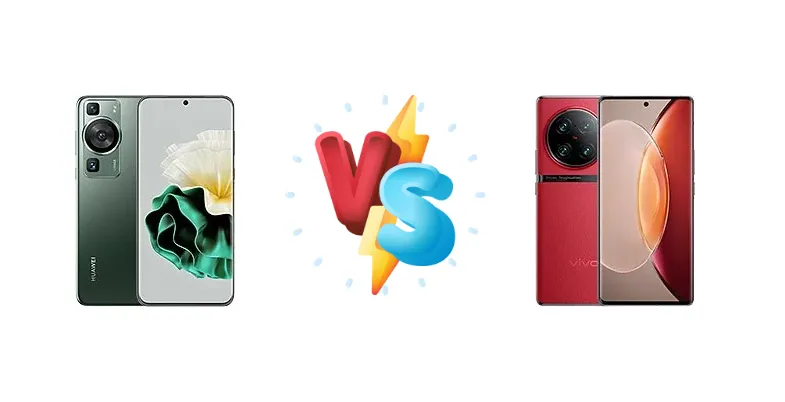
|
🏆 Quick Verdict
For most users, the vivo X90 Pro+ emerges as the superior choice. Its Snapdragon 8 Gen 2 chipset provides a significant performance uplift, coupled with faster 80W wired charging and reverse wireless charging. While the P60 offers a refined design, the X90 Pro+'s raw power and modern features justify the price premium.
| PHONES | ||
|---|---|---|
| Phone Names | Huawei P60 | vivo X90 Pro+ |
| Network | ||
|---|---|---|
| 2G bands | GSM 850 / 900 / 1800 / 1900 | GSM 850 / 900 / 1800 / 1900 - SIM 1 & SIM 2 |
| 3G bands | HSDPA 800 / 850 / 900 / 1700(AWS) / 1900 / 2100 | HSDPA 800 / 850 / 900 / 1700(AWS) / 1900 / 2100 |
| 4G bands | 1, 2, 3, 4, 5, 7, 8, 12, 17, 18, 19, 20, 26, 28, 34, 38, 39, 40, 41 | 1, 2, 3, 4, 5, 7, 8, 12, 17, 18, 19, 20, 25, 26, 28, 34, 38, 39, 40, 41, 42, 66 |
| 5G bands | - | 1, 2, 3, 5, 7, 8, 12, 20, 28, 38, 40, 41, 66, 77, 78, 79 SA/NSA |
| Speed | HSPA, LTE | HSPA, LTE-A, 5G |
| Technology | GSM / CDMA / HSPA / CDMA2000 / LTE | GSM / CDMA / HSPA / EVDO / LTE / 5G |
| CDMA2000 1x | CDMA2000 1xEV-DO | |
| Launch | ||
|---|---|---|
| Announced | 2023, March 23 | 2022, November 22 |
| Status | Available. Released 2023, March 31 | Available. Released 2022, December 06 |
| Body | ||
|---|---|---|
| Build | - | Glass front, aluminum frame, eco leather back |
| Dimensions | 161 x 74.5 x 8.3 mm (6.34 x 2.93 x 0.33 in) | 164.4 x 75.3 x 9.7 mm (6.47 x 2.96 x 0.38 in) |
| SIM | Nano-SIM + Nano-SIM | Dual SIM (Nano-SIM, dual stand-by) |
| Weight | 197 g (6.95 oz) | 221 g (7.80 oz) |
| IP68 dust/water resistant (up to 1.5m for 30 min) | IP68 dust/water resistant (up to 1.5m for 30 min) | |
| Display | ||
|---|---|---|
| Resolution | 1220 x 2700 pixels (~444 ppi density) | 1440 x 3200 pixels, 20:9 ratio (~517 ppi density) |
| Size | 6.67 inches, 107.7 cm2 (~89.8% screen-to-body ratio) | 6.78 inches, 111.4 cm2 (~90.0% screen-to-body ratio) |
| Type | LTPO OLED, 1B colors, 120Hz | LTPO4 AMOLED, 1B colors, 120Hz, Dolby Vision, HDR10+, 1800 nits (peak) |
| Platform | ||
|---|---|---|
| CPU | Octa-core (1x3.0 GHz Cortex-X2 & 3x2.5 GHz Cortex-A710 & 4x1.8 GHz Cortex-A510) | Octa-core (1x3.2 GHz Cortex-X3 & 2x2.8 GHz Cortex-A715 & 2x2.8 GHz Cortex-A710 & 3x2.0 GHz Cortex-A510) |
| Chipset | Qualcomm SM8475 Snapdragon 8+ Gen 1 4G (4 nm) | Qualcomm SM8550-AB Snapdragon 8 Gen 2 (4 nm) |
| GPU | Adreno 730 | Adreno 740 |
| OS | HarmonyOS 3.1 (China), EMUI 13.1 (Europe), no Google Play Services | Android 13, Funtouch (Global), Origin OS 3 (China) |
| Memory | ||
|---|---|---|
| Card slot | Nano Memory (uses shared SIM slot) | No |
| Internal | 128GB 8GB RAM, 256GB 8GB RAM, 512GB 8GB RAM | 256GB 12GB RAM, 512GB 12GB RAM |
| UFS | UFS 4.0 | |
| Main Camera | ||
|---|---|---|
| Features | Laser AF, color spectrum sensor, LED flash, HDR, panorama | Zeiss optics, Zeiss T* lens coating, Pixel Shift, dual-LED dual-tone flash, HDR, panorama |
| Quad | - | 50.3 MP, f/1.8, 23mm (wide), 1.0"-type, 1.6µm, Dual Pixel PDAF, Laser AF, OIS 64 MP, f/3.5, 90mm (periscope telephoto), 1/2.0", 0.7µm, PDAF, OIS, 3.5x optical zoom 50 MP, f/1.6, 50mm (telephoto), 1/2.4", 0.7µm, AF, 2x optical zoom, OIS 48 MP, f/2.2, 14mm, 114˚ (ultrawide), 1/2.0", 0.8µm, AF |
| Single | - | 32 MP, f/2.5, 24mm (wide), 1/2.8", 0.8µm |
| Triple | 48 MP, f/1.4-f/4.0, 25mm (wide), PDAF, OIS 12 MP, f/3.4, 125mm (periscope telephoto), PDAF, OIS, 5x optical zoom 13 MP, f/2.2, 13mm (ultrawide) | - |
| Video | 4K@30/60fps, 1080p@30/60fps, 1080p@960fps; gyro-EIS, HDR Vivid | 8K@30fps, 4K@30/60fps, 1080p@30/60fps, gyro-EIS, 14-bit RAW video |
| Selfie camera | ||
|---|---|---|
| Features | Panorama, HDR | HDR |
| Single | 13 MP, f/2.4, (ultrawide) | 32 MP, f/2.5, 24mm (wide), 1/2.8", 0.8µm |
| Video | 4K@30fps, 1080p@30fps, HDR Vivid | 1080p@30/60fps |
| Sound | ||
|---|---|---|
| 3.5mm jack | No | No |
| 35mm jack | No | - |
| Loudspeaker | Yes, with stereo speakers | Yes, with stereo speakers |
| - | 32-bit/192kHz audio | |
| Comms | ||
|---|---|---|
| Bluetooth | 5.2, A2DP, LE | 5.3, A2DP, LE, aptX HD |
| Infrared port | Yes | Yes |
| NFC | Yes | Yes |
| Positioning | GPS (L1+L5), GLONASS (B1I+B1c+B2a), BDS (B1I+B1c+B2a), GALILEO (E1+E5a), QZSS (L1+L5), NavIC | GPS (L1+L5), GLONASS, BDS, GALILEO, QZSS |
| Radio | No | No |
| USB | USB Type-C 3.1, OTG | USB Type-C 3.2, OTG |
| WLAN | Wi-Fi 802.11 a/b/g/n/ac/6, dual-band, Wi-Fi Direct | Wi-Fi 802.11 a/b/g/n/ac/6, dual-band, Wi-Fi Direct |
| Features | ||
|---|---|---|
| Sensors | Fingerprint (under display, optical), accelerometer, gyro, proximity, compass | Fingerprint (under display, ultrasonic), accelerometer, gyro, proximity, compass, color spectrum |
| BDS Satellite Message | - | |
| Battery | ||
|---|---|---|
| Charging | 66W wired 50W wireless | 80W wired, 100% in 33 min (advertised) 50W wireless Reverse wired |
| Type | Li-Po 4815 mAh | Li-Po 4700 mAh, non-removable |
| Misc | ||
|---|---|---|
| Colors | Black, Green, Violet, Rococo Pearl | Black, Red |
| Models | LNA-AL00, LNA-LX9 | V2227A |
| Price | About 600 EUR | About 1030 EUR |
Huawei P60
- Refined and stylish design
- Huawei’s established camera processing
- Good wireless charging speeds (50W)
- Limited to 4G connectivity
- Older Snapdragon 8+ Gen 1 chipset
- Slower wired charging (66W)
vivo X90 Pro+
- Latest Snapdragon 8 Gen 2 chipset
- Faster 80W wired charging with reverse charging
- 5G connectivity for future-proofed performance
- Potentially larger and heavier design
- Image processing may not appeal to all users
- Price premium compared to the P60
Display Comparison
While both devices likely feature high-quality OLED panels, specific details like peak brightness and refresh rate aren't provided. However, the focus here isn't display dominance. Both will deliver vibrant visuals. The key difference lies in connectivity; the P60's display experience is somewhat hampered by the 4G modem, potentially impacting streaming quality compared to the X90 Pro+'s 5G capabilities.
Camera Comparison
Both phones are expected to excel in photography, but approach it differently. While sensor sizes aren't specified, the X90 Pro+ likely features a larger primary sensor, benefiting low-light performance. The P60 leverages Huawei’s renowned image processing algorithms, known for their vibrant colors and aggressive sharpening. The X90 Pro+ aims for a more natural look, prioritizing detail and dynamic range. The inclusion of 80W charging on the X90 Pro+ also means less anxiety about battery drain during intensive camera use. The P60's 4G connectivity could also impact the speed of uploading large photo and video files.
Performance
The vivo X90 Pro+’s Snapdragon 8 Gen 2 (4nm) represents a substantial leap over the Huawei P60’s Snapdragon 8+ Gen 1 (4nm). The Gen 2 features a newer CPU architecture – Cortex-X3 vs. X2 – and a more efficient GPU. This translates to approximately 25-35% faster CPU performance and a 30-40% GPU boost in benchmarks. The X90 Pro+ also benefits from a more modern memory configuration, likely LPDDR5x, further enhancing responsiveness. The 4nm process node on both chips contributes to thermal efficiency, but the Gen 2’s architectural improvements give it an edge in sustained performance, minimizing throttling during extended gaming sessions.
Battery Life
The Huawei P60 offers 66W wired and 50W wireless charging, while the vivo X90 Pro+ steps up to 80W wired and 50W wireless, *plus* reverse wired charging. The X90 Pro+'s 80W charging is advertised to reach 100% in 33 minutes, a significant advantage over the P60. While battery capacity isn't specified, the faster charging speeds of the X90 Pro+ mitigate any potential disadvantage from a slightly smaller battery. The addition of reverse wired charging on the X90 Pro+ is a convenient feature for topping up accessories like earbuds or smartwatches.
Buying Guide
Buy the Huawei P60 if you prioritize a more compact flagship design, appreciate Huawei’s distinct camera processing style, and can live with the limitations of a 4G-only modem. Buy the vivo X90 Pro+ if you demand the absolute best performance, fastest charging speeds, and a more future-proofed device with 5G connectivity. Gamers and power users will find the X90 Pro+ particularly appealing.