
Huawei P60 vs. Samsung Galaxy S23 FE: Which Flagship Offers the Best Value?
| Phones Images | |||||
|---|---|---|---|---|---|
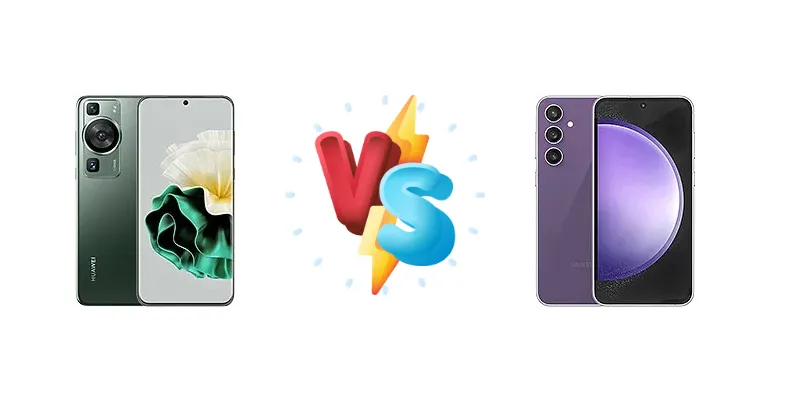
|
🏆 Quick Verdict
For most users, the Samsung Galaxy S23 FE emerges as the stronger all-rounder. Its superior battery life (8:28h active use), brighter display (985 nits), and wider availability of 5G connectivity outweigh the P60’s potentially faster charging and refined aesthetics. However, the P60 remains a viable option for those prioritizing camera quality and don't require 5G.
| PHONES | ||
|---|---|---|
| Phone Names | Huawei P60 | Samsung Galaxy S23 FE |
| Network | ||
|---|---|---|
| 2G bands | GSM 850 / 900 / 1800 / 1900 | GSM 850 / 900 / 1800 / 1900 |
| 3G bands | HSDPA 800 / 850 / 900 / 1700(AWS) / 1900 / 2100 | HSDPA 850 / 900 / 1700(AWS) / 1900 / 2100 |
| 4G bands | 1, 2, 3, 4, 5, 7, 8, 12, 17, 18, 19, 20, 26, 28, 34, 38, 39, 40, 41 | 1, 2, 3, 4, 5, 7, 8, 12, 13, 17, 20, 26, 28, 38, 40, 41, 66 - International |
| 5G bands | - | 1, 2, 3, 5, 7, 8, 20, 28, 38, 40, 41, 66, 77, 78 SA/NSA/Sub6 - International |
| Speed | HSPA, LTE | HSPA, LTE, 5G |
| Technology | GSM / CDMA / HSPA / CDMA2000 / LTE | GSM / HSPA / LTE / 5G |
| CDMA2000 1x | - | |
| Launch | ||
|---|---|---|
| Announced | 2023, March 23 | 2023, October 04 |
| Status | Available. Released 2023, March 31 | Available. Released 2023, October 05 |
| Body | ||
|---|---|---|
| Build | - | Glass front (Gorilla Glass 5), glass back (Gorilla Glass 5), aluminum frame |
| Dimensions | 161 x 74.5 x 8.3 mm (6.34 x 2.93 x 0.33 in) | 158 x 76.5 x 8.2 mm (6.22 x 3.01 x 0.32 in) |
| SIM | Nano-SIM + Nano-SIM | · Nano-SIM· Nano-SIM + Nano-SIM· Nano-SIM + Nano-SIM + eSIM (max 2 at a time) |
| Weight | 197 g (6.95 oz) | 209 g (7.37 oz) |
| IP68 dust/water resistant (up to 1.5m for 30 min) | - | |
| Display | ||
|---|---|---|
| Protection | - | Corning Gorilla Glass 5 |
| Resolution | 1220 x 2700 pixels (~444 ppi density) | 1080 x 2340 pixels, 19.5:9 ratio (~403 ppi density) |
| Size | 6.67 inches, 107.7 cm2 (~89.8% screen-to-body ratio) | 6.4 inches, 100.5 cm2 (~83.2% screen-to-body ratio) |
| Type | LTPO OLED, 1B colors, 120Hz | Dynamic AMOLED 2X, 120Hz, HDR10+, 1450 nits (peak) |
| Platform | ||
|---|---|---|
| CPU | Octa-core (1x3.0 GHz Cortex-X2 & 3x2.5 GHz Cortex-A710 & 4x1.8 GHz Cortex-A510) | Octa-core (1x2.8 GHz Cortex-X2 & 3x2.50 GHz Cortex-A710 & 4x1.8 GHz Cortex-A510) - InternationalOcta-core (1x3.00 GHz Cortex-X2 & 3x2.50 GHz Cortex-A710 & 4x1.80 GHz Cortex-A510) - USA |
| Chipset | Qualcomm SM8475 Snapdragon 8+ Gen 1 4G (4 nm) | Exynos 2200 (4 nm) - InternationalQualcomm SM8450 Snapdragon 8 Gen 1 (4 nm) - USA |
| GPU | Adreno 730 | Xclipse 920 - InternationalAdreno 730 - USA |
| OS | HarmonyOS 3.1 (China), EMUI 13.1 (Europe), no Google Play Services | Android 13, up to 4 major Android upgrades, One UI 8 |
| Memory | ||
|---|---|---|
| Card slot | Nano Memory (uses shared SIM slot) | No |
| Internal | 128GB 8GB RAM, 256GB 8GB RAM, 512GB 8GB RAM | 128GB 8GB RAM, 256GB 8GB RAM |
| UFS | - | |
| Main Camera | ||
|---|---|---|
| Features | Laser AF, color spectrum sensor, LED flash, HDR, panorama | LED flash, HDR, panorama |
| Triple | 48 MP, f/1.4-f/4.0, 25mm (wide), PDAF, OIS 12 MP, f/3.4, 125mm (periscope telephoto), PDAF, OIS, 5x optical zoom 13 MP, f/2.2, 13mm (ultrawide) | 50 MP, f/1.8, 23mm (wide), 1/1.57", 1.0µm, dual pixel PDAF, OIS 8 MP, f/2.4, 76mm (telephoto), 1/4.5", 1.0µm, PDAF, OIS, 3x optical zoom 12 MP, f/2.2, 13mm, 123˚ (ultrawide), 1/3.0", 1.12µm |
| Video | 4K@30/60fps, 1080p@30/60fps, 1080p@960fps; gyro-EIS, HDR Vivid | 8K@24fps, 4K@30/60fps, 1080p@30/60/120/240fps |
| Selfie camera | ||
|---|---|---|
| Features | Panorama, HDR | - |
| Single | 13 MP, f/2.4, (ultrawide) | 10 MP, f/2.4, 25mm (wide), 1/3.0", 1.22µm |
| Video | 4K@30fps, 1080p@30fps, HDR Vivid | 4K@30/60fps, 1080p@30/60fps; gyro-EIS |
| Sound | ||
|---|---|---|
| 3.5mm jack | No | - |
| 35mm jack | No | No |
| Loudspeaker | Yes, with stereo speakers | Yes, with stereo speakers |
| Comms | ||
|---|---|---|
| Bluetooth | 5.2, A2DP, LE | 5.3, A2DP, LE |
| Infrared port | Yes | - |
| NFC | Yes | Yes |
| Positioning | GPS (L1+L5), GLONASS (B1I+B1c+B2a), BDS (B1I+B1c+B2a), GALILEO (E1+E5a), QZSS (L1+L5), NavIC | GPS, GLONASS, GALILEO, BDS |
| Radio | No | Unspecified |
| USB | USB Type-C 3.1, OTG | USB Type-C, OTG |
| WLAN | Wi-Fi 802.11 a/b/g/n/ac/6, dual-band, Wi-Fi Direct | Wi-Fi 802.11 a/b/g/n/ac/6e, dual-band, Wi-Fi Direct |
| Features | ||
|---|---|---|
| Sensors | Fingerprint (under display, optical), accelerometer, gyro, proximity, compass | Fingerprint (under display, optical), accelerometer, gyro, compass |
| BDS Satellite Message | - | |
| Battery | ||
|---|---|---|
| Charging | 66W wired 50W wireless | 25W wired, PD3.0, 50% in 30 min 15W wireless Reverse wireless |
| Type | Li-Po 4815 mAh | Li-Ion 4500 mAh |
| Misc | ||
|---|---|---|
| Colors | Black, Green, Violet, Rococo Pearl | Mint, Cream, Graphite, Purple, Indigo, Tangerine |
| Models | LNA-AL00, LNA-LX9 | SM-S711B, SM-S711B/DS, SM-S711U1, SM-S711U, SM-S711W, SM-S7110, SM-S711N |
| Price | About 600 EUR | $ 219.95 / C$ 327.90 / £ 248.99 / € 272.00 / ₹ 34,999 |
| SAR | - | 0.80 W/kg (head) 0.72 W/kg (body) |
| SAR EU | - | 0.76 W/kg (head) 1.04 W/kg (body) |
Huawei P60
- Faster wired and wireless charging (66W/50W)
- Potentially superior camera image processing
- Efficient Snapdragon 8+ Gen 1 chipset
- Limited to 4G connectivity
- Battery life likely shorter than S23 FE
- Regional availability concerns
Samsung Galaxy S23 FE
- Longer battery life (8:28h active use)
- Brighter display (985 nits)
- 5G connectivity (depending on region)
- Exynos 2200 variant prone to throttling
- Slower charging speeds (25W wired)
- Potentially less refined camera processing
Display Comparison
The Samsung Galaxy S23 FE boasts a significantly brighter display, reaching 985 nits measured, ensuring excellent visibility outdoors. While the P60’s display specs aren’t provided, Huawei typically prioritizes color accuracy. The S23 FE’s higher peak brightness is a tangible benefit for everyday use, especially in sunny conditions. Both phones likely utilize AMOLED panels, but the S23 FE’s brightness advantage is a clear win. The absence of LTPO on either device suggests a standard 120Hz refresh rate, impacting power consumption compared to adaptive refresh rate technologies.
Camera Comparison
Without detailed camera specs beyond 'Photo/Video' for the S23 FE, a direct comparison is challenging. However, Huawei consistently excels in computational photography. The P60 likely leverages advanced algorithms for image processing, potentially delivering superior dynamic range and low-light performance. The S23 FE’s camera system is expected to be versatile, but may not reach the same level of refinement as Huawei’s offering. Ignoring the likely inclusion of 2MP macro lenses on both devices, the main sensor and image processing pipeline will be the deciding factors, and based on brand reputation, the P60 has an edge.
Performance
The chipset choice is a key differentiator. The P60 utilizes the Snapdragon 8+ Gen 1 (4nm), known for its efficiency and strong performance. The S23 FE, however, comes in two variants: the Exynos 2200 (International) and the Snapdragon 8 Gen 1 (USA). The Exynos 2200 has historically faced criticism for thermal throttling under sustained load, potentially impacting gaming performance. While both CPUs share the same core configuration (1x Cortex-X2, 3x Cortex-A710, 4x Cortex-A510), the Snapdragon 8+ Gen 1’s 4nm process offers better thermal efficiency. The USA variant of the S23 FE with the Snapdragon 8 Gen 1 will perform closer to the P60, but still may not match the efficiency of the 8+ Gen 1.
Battery Life
The Samsung Galaxy S23 FE demonstrates a clear advantage in battery life, achieving 8:28h of active use. The P60’s battery capacity is not specified, but its 66W wired and 50W wireless charging capabilities are faster than the S23 FE’s 25W wired and 15W wireless. However, faster charging doesn’t compensate for a smaller battery. The S23 FE’s 25W charging, while slower, can reach 50% in 30 minutes with PD3.0, and its longer battery life provides more sustained usage.
Buying Guide
Buy the Huawei P60 if you prioritize camera performance, appreciate a sleek design, and can live without 5G connectivity. Its 66W wired and 50W wireless charging are also compelling. Buy the Samsung Galaxy S23 FE if you value long battery life, a brighter display, 5G support, and a more balanced overall experience. The S23 FE is the better choice for gamers and power users who need consistent performance.