
Huawei P60 vs Oppo Find X6 Pro: A Deep Dive into Flagship Performance and Photography
| Phones Images | |||||
|---|---|---|---|---|---|
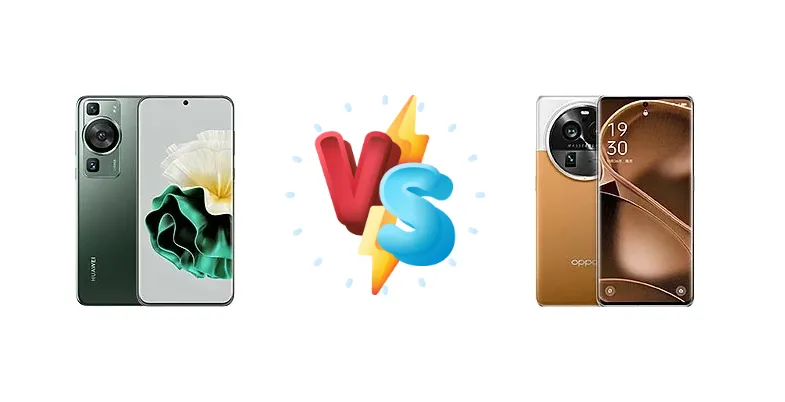
|
🏆 Quick Verdict
For most users, the Oppo Find X6 Pro emerges as the stronger contender. Its Snapdragon 8 Gen 2 chipset delivers a noticeable performance uplift, coupled with significantly faster 100W charging. While the P60 offers a compelling camera system, the Find X6 Pro’s superior processing power and charging speed provide a more well-rounded flagship experience.
| PHONES | ||
|---|---|---|
| Phone Names | Huawei P60 | Oppo Find X6 Pro |
| Network | ||
|---|---|---|
| 2G bands | GSM 850 / 900 / 1800 / 1900 | GSM 850 / 900 / 1800 / 1900 |
| 3G bands | HSDPA 800 / 850 / 900 / 1700(AWS) / 1900 / 2100 | HSDPA 800 / 850 / 900 / 1700(AWS) / 1900 / 2100 |
| 4G bands | 1, 2, 3, 4, 5, 7, 8, 12, 17, 18, 19, 20, 26, 28, 34, 38, 39, 40, 41 | 1, 2, 3, 4, 5, 7, 8, 12, 17, 18, 19, 20, 26, 28, 34, 38, 39, 40, 41, 66 |
| 5G bands | - | 1, 3, 5, 7, 8, 20, 28, 38, 40, 41, 66, 77, 78, 79 SA/NSA |
| Speed | HSPA, LTE | HSPA, LTE, 5G |
| Technology | GSM / CDMA / HSPA / CDMA2000 / LTE | GSM / CDMA / HSPA / CDMA2000 / LTE / 5G |
| CDMA2000 1x | CDMA2000 1x | |
| Launch | ||
|---|---|---|
| Announced | 2023, March 23 | 2023, March 21 |
| Status | Available. Released 2023, March 31 | Available. Released 2023, March 24 |
| Body | ||
|---|---|---|
| Build | - | Glass front (Gorilla Glass Victus 2), glass back (Gorilla Glass 5) or eco leather back, aluminum frame |
| Dimensions | 161 x 74.5 x 8.3 mm (6.34 x 2.93 x 0.33 in) | 164.8 x 76.2 x 9.1 mm or 9.5 mm |
| SIM | Nano-SIM + Nano-SIM | Nano-SIM + Nano-SIM |
| Weight | 197 g (6.95 oz) | 216 g or 218 g (7.62 oz) |
| IP68 dust/water resistant (up to 1.5m for 30 min) | IP68 dust/water resistant (up to 1.5m for 30 min) | |
| Display | ||
|---|---|---|
| Protection | - | Corning Gorilla Glass Victus 2 |
| Resolution | 1220 x 2700 pixels (~444 ppi density) | 1440 x 3168 pixels (~510 ppi density) |
| Size | 6.67 inches, 107.7 cm2 (~89.8% screen-to-body ratio) | 6.82 inches, 113.0 cm2 (~90.0% screen-to-body ratio) |
| Type | LTPO OLED, 1B colors, 120Hz | LTPO3 AMOLED, 1B colors, 120Hz, Dolby Vision, HDR10+, 800 nits (typ), 1500 nits (HBM), 2500 nits (peak) |
| Platform | ||
|---|---|---|
| CPU | Octa-core (1x3.0 GHz Cortex-X2 & 3x2.5 GHz Cortex-A710 & 4x1.8 GHz Cortex-A510) | Octa-core (1x3.2 GHz Cortex-X3 & 2x2.8 GHz Cortex-A715 & 2x2.8 GHz Cortex-A710 & 3x2.0 GHz Cortex-A510) |
| Chipset | Qualcomm SM8475 Snapdragon 8+ Gen 1 4G (4 nm) | Qualcomm SM8550-AB Snapdragon 8 Gen 2 (4 nm) |
| GPU | Adreno 730 | Adreno 740 |
| OS | HarmonyOS 3.1 (China), EMUI 13.1 (Europe), no Google Play Services | Android 13, up to 4 major Android upgrades, ColorOS 14 |
| Memory | ||
|---|---|---|
| Card slot | Nano Memory (uses shared SIM slot) | No |
| Internal | 128GB 8GB RAM, 256GB 8GB RAM, 512GB 8GB RAM | 256GB 12GB RAM, 256GB 16GB RAM, 512GB 16GB RAM |
| UFS | UFS 4.0 | |
| Main Camera | ||
|---|---|---|
| Features | Laser AF, color spectrum sensor, LED flash, HDR, panorama | Laser AF, color spectrum sensor, Hasselblad Color Calibration, LED flash, HDR, panorama |
| Triple | 48 MP, f/1.4-f/4.0, 25mm (wide), PDAF, OIS 12 MP, f/3.4, 125mm (periscope telephoto), PDAF, OIS, 5x optical zoom 13 MP, f/2.2, 13mm (ultrawide) | 50 MP, f/1.8, 23mm (wide), 1.0"-type, 1.6µm, dual pixel PDAF, OIS 50 MP, f/2.6, 65mm (periscope telephoto), 1/1.56", 1.0µm, 2.8x optical zoom, multi-directional PDAF, OIS 50 MP, f/2.2, 15mm, 110˚ (ultrawide), 1/1.56", 1.0µm, multi-directional PDAF |
| Video | 4K@30/60fps, 1080p@30/60fps, 1080p@960fps; gyro-EIS, HDR Vivid | 4K@30/60fps, 1080p@30/60/240fps; gyro-EIS; HDR, 10‑bit video, Dolby Vision |
| Selfie camera | ||
|---|---|---|
| Features | Panorama, HDR | Panorama |
| Single | 13 MP, f/2.4, (ultrawide) | 32 MP, f/2.4, 21mm (wide), 1/2.74", 0.8µm, PDAF |
| Video | 4K@30fps, 1080p@30fps, HDR Vivid | 4K@30fps, gyro-EIS |
| Sound | ||
|---|---|---|
| 3.5mm jack | No | No |
| 35mm jack | No | No |
| Loudspeaker | Yes, with stereo speakers | Yes, with stereo speakers |
| Comms | ||
|---|---|---|
| Bluetooth | 5.2, A2DP, LE | 5.3, A2DP, LE, aptX HD |
| Infrared port | Yes | Yes |
| NFC | Yes | Yes |
| Positioning | GPS (L1+L5), GLONASS (B1I+B1c+B2a), BDS (B1I+B1c+B2a), GALILEO (E1+E5a), QZSS (L1+L5), NavIC | GPS (L1+L5), GLONASS (G1), BDS (B1I+B1c+B2a), GALILEO (E1+E5a), QZSS (L1+L5) |
| Radio | No | No |
| USB | USB Type-C 3.1, OTG | USB Type-C 3.1, OTG |
| WLAN | Wi-Fi 802.11 a/b/g/n/ac/6, dual-band, Wi-Fi Direct | Wi-Fi 802.11 a/b/g/n/ac/6e/7, tri-band, Wi-Fi Direct |
| Features | ||
|---|---|---|
| Sensors | Fingerprint (under display, optical), accelerometer, gyro, proximity, compass | Fingerprint (under display, optical), accelerometer, gyro, proximity, compass |
| BDS Satellite Message | - | |
| Battery | ||
|---|---|---|
| Charging | 66W wired 50W wireless | 100W wired, PD, 45% in 10 min, 100% in 30 min 50W wireless, 50% in 22 min, 100% in 51 min 10W reverse wireless |
| Type | Li-Po 4815 mAh | Li-Po 5000 mAh |
| Misc | ||
|---|---|---|
| Colors | Black, Green, Violet, Rococo Pearl | Black, Green, Brown |
| Models | LNA-AL00, LNA-LX9 | PGEM110, PGEM10 |
| Price | About 600 EUR | About 820 EUR |
| Tests | ||
|---|---|---|
| Battery life | - | Endurance rating 114h |
| Camera | - | Photo / Video |
| Display | - | Contrast ratio: Infinite (nominal) |
| Loudspeaker | - | -25.1 LUFS (Very good) |
| Performance | - | AnTuTu: 1294797 (v9) GeekBench: 4791 (v5.1), 5226 (v6) GFXBench: 60fps (ES 3.1 onscreen) |
Huawei P60
- Potentially more compact design
- Huawei’s established camera processing
- 50W Wireless Charging
- Snapdragon 8+ Gen 1 is a generation behind
- Limited to 4G connectivity
- Less detailed display specifications
Oppo Find X6 Pro
- Snapdragon 8 Gen 2 delivers superior performance
- 100W SuperVOOC charging is incredibly fast
- Brighter and higher contrast display
- Potentially larger and heavier
- Oppo’s ColorOS may not appeal to all users
- May be more expensive
Display Comparison
The Oppo Find X6 Pro boasts a significantly brighter display, reaching a measured peak of 1318 nits compared to an unstated peak for the P60. This translates to superior visibility in direct sunlight. While both likely utilize high-refresh-rate OLED panels, the Find X6 Pro’s infinite contrast ratio suggests a more advanced panel technology. The P60’s display specs are less detailed, leaving questions about its color accuracy and PWM dimming frequency unanswered, potentially impacting users sensitive to flicker.
Camera Comparison
Both phones are marketed as photography powerhouses, but details are scarce. Without specific sensor details for the P60, it’s difficult to make a direct comparison. However, the Find X6 Pro’s image processing benefits from the more powerful Snapdragon 8 Gen 2, enabling faster processing of complex algorithms like HDR and night mode. The P60 likely relies on Huawei’s established computational photography expertise, but the Gen 2’s ISP in the Find X6 Pro offers a clear advantage in dynamic range and detail capture. The lack of information on the P60’s video capabilities makes a direct comparison impossible.
Performance
The core difference lies in the chipsets. The Oppo Find X6 Pro’s Snapdragon 8 Gen 2 (4nm) represents a substantial upgrade over the Huawei P60’s Snapdragon 8+ Gen 1 (4nm). The Gen 2 features a newer Cortex-X3 prime core clocked at 3.2 GHz versus the P60’s 3.0 GHz Cortex-X2. Furthermore, the Gen 2 utilizes a more efficient CPU architecture (Cortex-A715 and A710) compared to the P60’s A710 and A510. This results in faster application loading, smoother multitasking, and improved gaming performance. The P60’s 4G limitation is a significant drawback for users in areas with robust 5G infrastructure.
Battery Life
Both devices achieve an endurance rating of 114 hours, suggesting similar real-world battery life despite the P60’s smaller battery (implied). However, the charging speeds are drastically different. The Oppo Find X6 Pro’s 100W wired charging can replenish the battery to 100% in just 30 minutes, a significant advantage over the P60’s 66W charging. The Find X6 Pro also offers 50W wireless charging (full charge in 51 minutes) and 10W reverse wireless charging, features absent or less capable on the P60’s 50W wireless solution.
Buying Guide
Buy the Huawei P60 if you prioritize a more compact form factor, appreciate Huawei’s distinct camera processing style, and are willing to accept the limitations of a 4G-only modem. Buy the Oppo Find X6 Pro if you demand the fastest possible performance, require rapid charging, and value a brighter, more vibrant display. The Find X6 Pro is the better choice for power users and mobile gamers.