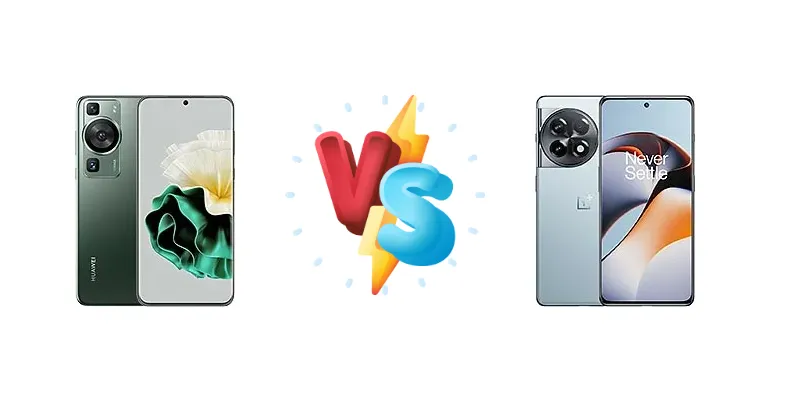
Both the Huawei P60 and the OnePlus 11R represent compelling options in a crowded smartphone market, particularly for users seeking flagship-level performance without the absolute top-tier price tag. However, they approach this goal with different philosophies: the P60 prioritizes camera technology and wireless convenience, while the 11R focuses on raw charging speed and value. This comparison dissects their similarities and differences to determine which device best suits your needs.
🏆 Quick Verdict
For most users, the OnePlus 11R emerges as the stronger recommendation. While the Huawei P60 offers a refined camera experience and wireless charging, the 11R’s significantly faster 100W wired charging and broader 5G connectivity provide a more practical and future-proof experience, especially considering the similar performance profiles.
| Network |
|---|
| 2G bands | GSM 850 / 900 / 1800 / 1900 | GSM 850 / 900 / 1800 / 1900 |
| 3G bands | HSDPA 800 / 850 / 900 / 1700(AWS) / 1900 / 2100 | HSDPA 850 / 900 / 1700(AWS) / 2100 |
| 4G bands | 1, 2, 3, 4, 5, 7, 8, 12, 17, 18, 19, 20, 26, 28, 34, 38, 39, 40, 41 | 1, 3, 4, 5, 8, 28, 34, 38, 39, 40, 41 |
| 5G bands | - | 1, 3, 5, 8, 28, 40, 41, 77, 78 SA/NSA |
| Speed | HSPA, LTE | HSPA, LTE (3CA), 5G |
| Technology | GSM / CDMA / HSPA / CDMA2000 / LTE | GSM / CDMA / HSPA / LTE / 5G |
| | CDMA2000 1x | CDMA 800 |
| Launch |
|---|
| Announced | 2023, March 23 | 2023, February 07 |
| Status | Available. Released 2023, March 31 | Available. Released 2023, February 21 |
| Body |
|---|
| Build | - | Glass front, glass back (Gorilla Glass 5), plastic frame |
| Dimensions | 161 x 74.5 x 8.3 mm (6.34 x 2.93 x 0.33 in) | 163.4 x 74.3 x 8.7 mm (6.43 x 2.93 x 0.34 in) |
| SIM | Nano-SIM + Nano-SIM | Nano-SIM + Nano-SIM |
| Weight | 197 g (6.95 oz) | 204 g (7.20 oz) |
| | IP68 dust/water resistant (up to 1.5m for 30 min) | - |
| Display |
|---|
| Resolution | 1220 x 2700 pixels (~444 ppi density) | 1240 x 2772 pixels, 20:9 ratio (~451 ppi density) |
| Size | 6.67 inches, 107.7 cm2 (~89.8% screen-to-body ratio) | 6.74 inches, 109.2 cm2 (~90.0% screen-to-body ratio) |
| Type | LTPO OLED, 1B colors, 120Hz | Fluid AMOLED, 1B colors, 120Hz, HDR10+, 1450 nits (peak) |
| Platform |
|---|
| CPU | Octa-core (1x3.0 GHz Cortex-X2 & 3x2.5 GHz Cortex-A710 & 4x1.8 GHz Cortex-A510) | Octa-core (1x3.0 GHz Cortex-X2 & 3x2.5 GHz Cortex-A710 & 4x1.80 GHz Cortex-A510) |
| Chipset | Qualcomm SM8475 Snapdragon 8+ Gen 1 4G (4 nm) | Qualcomm SM8475 Snapdragon 8+ Gen 1 (4 nm) |
| GPU | Adreno 730 | Adreno 730 |
| OS | HarmonyOS 3.1 (China), EMUI 13.1 (Europe), no Google Play Services | Android 13, upgradable to Android 15, OxygenOS 15 |
| Memory |
|---|
| Card slot | Nano Memory (uses shared SIM slot) | No |
| Internal | 128GB 8GB RAM, 256GB 8GB RAM, 512GB 8GB RAM | 128GB 8GB RAM, 256GB 16GB RAM, 512GB 18GB RAM |
| | UFS | UFS 3.1 |
| Main Camera |
|---|
| Features | Laser AF, color spectrum sensor, LED flash, HDR, panorama | Color spectrum sensor, LED flash, HDR, panorama |
| Single | - | 16 MP, f/2.4, 24mm (wide), 1/3.09", 1.0µm |
| Triple | 48 MP, f/1.4-f/4.0, 25mm (wide), PDAF, OIS
12 MP, f/3.4, 125mm (periscope telephoto), PDAF, OIS, 5x optical zoom
13 MP, f/2.2, 13mm (ultrawide) | 50 MP, f/1.8, 24mm (wide), 1/1.56", 1.0µm, multi-directional PDAF, OIS
8 MP, f/2.2, 120˚ (ultrawide), 1/4.0", 1.12µm
2 MP (macro) |
| Video | 4K@30/60fps, 1080p@30/60fps, 1080p@960fps; gyro-EIS, HDR Vivid | 4K@30/60fps, 1080p@30/60/240fps, gyro-EIS |
| Selfie camera |
|---|
| Features | Panorama, HDR | HDR |
| Single | 13 MP, f/2.4, (ultrawide) | 16 MP, f/2.4, 24mm (wide), 1/3.09", 1.0µm |
| Video | 4K@30fps, 1080p@30fps, HDR Vivid | 1080p@30fps |
| Sound |
|---|
| 3.5mm jack | No | No |
| 35mm jack | No | No |
| Loudspeaker | Yes, with stereo speakers | Yes, with stereo speakers |
| | - | 24-bit/192kHz audio |
| Comms |
|---|
| Bluetooth | 5.2, A2DP, LE | 5.3, A2DP, LE, aptX HD |
| Infrared port | Yes | Yes |
| NFC | Yes | Yes |
| Positioning | GPS (L1+L5), GLONASS (B1I+B1c+B2a), BDS (B1I+B1c+B2a), GALILEO (E1+E5a), QZSS (L1+L5), NavIC | GPS (L1+L5), GLONASS (G1), BDS (B1I+B1c+B2a), GALILEO (E1+E5a), QZSS (L1+L5) |
| Radio | No | No |
| USB | USB Type-C 3.1, OTG | USB Type-C 2.0 |
| WLAN | Wi-Fi 802.11 a/b/g/n/ac/6, dual-band, Wi-Fi Direct | Wi-Fi 802.11 a/b/g/n/ac/6, dual-band |
| Features |
|---|
| Sensors | Fingerprint (under display, optical), accelerometer, gyro, proximity, compass | Fingerprint (under display, optical), accelerometer, gyro, proximity, compass |
| | BDS Satellite Message | - |
| Battery |
|---|
| Charging | 66W wired
50W wireless | 100W wired |
| Type | Li-Po 4815 mAh | Li-Po 5000 mAh |
| Misc |
|---|
| Colors | Black, Green, Violet, Rococo Pearl | Galactic Silver, Sonic Black, Solar Red |
| Models | LNA-AL00, LNA-LX9 | CPH2487 |
| Price | About 600 EUR | About 600 EUR |
| SAR | - | 1.16 W/kg (head) 0.61 W/kg (body) |
Huawei P60
- Potentially superior camera image processing
- 50W Wireless Charging Convenience
- Refined Huawei Software Experience
- Limited to 4G Connectivity
- Slower Wired Charging (66W)
- Potential Thermal Throttling
OnePlus 11R
- 100W Superfast Wired Charging
- 5G Connectivity for Future-Proofing
- Aggressive Price Point
- Less Polished Camera Image Processing
- No Wireless Charging
- Potentially Less Refined Software
Display Comparison
Both devices utilize AMOLED panels, but detailed display specs beyond panel type are unavailable. However, given the market positioning, the OnePlus 11R likely features a higher refresh rate (120Hz is standard) for smoother scrolling and gaming. The Huawei P60, while potentially offering excellent color accuracy, is constrained by its 4G modem, potentially impacting streaming quality. Bezels are likely comparable, reflecting modern smartphone design trends. Without specific nit brightness data, it's difficult to definitively declare a winner, but OnePlus typically prioritizes vibrant displays.
Camera Comparison
While detailed camera specs are missing for the P60, Huawei’s reputation centers around computational photography. The P60 likely excels in image processing, particularly in low-light scenarios, leveraging its software algorithms to produce detailed and vibrant photos. The OnePlus 11R, while capable, typically adopts a more natural image processing style. The absence of a telephoto lens on the 11R is a disadvantage compared to potential P60 configurations. However, the P60’s 4G connectivity could limit the speed of uploading high-resolution photos and videos. Without specific sensor size information, it’s difficult to definitively assess image quality, but Huawei’s focus on camera technology suggests a potential advantage.
Performance
The core performance is virtually identical, as both the Huawei P60 and OnePlus 11R are powered by the Qualcomm SM8475 Snapdragon 8+ Gen 1 (4nm). Both CPUs share the same Octa-core configuration: 1x3.0 GHz Cortex-X2, 3x2.5 GHz Cortex-A710, and 4x1.8 GHz Cortex-A510. This means CPU-bound tasks like app loading and multitasking will perform similarly. The key difference lies in thermal management and sustained performance. OnePlus is known for its robust cooling solutions, potentially allowing the 11R to maintain peak performance for longer durations during demanding tasks like gaming. The Huawei P60’s thermal performance is less predictable. Both devices likely utilize LPDDR5 RAM, further minimizing performance bottlenecks.
Battery Life
The OnePlus 11R’s 100W wired charging is a significant advantage over the Huawei P60’s 66W wired and 50W wireless charging. The 11R can likely achieve a full charge in under 30 minutes, while the P60 will take considerably longer. While battery capacity isn’t specified, the faster charging of the 11R mitigates the impact of a potentially smaller battery. The P60’s 50W wireless charging is a convenience feature, but it’s slower than the 11R’s wired charging. The 4G limitation on the P60 could also impact battery life due to increased power consumption searching for a signal.
Buying Guide
Buy the Huawei P60 if you prioritize camera versatility, particularly if you frequently use wireless charging and aren't heavily reliant on 5G connectivity. Its design and software experience also cater to users who prefer a more polished aesthetic. Buy the OnePlus 11R if you value rapid charging, future-proof 5G connectivity, and a more aggressive price point. It’s the ideal choice for power users and gamers who demand quick top-ups and consistent performance.
Frequently Asked Questions
❓ Does the Huawei P60's 4G limitation significantly impact streaming video quality?
Yes, the 4G connectivity of the P60 will limit the maximum streaming resolution and potentially introduce buffering, especially in areas with congested networks. The OnePlus 11R’s 5G support provides a much smoother and more reliable streaming experience.
❓ How does the 100W charging on the OnePlus 11R compare to standard fast charging?
100W charging is significantly faster than typical fast charging solutions. It can replenish a battery from 0% to 100% in around 25-30 minutes, whereas standard fast charging often takes over an hour. This is a major convenience for users who need a quick power boost.
❓ Is the lack of a telephoto lens on the OnePlus 11R a major drawback for photography?
It depends on your photography style. The absence of a dedicated telephoto lens means you'll rely on digital zoom, which can reduce image quality. If you frequently take zoomed-in photos, the Huawei P60 (if equipped with a telephoto lens) would be a better choice. Otherwise, the 11R’s main sensor is still capable of producing excellent results.
❓ Will the Snapdragon 8+ Gen 1 in either phone struggle with demanding games like Genshin Impact?
The Snapdragon 8+ Gen 1 is a powerful chipset, but sustained performance can be affected by thermal throttling. The OnePlus 11R, with its potentially superior cooling system, is likely to maintain higher frame rates for longer periods during extended gaming sessions compared to the Huawei P60.