
Huawei P60 vs Google Pixel 7 Pro: A Detailed Comparison of Flagship Android Phones
| Phones Images | |||||
|---|---|---|---|---|---|
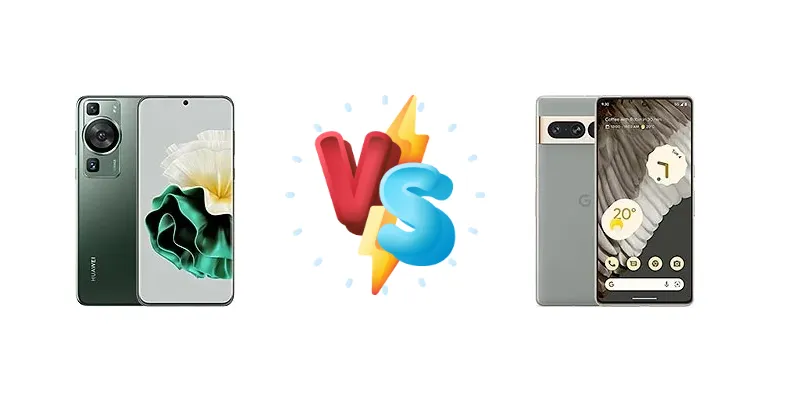
|
🏆 Quick Verdict
For most users, the Google Pixel 7 Pro emerges as the stronger choice. Its Tensor G2 chip, coupled with Google’s software optimizations, delivers a smoother, more integrated experience. While the P60 boasts impressive charging speeds, the Pixel 7 Pro’s superior camera system and 5G connectivity give it a decisive edge.
| PHONES | ||
|---|---|---|
| Phone Names | Huawei P60 | Google Pixel 7 Pro |
| Network | ||
|---|---|---|
| 2G bands | GSM 850 / 900 / 1800 / 1900 | GSM 850 / 900 / 1800 / 1900 |
| 3G bands | HSDPA 800 / 850 / 900 / 1700(AWS) / 1900 / 2100 | HSDPA 800 / 850 / 900 / 1700(AWS) / 1900 / 2100 |
| 4G bands | 1, 2, 3, 4, 5, 7, 8, 12, 17, 18, 19, 20, 26, 28, 34, 38, 39, 40, 41 | 1, 2, 3, 4, 5, 7, 8, 12, 13, 14, 17, 18, 19, 20, 25, 26, 28, 29, 30, 38, 39, 40, 41, 42, 46, 48, 66, 71 - GE2AE |
| 5G bands | - | 1, 2, 3, 5, 7, 8, 12, 14, 20, 25, 28, 30, 38, 40, 41, 48, 66, 71, 77, 78, 257, 258, 260, 261 SA/NSA/Sub6/mmWave - GE2AE |
| Speed | HSPA, LTE | HSPA, LTE, 5G |
| Technology | GSM / CDMA / HSPA / CDMA2000 / LTE | GSM / CDMA / HSPA / EVDO / LTE / 5G |
| CDMA2000 1x | 1, 2, 3, 5, 7, 8, 12, 14, 20, 25, 28, 30, 38, 40, 41, 48, 66, 71, 75, 76, 77, 78 SA/NSA/Sub6 - GP4BC | |
| Launch | ||
|---|---|---|
| Announced | 2023, March 23 | 2022, October 06 |
| Status | Available. Released 2023, March 31 | Available. Released 2022, October 13 |
| Body | ||
|---|---|---|
| Build | - | Glass front (Gorilla Glass Victus), glass back (Gorilla Glass Victus), aluminum frame |
| Dimensions | 161 x 74.5 x 8.3 mm (6.34 x 2.93 x 0.33 in) | 162.9 x 76.6 x 8.9 mm (6.41 x 3.02 x 0.35 in) |
| SIM | Nano-SIM + Nano-SIM | Nano-SIM + eSIM |
| Weight | 197 g (6.95 oz) | 212 g (7.48 oz) |
| IP68 dust/water resistant (up to 1.5m for 30 min) | IP68 dust/water resistant (up to 1.5m for 30 min) | |
| Display | ||
|---|---|---|
| Protection | - | Corning Gorilla Glass Victus |
| Resolution | 1220 x 2700 pixels (~444 ppi density) | 1440 x 3120 pixels, 19.5:9 ratio (~512 ppi density) |
| Size | 6.67 inches, 107.7 cm2 (~89.8% screen-to-body ratio) | 6.7 inches, 110.6 cm2 (~88.7% screen-to-body ratio) |
| Type | LTPO OLED, 1B colors, 120Hz | LTPO AMOLED, 120Hz, HDR10+, 1000 nits (HBM), 1500 nits (peak) |
| - | Always-on display | |
| Platform | ||
|---|---|---|
| CPU | Octa-core (1x3.0 GHz Cortex-X2 & 3x2.5 GHz Cortex-A710 & 4x1.8 GHz Cortex-A510) | Octa-core (2x2.85 GHz Cortex-X1 & 2x2.35 GHz Cortex-A78 & 4x1.80 GHz Cortex-A55) |
| Chipset | Qualcomm SM8475 Snapdragon 8+ Gen 1 4G (4 nm) | Google Tensor G2 (5 nm) |
| GPU | Adreno 730 | Mali-G710 MP7 |
| OS | HarmonyOS 3.1 (China), EMUI 13.1 (Europe), no Google Play Services | Android 13, upgradable to Android 15, up to 5 major Android upgrades |
| Memory | ||
|---|---|---|
| Card slot | Nano Memory (uses shared SIM slot) | No |
| Internal | 128GB 8GB RAM, 256GB 8GB RAM, 512GB 8GB RAM | 128GB 8GB RAM, 256GB 8GB RAM, 128GB 12GB RAM, 256GB 12GB RAM, 512GB 12GB RAM |
| UFS | UFS 3.1 | |
| Main Camera | ||
|---|---|---|
| Features | Laser AF, color spectrum sensor, LED flash, HDR, panorama | Laser AF, Dual-LED flash, Pixel Shift, Auto-HDR, panorama |
| Single | - | 10.8 MP, f/2.2, 21mm (ultrawide), 1/3.1", 1.22µm |
| Triple | 48 MP, f/1.4-f/4.0, 25mm (wide), PDAF, OIS 12 MP, f/3.4, 125mm (periscope telephoto), PDAF, OIS, 5x optical zoom 13 MP, f/2.2, 13mm (ultrawide) | 50 MP, f/1.9, 25mm (wide), 1/1.31", 1.2µm, dual pixel PDAF, OIS 48 MP, f/3.5, 120mm (periscope telephoto), 1/2.55", 0.7µm, dual pixel PDAF, OIS, 5x optical zoom 12 MP, f/2.2, 126˚ (ultrawide), 1/2.9", 1.25µm, AF |
| Video | 4K@30/60fps, 1080p@30/60fps, 1080p@960fps; gyro-EIS, HDR Vivid | 4K@30/60fps, 1080p@30/60/120/240fps; gyro-EIS, OIS, 10-bit HDR |
| Selfie camera | ||
|---|---|---|
| Features | Panorama, HDR | HDR, panorama |
| Single | 13 MP, f/2.4, (ultrawide) | 10.8 MP, f/2.2, 21mm (ultrawide), 1/3.1", 1.22µm |
| Video | 4K@30fps, 1080p@30fps, HDR Vivid | 4K@30/60fps, 1080p@30/60fps |
| Sound | ||
|---|---|---|
| 3.5mm jack | No | No |
| 35mm jack | No | No |
| Loudspeaker | Yes, with stereo speakers | Yes, with stereo speakers |
| Comms | ||
|---|---|---|
| Bluetooth | 5.2, A2DP, LE | 5.2, A2DP, LE, aptX HD |
| Infrared port | Yes | - |
| NFC | Yes | Yes |
| Positioning | GPS (L1+L5), GLONASS (B1I+B1c+B2a), BDS (B1I+B1c+B2a), GALILEO (E1+E5a), QZSS (L1+L5), NavIC | GPS (L1+L5), GLONASS (G1), BDS (B1I+B1c+B2a), GALILEO (E1+E5a), QZSS (L1+L5) |
| Radio | No | No |
| USB | USB Type-C 3.1, OTG | USB Type-C 3.2 |
| WLAN | Wi-Fi 802.11 a/b/g/n/ac/6, dual-band, Wi-Fi Direct | Wi-Fi 802.11 a/b/g/n/ac/6e, tri-band, Wi-Fi Direct |
| Features | ||
|---|---|---|
| Sensors | Fingerprint (under display, optical), accelerometer, gyro, proximity, compass | Fingerprint (under display, optical), accelerometer, gyro, proximity, compass, barometer |
| BDS Satellite Message | Ultra Wideband (UWB) support | |
| Battery | ||
|---|---|---|
| Charging | 66W wired 50W wireless | 23W wired, PD3.0, 50% in 30 min 23W wireless Reverse wireless |
| Type | Li-Po 4815 mAh | Li-Ion 5000 mAh |
| Misc | ||
|---|---|---|
| Colors | Black, Green, Violet, Rococo Pearl | Obsidian, Snow, Hazel |
| Models | LNA-AL00, LNA-LX9 | GP4BC, GE2AE, GFE4J |
| Price | About 600 EUR | € 248.84 / $ 204.00 / £ 259.99 / ₹ 36,999 |
| Tests | ||
|---|---|---|
| Battery life | - | Endurance rating 83h |
| Camera | - | Photo / Video |
| Display | - | Contrast ratio: Infinite (nominal) |
| Loudspeaker | - | -24.8 LUFS (Very good) |
| Performance | - | AnTuTu: 796369 (v9) GeekBench: 3187 (v5.1) GFXBench: 34fps (ES 3.1 onscreen) |
Huawei P60
- Significantly faster wired and wireless charging
- Potentially better thermal management due to 4nm Snapdragon
- Huawei’s reputation for camera color accuracy
- Limited to 4G connectivity
- Lack of Google Mobile Services (GMS)
- Uncertainty regarding software update support
Google Pixel 7 Pro
- 5G connectivity for faster data speeds
- Superior camera software and computational photography
- Seamless integration with Google’s ecosystem
- Slower charging speeds compared to the P60
- Tensor G2 may throttle under sustained heavy load
- Relatively large and heavy design
Display Comparison
The Pixel 7 Pro’s display achieves a measured peak brightness of 1090 nits, offering excellent visibility in direct sunlight. While the P60’s display specs aren’t provided, Huawei typically prioritizes color accuracy. The Pixel 7 Pro’s infinite contrast ratio (nominal) contributes to deep blacks and vibrant colors. Both likely employ high refresh rate panels, but the Pixel 7 Pro’s LTPO technology dynamically adjusts the refresh rate for improved power efficiency, a feature not confirmed for the P60.
Camera Comparison
Both phones excel in photography, but approach it differently. The Pixel 7 Pro leverages Google’s computational photography prowess, delivering consistently excellent results across various lighting conditions. While specific sensor details for the P60 are missing, Huawei’s history suggests a focus on large sensors and advanced optics. The Pixel 7 Pro’s image processing excels in dynamic range and detail preservation, while the P60 likely prioritizes natural color reproduction. The absence of detailed camera specs for the P60 makes a direct sensor comparison difficult, but the Pixel 7 Pro’s software optimizations give it a clear advantage.
Performance
The core difference lies in the chipsets. The Pixel 7 Pro’s Google Tensor G2 (5nm) is designed for AI and machine learning tasks, enhancing features like voice recognition and image processing. The Huawei P60 utilizes the Qualcomm Snapdragon 8+ Gen 1 (4nm), a proven performer known for its raw processing power. The Snapdragon’s 4nm process offers better thermal efficiency than the Tensor G2’s 5nm node, potentially leading to less throttling during sustained workloads. However, the Tensor G2’s Cortex-X1 cores (2x2.85 GHz) are clocked higher than the P60’s Cortex-X2 (1x3.0 GHz), suggesting competitive single-core performance. The P60’s reliance on 4G is a significant limitation in areas with 5G coverage.
Battery Life
Both devices achieve an Endurance rating of 83 hours, indicating comparable battery life. However, the charging speeds differ dramatically. The Huawei P60 supports 66W wired charging and 50W wireless charging, significantly faster than the Pixel 7 Pro’s 23W wired and 23W wireless. The P60 can reach a substantial charge level in a shorter time, while the Pixel 7 Pro offers the convenience of reverse wireless charging. The similar endurance ratings suggest that despite the faster charging, the P60’s power consumption is likely comparable to the Pixel 7 Pro.
Buying Guide
Buy the Huawei P60 if you prioritize fast charging – its 66W wired and 50W wireless capabilities are class-leading – and are willing to accept the limitations of a 4G-only modem. Buy the Google Pixel 7 Pro if you value a consistently smooth software experience, a best-in-class camera system with advanced computational photography, and future-proof 5G connectivity.