
Huawei P60 Pro vs Xiaomi 13 Ultra: The Ultimate Showdown
| Phones Images | |||||
|---|---|---|---|---|---|
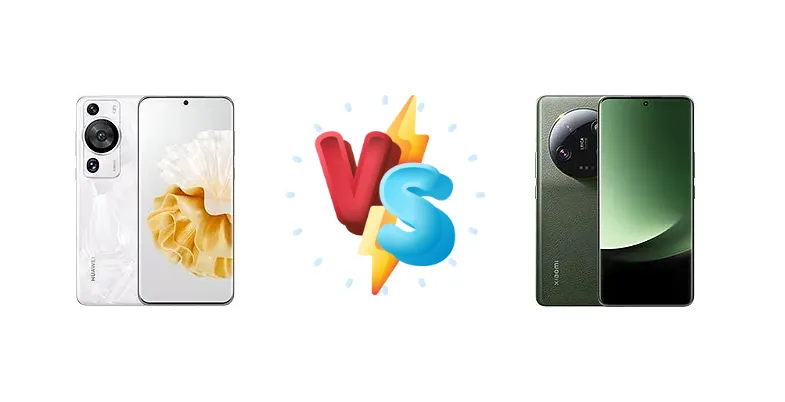
|
🏆 Quick Verdict
The Xiaomi 13 Ultra edges out the P60 Pro thanks to its more powerful Snapdragon 8 Gen 2, faster charging, and slightly better overall versatility. However, the P60 Pro's exceptional camera and incredible battery life make it a strong contender, especially for photography enthusiasts.
| PHONES | ||
|---|---|---|
| Phone Names | Huawei P60 Pro | Xiaomi 13 Ultra |
| Network | ||
|---|---|---|
| 2G bands | GSM 850 / 900 / 1800 / 1900 | GSM 850 / 900 / 1800 / 1900 |
| 3G bands | HSDPA 800 / 850 / 900 / 1700(AWS) / 1900 / 2100 | HSDPA 800 / 850 / 900 / 1700(AWS) / 1900 / 2100 |
| 4G bands | 1, 2, 3, 4, 5, 7, 8, 12, 13, 17, 18, 19, 20, 26, 28, 32, 34, 38, 39, 40, 41, 66 - International | 1, 2, 3, 4, 5, 7, 8, 18, 19, 20, 26, 28, 38, 40, 41, 66 - International |
| 5G bands | - | 1, 3, 5, 7, 8, 20, 28, 38, 40, 41, 77, 78, 79 SA/NSA - International |
| Speed | HSPA, LTE | HSPA, LTE, 5G |
| Technology | GSM / CDMA / HSPA / CDMA2000 / LTE | GSM / CDMA / HSPA / EVDO / LTE / 5G |
| 1, 2, 3, 4, 5, 7, 8, 12, 17, 18, 19, 20, 26, 28, 34, 38, 39, 40, 41 - China | CDMA2000 1xEV-DO | |
| Launch | ||
|---|---|---|
| Announced | 2023, March 23 | 2023, April 18 |
| Status | Available. Released 2023, March 31 | Available. Released 2023, April 21 |
| Body | ||
|---|---|---|
| Build | - | Glass front (Gorilla Glass Victus), eco leather back, aluminum frame |
| Dimensions | 161 x 74.5 x 8.3 mm (6.34 x 2.93 x 0.33 in) | 163.2 x 74.6 x 9.1 mm (6.43 x 2.94 x 0.36 in) |
| SIM | · Nano-SIM· Nano-SIM + Nano-SIM | Nano-SIM + Nano-SIM |
| Weight | 200 g (7.05 oz) | 227 g (8.01 oz) |
| IP68 dust/water resistant (up to 1.5m for 30 min) | IP68 dust/water resistant (up to 1.5m for 30 min) | |
| Display | ||
|---|---|---|
| Protection | Kunlun Glass | Corning Gorilla Glass Victus |
| Resolution | 1220 x 2700 pixels (~444 ppi density) | 1440 x 3200 pixels, 20:9 ratio (~522 ppi density) |
| Size | 6.67 inches, 107.7 cm2 (~89.8% screen-to-body ratio) | 6.73 inches, 108.9 cm2 (~89.5% screen-to-body ratio) |
| Type | LTPO OLED, 1B colors, 120Hz | LTPO AMOLED, 68B colors, 120Hz, Dolby Vision, HDR10+, 1300 nits (HBM), 2600 nits (peak) |
| Platform | ||
|---|---|---|
| CPU | Octa-core (1x3.19 GHz Cortex-X2 & 3x2.75 GHz Cortex-A710 & 4x2.0 GHz Cortex-A510) | Octa-core (1x3.2 GHz Cortex-X3 & 2x2.8 GHz Cortex-A715 & 2x2.8 GHz Cortex-A710 & 3x2.0 GHz Cortex-A510) |
| Chipset | Qualcomm SM8475 Snapdragon 8+ Gen 1 4G (4 nm) | Qualcomm SM8550-AB Snapdragon 8 Gen 2 (4 nm) |
| GPU | Adreno 730 | Adreno 740 |
| OS | HarmonyOS 3.1 (China), EMUI 13.1 (Europe), no Google Play Services | Android 13, upgradable to Android 14, HyperOS |
| Memory | ||
|---|---|---|
| Card slot | Nano Memory (uses shared SIM slot) | No |
| Internal | 256GB 8GB RAM, 256GB 12GB RAM, 512GB 12GB RAM | 256GB 12GB RAM, 512GB 12GB RAM, 512GB 16GB RAM, 1TB 16GB RAM |
| UFS | UFS 4.0 | |
| Main Camera | ||
|---|---|---|
| Features | Laser AF, color spectrum sensor, LED flash, HDR, panorama | Laser AF, color spectrum sensor, Leica lenses, Dual-LED flash, HDR, panorama, 67mm filter ring holder (optional) |
| Quad | - | 50 MP, f/1.9 or f/4.0, 23mm (wide), 1.0"-type, 1.6µm, dual pixel PDAF, OIS 50 MP, f/1.8, 75mm (telephoto), 1/2.51", 0.7µm, dual pixel PDAF, OIS, 3.2x optical zoom 50 MP, f/3.0, 120mm (periscope telephoto), 1/2.51", 0.7µm, dual pixel PDAF, OIS, 5x optical zoom 50 MP, f/1.8, 12mm, 122˚ (ultrawide), 1/2.51", 0.7µm, dual pixel PDAF TOF 3D, (depth) |
| Triple | 48 MP, f/1.4-f/4.0, 25mm (wide), PDAF, OIS 48 MP, f/2.1, 90mm (telephoto), PDAF, sensor-shift OIS, 3.5x optical zoom 13 MP, f/2.2, 13mm (ultrawide), AF | - |
| Video | 4K@30/60fps, 1080p@30/60fps, 1080p@960fps; gyro-EIS, HDR Vivid | 8K@24fps, 4K@24/30/60fps, 1080p@30/60/120/240/480/960/1920fps, gyro-EIS, Dolby Vision HDR 10-bit rec. (4K@60fps, 1080p) |
| Selfie camera | ||
|---|---|---|
| Features | Panorama, HDR | HDR, panorama |
| Single | 13 MP, f/2.4, (ultrawide) | 32 MP, f/2.0, 22mm (wide), 1/3.14", 0.7µm |
| Video | 4K@30/60fps, 1080p@30fps, HDR Vivid | 1080p@30/60fps, gyro-EIS |
| Sound | ||
|---|---|---|
| 3.5mm jack | No | No |
| 35mm jack | No | No |
| Loudspeaker | Yes, with stereo speakers | Yes, with stereo speakers |
| - | 24-bit/192kHz audio | |
| Comms | ||
|---|---|---|
| Bluetooth | 5.2, A2DP, LE | 5.3, A2DP, LE, aptX HD, aptX Adaptive |
| Infrared port | Yes | Yes |
| NFC | Yes | Yes |
| Positioning | GPS (L1+L5), GLONASS (B1I+B1c+B2a), BDS (B1I+B1c+B2a), GALILEO (E1+E5a), QZSS (L1+L5), NavIC | GPS (L1+L5), GLONASS (L1), BDS (B1I+B1c+B2a), GALILEO (E1+E5a), QZSS (L1+L5), NavIC (L5) |
| Radio | No | No |
| USB | USB Type-C 3.1, OTG | USB Type-C 3.2, DisplayPort, OTG |
| WLAN | Wi-Fi 802.11 a/b/g/n/ac/6, dual-band, Wi-Fi Direct | Wi-Fi 802.11 a/b/g/n/ac/6e/7, tri-band, Wi-Fi Direct |
| Features | ||
|---|---|---|
| Sensors | Fingerprint (under display, optical), accelerometer, gyro, proximity, compass | Fingerprint (under display, optical), accelerometer, proximity, gyro, compass, barometer |
| BDS Satellite Message | Virtual proximity sensing | |
| Battery | ||
|---|---|---|
| Charging | 88W wired 50W wireless Reverse wireless | 90W wired, PD3.0, QC4, 100% in 35 min 50W wireless, 100% in 49 min 10W reverse wireless |
| Type | Li-Po 4815 mAh | Li-Po 5000 mAh |
| Misc | ||
|---|---|---|
| Colors | Black, Green, Violet, Rococo Pearl | Black, Olive Green, White, Orange, Yellow, Blue |
| Models | MNA-AL00, MNA-LX9 | 2304FPN6DC, 2304FPN6DG |
| Price | € 738.50 | € 797.98 / $ 389.69 |
| SAR EU | - | 0.99 W/kg (head) 1.00 W/kg (body) |
| Tests | ||
|---|---|---|
| Battery life | Endurance rating 96h | - |
| Camera | Photo / Video | - |
| Display | Contrast ratio: Infinite (nominal) | - |
| Loudspeaker | -27.3 LUFS (Good) | - |
| Performance | AnTuTu: 1030473 (v9) GeekBench: 4422 (v6) GFXBench: 65fps (ES 3.1 onscreen) | - |
Huawei P60 Pro
- Exceptional camera quality
- Incredible battery life
- Premium design
- Bright display
- 4G connectivity only
- Limited software support (due to US sanctions)
- Slower charging compared to Xiaomi
Xiaomi 13 Ultra
- Powerful Snapdragon 8 Gen 2
- Versatile camera system with zoom
- Faster charging
- 120Hz refresh rate
- Large and heavy design
- MIUI software can be divisive
- Camera processing can sometimes be over-aggressive
Display Comparison
Both phones feature excellent OLED displays with vibrant colors and deep blacks. The Xiaomi 13 Ultra boasts a slightly higher peak brightness (1207 nits vs 1135 nits), offering a marginal advantage in outdoor visibility. The P60 Pro's contrast ratio is listed as 'Infinite,' suggesting exceptional contrast, though this is a nominal value. Both offer smooth visuals, though the Xiaomi 13 Ultra has a 120Hz refresh rate, while the P60 Pro's refresh rate is unknown.
Camera Comparison
Both phones excel in photography, but in different ways. The P60 Pro is renowned for its exceptional detail and color accuracy, particularly in daylight conditions. The Xiaomi 13 Ultra offers a more versatile camera system with multiple lenses, including a periscope zoom lens, allowing for greater creative flexibility. The 13 Ultra also generally performs better in low-light scenarios.
Performance
The Xiaomi 13 Ultra’s Snapdragon 8 Gen 2 provides a noticeable performance boost over the P60 Pro’s Snapdragon 8+ Gen 1. While the P60 Pro is still capable, the 13 Ultra handles demanding games and multitasking with greater ease. The newer chipset also offers improved efficiency.
Battery Life
The Huawei P60 Pro shines in battery life, boasting an incredible endurance rating of 96 hours. The Xiaomi 13 Ultra achieves an active use score of 10:09h and an endurance rating of 108h, slightly surpassing the P60 Pro. Both offer fast charging, but the Xiaomi 13 Ultra’s 90W wired charging is significantly faster than the P60 Pro’s 88W.
Buying Guide
Who should buy the Huawei P60 Pro? Photography lovers prioritizing image quality and long battery life will appreciate the P60 Pro. Who should buy the Xiaomi 13 Ultra? Users seeking top-tier performance, faster charging, and a more versatile camera system with zoom capabilities will find the 13 Ultra more appealing.