
Huawei P50E vs P40 Pro+: A Clash of Generations
| Phones Images | |||||
|---|---|---|---|---|---|
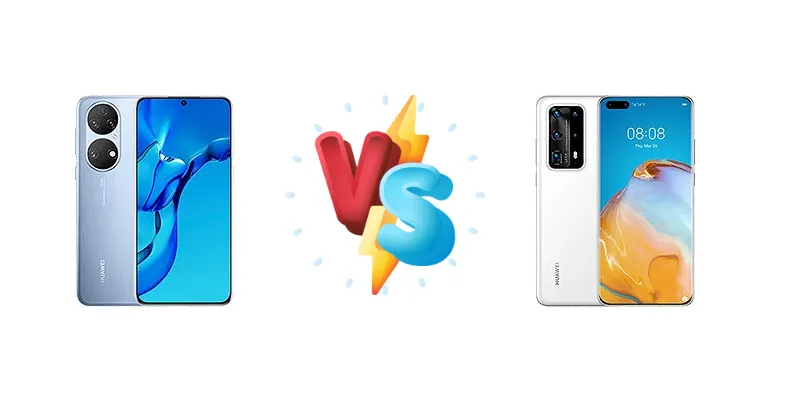
|
🏆 Quick Verdict
The P40 Pro+ remains a strong contender thanks to its superior camera system, faster wireless charging, and excellent battery life. However, the P50E boasts a more modern chipset and faster wired charging. Ultimately, the P40 Pro+ wins for photography enthusiasts, while the P50E offers a more balanced experience.
| PHONES | ||
|---|---|---|
| Phone Names | Huawei P50E | Huawei P40 Pro+ |
| Network | ||
|---|---|---|
| 2G bands | GSM 850 / 900 / 1800 / 1900 | GSM 850 / 900 / 1800 / 1900 |
| 3G bands | HSDPA 800 / 850 / 900 / 1700(AWS) / 1900 / 2100 | HSDPA 800 / 850 / 900 / 1700(AWS) / 1900 / 2100 |
| 4G bands | 1, 2, 3, 4, 5, 7, 8, 12, 17, 18, 19, 20, 26, 28, 34, 38, 39, 40, 41 | 1, 2, 3, 4, 5, 6, 7, 8, 9, 12, 17, 18, 19, 20, 26, 28, 34, 38, 39, 40, 41 |
| 5G bands | - | 1, 3, 28, 38, 41, 77, 78, 79 SA/NSA |
| Speed | HSPA, LTE | HSPA, LTE, 5G |
| Technology | GSM / CDMA / HSPA / CDMA2000 / LTE | GSM / HSPA / LTE / 5G |
| CDMA2000 1x | - | |
| Launch | ||
|---|---|---|
| Announced | 2022, March 17 | 2020, March 26 |
| Status | Available. Released 2022, March 24 | Available. Released 2020, June 06 |
| Body | ||
|---|---|---|
| Build | - | Glass front, ceramic back, ceramic frame |
| Dimensions | 156.5 x 73.8 x 7.9 mm (6.16 x 2.91 x 0.31 in) | 158.2 x 72.6 x 9 mm (6.23 x 2.86 x 0.35 in) |
| SIM | Nano-SIM + Nano-SIM | · Nano-SIM· Nano-SIM + Nano-SIM |
| Weight | 181 g (6.38 oz) | 226 g (7.97 oz) |
| IP68 dust/water resistant (up to 1.5m for 30 min) | IP68 dust/water resistant (up to 1.5m for 30 mins) | |
| Display | ||
|---|---|---|
| Resolution | 1224 x 2700 pixels (~456 ppi density) | 1200 x 2640 pixels (~441 ppi density) |
| Size | 6.5 inches, 102.5 cm2 (~88.8% screen-to-body ratio) | 6.58 inches, 105.2 cm2 (~91.6% screen-to-body ratio) |
| Type | OLED, 1B colors, 90Hz | OLED, 90Hz, HDR10 |
| Platform | ||
|---|---|---|
| CPU | Octa-core (4x2.4 GHz Kryo 670 & 4x1.8 GHz Kryo 670) | Octa-core (2x2.86 GHz Cortex-A76 & 2x2.36 GHz Cortex-A76 & 4x1.95 GHz Cortex-A55) |
| Chipset | Qualcomm SM7325 Snapdragon 778G 4G (6 nm) | Kirin 990 5G (7 nm+) |
| GPU | Adreno 642L | Mali-G76 MP16 |
| OS | HarmonyOS 2.0 | Android 10, EMUI 10.1, no Google Play Services |
| Memory | ||
|---|---|---|
| Card slot | Nano Memory (uses shared SIM slot) | Nano Memory (uses shared SIM slot) |
| Internal | 128GB 8GB RAM, 256GB 8GB RAM | 256GB 8GB RAM, 512GB 8GB RAM |
| - | UFS 3.0 | |
| Main Camera | ||
|---|---|---|
| Features | Laser AF, color spectrum sensor, Leica optics, dual-LED flash, panorama, HDR | Leica optics, color spectrum sensor, LED flash, panorama, HDR |
| Quad | - | 50 MP, f/1.9, 23mm (wide), 1/1.28", 1.22µm, dual pixel PDAF, OIS 8 MP, f/4.4, 240mm (periscope telephoto), PDAF, OIS, 10x optical zoom 8 MP, f/2.4, 80mm (telephoto), PDAF, OIS, 3x optical zoom 40 MP, f/1.8, 18mm (ultrawide), 1/1.54", PDAF TOF 3D, (depth) |
| Single | 13 MP, f/2.4, 100˚ (ultrawide) | - |
| Triple | 50 MP, f/1.8, 23mm (wide), PDAF, OIS 12 MP, f/3.4, 125mm (periscope telephoto), PDAF, OIS, 5x optical zoom 13 MP, f/2.2, 16mm (ultrawide) | - |
| Video | 4K@30/60fps, 1080p@30/60fps; gyro-EIS | 4K@30/60fps, 1080p@30/60fps, 720@7680fps, 1080p@960fps, HDR; gyro-EIS |
| Selfie camera | ||
|---|---|---|
| Features | Panorama, HDR | HDR |
| Single | 13 MP, f/2.4, 100˚ (ultrawide) | 32 MP, f/2.2, 26mm (wide), 1/2.8", 0.8µm, AF IR TOF 3D, (depth/biometrics sensor) |
| Video | 4K@30fps, 1080p@30/60fps | 4K@30/60fps, 1080p@30/60fps |
| Sound | ||
|---|---|---|
| 3.5mm jack | No | No |
| 35mm jack | No | No |
| Loudspeaker | Yes, with stereo speakers | Yes |
| - | 32-bit/384kHz audio | |
| Comms | ||
|---|---|---|
| Bluetooth | 5.2, A2DP, LE | 5.1, A2DP, LE |
| Infrared port | - | Yes |
| NFC | Yes | Yes |
| Positioning | GPS (L1+L5), GLONASS (L1), BDS (B1I+B1c+B2a), GALILEO (E1+E5a), QZSS (L1+L5), NavIC (L5) | GPS (L1+L5), GLONASS (L1), BDS (B1I+B1c+B2a), GALILEO (E1+E5a), QZSS (L1+L5), NavIC |
| Radio | No | No |
| USB | USB Type-C 3.1, OTG | USB Type-C 3.1, OTG |
| WLAN | Wi-Fi 802.11 a/b/g/n/ac/6, dual-band, Wi-Fi Direct | Wi-Fi 802.11 a/b/g/n/ac/6, dual-band, Wi-Fi Direct |
| Features | ||
|---|---|---|
| Sensors | Fingerprint (under display, optical), accelerometer, gyro, proximity, compass | Infrared Face ID, fingerprint (under display, optical), accelerometer, gyro, proximity, compass |
| Battery | ||
|---|---|---|
| Charging | 66W wired | 40W wired 40W wireless 27W reverse wireless |
| Type | Li-Po 4100 mAh | Li-Po 4200 mAh |
| Misc | ||
|---|---|---|
| Colors | Galaxy Blue, Cocoa Tea Gold, Snow White, Obsidian Black | White Ceramic, Black Ceramic |
| Models | ABR-AL60 | ELS-N39, ELS-AN10 |
| Price | About 580 EUR | About 1000 EUR |
| Tests | ||
|---|---|---|
| Battery life | - | Endurance rating 95h |
| Camera | - | Photo / Video |
| Display | - | Contrast ratio: Infinite (nominal) |
| Loudspeaker | - | -27.4 LUFS (Good) |
| Performance | - | AnTuTu: 529687 (v8) GeekBench: 3203 (v5.1) GFXBench: 31fps (ES 3.1 onscreen) |
Huawei P50E
- Modern Snapdragon 778G 4G chipset
- Faster 66W wired charging
- Generally smoother user experience
- Potentially more software updates (depending on region)
- Less impressive camera compared to P40 Pro+
- No wireless charging
- Lower peak brightness display
- Unknown battery life figures
Huawei P40 Pro+
- Exceptional camera system
- Excellent battery life (95h endurance rating)
- Wireless charging (40W) and reverse wireless charging
- High-quality display with infinite contrast ratio
- Strong single-core performance
- Older chipset (Kirin 990 5G)
- Slower wired charging (40W)
- Potentially fewer software updates
- Larger and heavier design
Display Comparison
The P40 Pro+ features a stunning display with a near-infinite contrast ratio, offering exceptional visual depth. While the P50E's display is good, it lacks the same level of contrast and peak brightness (760 nits vs unknown for P50E). The P40 Pro+'s display is noticeably more vibrant and immersive.
Camera Comparison
The P40 Pro+’s camera system is a major highlight, offering exceptional detail, dynamic range, and low-light performance. It generally surpasses the P50E in overall image quality. The P50E's camera is still good, but doesn't reach the same heights as its predecessor. The P40 Pro+’s zoom capabilities are also superior.
Performance
The P50E's Snapdragon 778G 4G provides a solid performance boost over the P40 Pro+'s Kirin 990 5G, particularly in graphics-intensive tasks. While the Kirin 990 5G is still capable, the 778G offers a more modern architecture and improved efficiency. However, the P40 Pro+'s CPU configuration with its Cortex-A76 cores provides strong single-core performance.
Battery Life
Both phones offer excellent battery life, with the P40 Pro+ achieving an impressive endurance rating of 95h. The P50E's battery life is also very good, though specific figures are unavailable. The P40 Pro+ also has the advantage of 40W wireless charging and 27W reverse wireless charging, features absent in the P50E.
Buying Guide
The Huawei P50E is ideal for users prioritizing a smooth, modern experience with decent performance and fast charging, especially those less concerned with top-tier camera capabilities. The Huawei P40 Pro+ is perfect for photography lovers who demand exceptional image quality and long battery life, and are comfortable with a slightly older device.