
Huawei P50E vs Huawei P40 4G: A Clash of Generations
| Phones Images | |||||
|---|---|---|---|---|---|
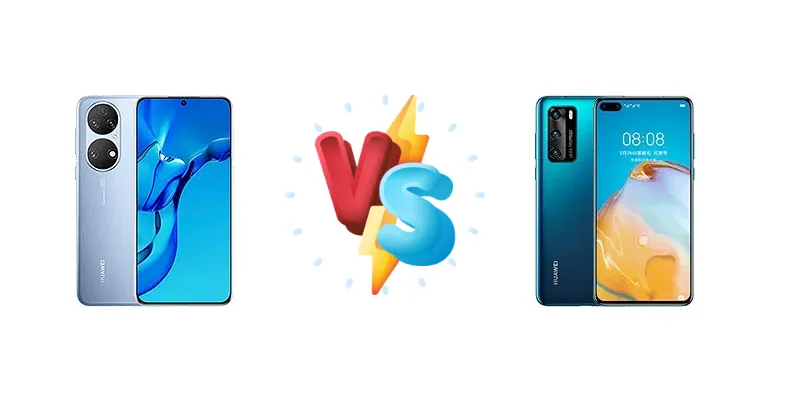
|
🏆 Quick Verdict
The Huawei P50E takes the crown thanks to its significantly faster charging, more modern chipset, and generally improved performance. While the P40 4G still holds its own with a solid camera, the P50E's advancements make it the more compelling choice for most users.
| PHONES | ||
|---|---|---|
| Phone Names | Huawei P50E | Huawei P40 4G |
| Network | ||
|---|---|---|
| 2G bands | GSM 850 / 900 / 1800 / 1900 | GSM 850 / 900 / 1800 / 1900 |
| 3G bands | HSDPA 800 / 850 / 900 / 1700(AWS) / 1900 / 2100 | HSDPA 850 / 900 / 1700(AWS) / 1900 / 2100 |
| 4G bands | 1, 2, 3, 4, 5, 7, 8, 12, 17, 18, 19, 20, 26, 28, 34, 38, 39, 40, 41 | LTE |
| Speed | HSPA, LTE | HSPA, LTE |
| Technology | GSM / CDMA / HSPA / CDMA2000 / LTE | GSM / HSPA / LTE |
| CDMA2000 1x | - | |
| Launch | ||
|---|---|---|
| Announced | 2022, March 17 | 2021, February 26 |
| Status | Available. Released 2022, March 24 | Available. Released 2021, February 26 |
| Body | ||
|---|---|---|
| Build | - | Glass front, glass back, aluminum frame |
| Dimensions | 156.5 x 73.8 x 7.9 mm (6.16 x 2.91 x 0.31 in) | 148.9 x 71.1 x 8.5 mm (5.86 x 2.80 x 0.33 in) |
| SIM | Nano-SIM + Nano-SIM | · Nano-SIM + eSIM· Nano-SIM + Nano-SIM |
| Weight | 181 g (6.38 oz) | 175 g (6.17 oz) |
| IP68 dust/water resistant (up to 1.5m for 30 min) | IP53, dust and splash resistant | |
| Display | ||
|---|---|---|
| Resolution | 1224 x 2700 pixels (~456 ppi density) | 1080 x 2340 pixels, 19.5:9 ratio (~422 ppi density) |
| Size | 6.5 inches, 102.5 cm2 (~88.8% screen-to-body ratio) | 6.1 inches, 91.3 cm2 (~86.3% screen-to-body ratio) |
| Type | OLED, 1B colors, 90Hz | OLED |
| Platform | ||
|---|---|---|
| CPU | Octa-core (4x2.4 GHz Kryo 670 & 4x1.8 GHz Kryo 670) | Octa-core (2x2.86 GHz Cortex-A76 & 2x2.09 GHz Cortex-A76 & 4x1.86 GHz Cortex-A55) |
| Chipset | Qualcomm SM7325 Snapdragon 778G 4G (6 nm) | Kirin 990 (7 nm+) |
| GPU | Adreno 642L | Mali-G76 MP16 |
| OS | HarmonyOS 2.0 | Android 10, EMUI, no Google Play Services |
| Memory | ||
|---|---|---|
| Card slot | Nano Memory (uses shared SIM slot) | Nano Memory (uses shared SIM slot) |
| Internal | 128GB 8GB RAM, 256GB 8GB RAM | 128GB 4GB RAM, 128GB 8GB RAM |
| - | UFS 3.0 | |
| Main Camera | ||
|---|---|---|
| Features | Laser AF, color spectrum sensor, Leica optics, dual-LED flash, panorama, HDR | Leica optics, color spectrum sensor, LED flash, panorama, HDR |
| Single | 13 MP, f/2.4, 100˚ (ultrawide) | 32 MP, f/2.0, 26mm (wide), 1/2.8", 0.8µm IR TOF 3D, (biometrics sensor only) |
| Triple | 50 MP, f/1.8, 23mm (wide), PDAF, OIS 12 MP, f/3.4, 125mm (periscope telephoto), PDAF, OIS, 5x optical zoom 13 MP, f/2.2, 16mm (ultrawide) | 50 MP, f/1.9, 23mm (wide), 1/1.28", 1.22µm, multi-directional PDAF, OIS 8 MP, f/2.4, 80mm (telephoto), PDAF, OIS, 3x optical zoom 16 MP, f/2.2, 17mm (ultrawide), AF |
| Video | 4K@30/60fps, 1080p@30/60fps; gyro-EIS | 4K@30/60fps, 1080p@30/60fps, 720p@960fps; gyro-EIS |
| Selfie camera | ||
|---|---|---|
| Features | Panorama, HDR | HDR |
| Single | 13 MP, f/2.4, 100˚ (ultrawide) | 32 MP, f/2.0, 26mm (wide), 1/2.8", 0.8µm IR TOF 3D, (biometrics sensor only) |
| Video | 4K@30fps, 1080p@30/60fps | 4K@30/60fps, 1080p@30/60fps |
| Sound | ||
|---|---|---|
| 3.5mm jack | No | No |
| 35mm jack | No | No |
| Loudspeaker | Yes, with stereo speakers | Yes |
| Comms | ||
|---|---|---|
| Bluetooth | 5.2, A2DP, LE | 5.1, A2DP, LE |
| NFC | Yes | Yes |
| Positioning | GPS (L1+L5), GLONASS (L1), BDS (B1I+B1c+B2a), GALILEO (E1+E5a), QZSS (L1+L5), NavIC (L5) | GPS (L1+L5), GLONASS (L1), BDS (B1I+B1c+B2a), GALILEO (E1+E5a), QZSS (L1+L5), NavIC |
| Radio | No | No |
| USB | USB Type-C 3.1, OTG | USB Type-C 3.1, OTG |
| WLAN | Wi-Fi 802.11 a/b/g/n/ac/6, dual-band, Wi-Fi Direct | Wi-Fi 802.11 a/b/g/n/ac/6, dual-band, Wi-Fi Direct |
| Features | ||
|---|---|---|
| Sensors | Fingerprint (under display, optical), accelerometer, gyro, proximity, compass | Infrared Face ID, fingerprint (under display, optical), accelerometer, gyro, proximity, compass |
| Battery | ||
|---|---|---|
| Charging | 66W wired | 22.5W wired |
| Type | Li-Po 4100 mAh | Li-Po 3800 mAh |
| Misc | ||
|---|---|---|
| Colors | Galaxy Blue, Cocoa Tea Gold, Snow White, Obsidian Black | Frost Silver, Dark Blue |
| Models | ABR-AL60 | ANA-AL00 |
| Price | About 580 EUR | About 500 EUR |
Huawei P50E
- Faster Charging (66W)
- More Modern Chipset (Snapdragon 778G 4G)
- Improved Performance
- Slightly more modern design
- Potentially slightly less impressive zoom compared to P40 4G
- Software support may be limited due to Huawei's situation
Huawei P40 4G
- Excellent Camera (especially zoom)
- Mature Software (potentially)
- Generally more affordable
- Slower Charging (22.5W)
- Older Chipset (Kirin 990)
- Lower Performance
- Older Design
Display Comparison
Both phones feature OLED displays, offering vibrant colors and deep blacks. The P50E likely has a slightly more modern panel with potentially better brightness and color accuracy, though specific details on resolution and refresh rate are needed for a definitive comparison. Both offer excellent viewing experiences.
Camera Comparison
The P40 4G was renowned for its Leica-engineered camera system, particularly its periscope zoom lens. While the P50E also boasts a capable camera, the P40 4G's zoom capabilities might still be slightly superior. Image processing and overall camera features are comparable, but the P40 4G's zoom is a key differentiator.
Performance
The Snapdragon 778G 4G in the P50E is a clear winner here. It's built on a more efficient 6nm process and offers noticeably better CPU and GPU performance compared to the Kirin 990 in the P40 4G. Expect smoother multitasking and better gaming performance on the P50E.
Battery Life
The P50E's 66W wired charging is a game-changer compared to the P40 4G's 22.5W. You'll be able to top up the P50E's battery much faster. Battery capacity is likely similar between the two devices, but the P50E's charging speed provides a significant advantage.
Buying Guide
The Huawei P50E is ideal for users prioritizing fast charging, smooth performance, and a more recent chipset. The Huawei P40 4G is a good option for those seeking a reliable camera and a more budget-friendly price point, especially if charging speed isn't a major concern.