
Huawei P50 vs Xiaomi Mi 11 Ultra: A Deep Dive into Flagship Performance
| Phones Images | |||||
|---|---|---|---|---|---|
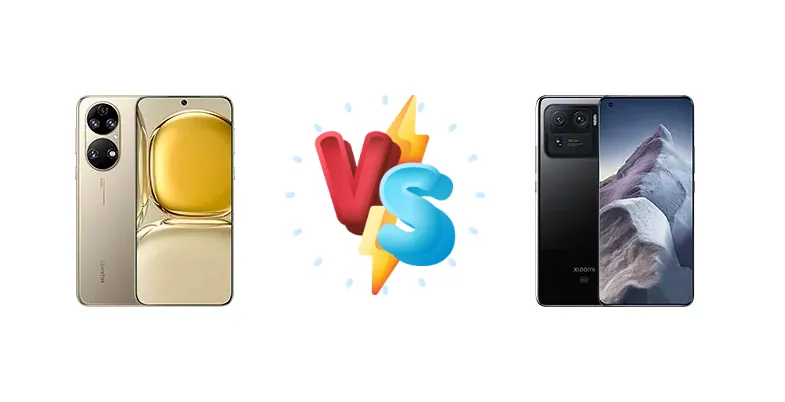
|
🏆 Quick Verdict
For most users, the Xiaomi Mi 11 Ultra emerges as the superior choice. Its 5G connectivity, faster charging speeds (including 67W wireless), and comparable performance offset the P50’s strengths. However, users prioritizing a potentially more refined camera experience and not needing 5G may find the P50 compelling.
| PHONES | ||
|---|---|---|
| Phone Names | Huawei P50 | Xiaomi Mi 11 Ultra |
| Network | ||
|---|---|---|
| 2G bands | GSM 850 / 900 / 1800 / 1900 | GSM 850 / 900 / 1800 / 1900 |
| 3G bands | HSDPA 800 / 850 / 900 / 1700(AWS) / 1900 / 2100 | HSDPA 850 / 900 / 1700(AWS) / 1900 / 2100 |
| 4G bands | 1, 2, 3, 4, 5, 6, 7, 8, 9, 12, 17, 18, 19, 20, 26, 28, 34, 38, 39, 40, 41 | 1, 2, 3, 4, 5, 7, 8, 12, 17, 20, 28, 32, 38, 40, 41, 42, 66 - International |
| 5G bands | - | 1, 3, 5, 7, 8, 20, 28, 38, 40, 41, 77, 78, 79 SA/NSA - International |
| Speed | HSPA, LTE | HSPA, LTE, 5G |
| Technology | GSM / CDMA / HSPA / CDMA2000 / LTE | GSM / CDMA / HSPA / EVDO / LTE / 5G |
| CDMA2000 1x | 1, 3, 28, 41, 77, 78, 79 SA/NSA - China | |
| Launch | ||
|---|---|---|
| Announced | 2021, July 29 | 2021, March 29 |
| Status | Available. Released 2021, October 04 | Available. Released 2021, April 02 |
| Body | ||
|---|---|---|
| Build | - | Glass front (Gorilla Glass Victus), ceramic back, aluminum frame |
| Dimensions | 156.5 x 73.8 x 7.9 mm (6.16 x 2.91 x 0.31 in) | 164.3 x 74.6 x 8.4 mm (6.47 x 2.94 x 0.33 in) |
| SIM | Nano-SIM + Nano-SIM | Nano-SIM + Nano-SIM |
| Weight | 181 g (6.38 oz) | 234 g (8.25 oz) |
| IP68 dust/water resistant (up to 1.5m for 30 min) | IP68 dust/water resistant (up to 1.5m for 30 min) | |
| Display | ||
|---|---|---|
| Protection | - | Corning Gorilla Glass Victus |
| Resolution | 1224 x 2700 pixels (~458 ppi density) | 1440 x 3200 pixels, 20:9 ratio (~515 ppi density) |
| Size | 6.5 inches, 101.6 cm2 (~88.0% screen-to-body ratio) | 6.81 inches, 112.0 cm2 (~91.4% screen-to-body ratio) |
| Type | OLED, 1B colors, 90Hz | AMOLED, 1B colors, 120Hz, HDR10+, Dolby Vision, 900 nits (HBM), 1700 nits (peak) |
| Platform | ||
|---|---|---|
| CPU | Octa-core (1x2.84 GHz Cortex-X1 & 3x2.42 GHz Cortex-A78 & 4x1.80 GHz Cortex-A55) | Octa-core (1x2.84 GHz Cortex-X1 & 3x2.42 GHz Cortex-A78 & 4x1.80 GHz Cortex-A55) |
| Chipset | Qualcomm SM8350 Snapdragon 888 4G (5 nm) | Qualcomm SM8350 Snapdragon 888 5G (5 nm) |
| GPU | Adreno 660 | Adreno 660 |
| OS | HarmonyOS 2.0 | Android 11, upgradable to Android 13, MIUI 14 |
| Memory | ||
|---|---|---|
| Card slot | Nano Memory (uses shared SIM slot) | No |
| Internal | 128GB 8GB RAM, 256GB 8GB RAM | 256GB 8GB RAM, 256GB 12GB RAM, 512GB 12GB RAM |
| - | UFS 3.1 | |
| Main Camera | ||
|---|---|---|
| Features | Laser AF, color spectrum sensor, Leica optics, dual-LED flash, panorama, HDR | Laser AF, color spectrum sensor, Dual-LED flash, HDR, panorama, 1.1” AMOLED selfie display |
| Single | 13 MP, f/2.4, (wide) | 20 MP, f/2.2, 27mm (wide), 1/3.4", 0.8µm |
| Triple | 50 MP, f/1.8, 23mm (wide), PDAF, OIS 12 MP, f/3.4, 125mm (periscope telephoto), PDAF, OIS, 5x optical zoom 13 MP, f/2.2, 16mm (ultrawide) | 50 MP, f/2.0, 24mm (wide), 1/1.12", 1.4µm, dual pixel PDAF, OIS 48 MP, f/4.1, 120mm (periscope telephoto), 1/2.0", 0.8µm, PDAF, OIS, 5x optical zoom 48 MP, f/2.2, 12mm, 128˚ (ultrawide), 1/2.0", 0.8µm, PDAF |
| Video | 4K@30/60fps, 1080p@30/60fps, 1080p@960fps; gyro-EIS | 8K@24fps, 4K@30/60fps, 1080p@30/60/120/240/960/1920fps, gyro-EIS, HDR10+ rec. |
| Selfie camera | ||
|---|---|---|
| Features | Panorama, HDR | HDR, panorama |
| Single | 13 MP, f/2.4, (wide) | 20 MP, f/2.2, 27mm (wide), 1/3.4", 0.8µm |
| Video | 4K@30fps, 1080p@30/60/240fps | 1080p@30/60fps, 720p@120fps, gyro-EIS |
| Sound | ||
|---|---|---|
| 3.5mm jack | No | No |
| 35mm jack | No | No |
| Loudspeaker | Yes, with stereo speakers | Yes, with stereo speakers |
| - | 24-bit/192kHz audio Tuned by Harman Kardon | |
| Comms | ||
|---|---|---|
| Bluetooth | 5.2, A2DP, LE | 5.2, A2DP, LE, aptX HD, aptX Adaptive |
| Infrared port | - | Yes |
| NFC | Yes | Yes |
| Positioning | GPS (L1+L5), GLONASS (L1), BDS (B1I+B1c+B2a), GALILEO (E1+E5a), QZSS (L1+L5), NavIC (L5) | GPS (L1+L5), GLONASS (L1), BDS (B1I+B1c+B2a), GALILEO (E1+E5a), QZSS (L1+L5), NavIC (L5) |
| Radio | No | No |
| USB | USB Type-C 3.1, OTG | USB Type-C 2.0, OTG |
| WLAN | Wi-Fi 802.11 a/b/g/n/ac/6, dual-band, Wi-Fi Direct | Wi-Fi 802.11 a/b/g/n/ac/6e, dual-band, Wi-Fi Direct, DLNA |
| Features | ||
|---|---|---|
| Sensors | Fingerprint (under display, optical), accelerometer, gyro, proximity, compass | Fingerprint (under display, optical), accelerometer, gyro, compass |
| - | Virtual proximity sensing | |
| Battery | ||
|---|---|---|
| Charging | 66W wired | 67W wired, PD3.0, QC4, 100% in 36 min 67W wireless, 100% in 39 min 10W reverse wireless |
| Type | Li-Po 4100 mAh | Li-Po 5000 mAh |
| Misc | ||
|---|---|---|
| Colors | Black, Gold, White | Ceramic White (Cosmic White), Ceramic Black (Cosmic Black) |
| Models | ABR-AL00, ABR-LX9 | M2102K1G, M2102K1C |
| Price | About 700 EUR | About 1500 EUR |
| SAR | - | 1.08 W/kg (head) 0.81 W/kg (body) |
| SAR EU | - | 0.55 W/kg (head) 0.99 W/kg (body) |
| Tests | ||
|---|---|---|
| Battery life | - | Endurance rating 95h |
| Camera | - | Photo / Video |
| Display | - | Contrast ratio: Infinite (nominal) |
| Loudspeaker | - | -24.3 LUFS (Very good) |
| Performance | - | AnTuTu: 688720 (v8) GeekBench: 3191 (v5.1) GFXBench: 33fps (ES 3.1 onscreen) |
Huawei P50
- Potentially superior color accuracy in photos (Leica partnership)
- Sleek and refined design
- Competitive price point (potentially, due to age)
- Limited to 4G connectivity
- Charging speeds are slower than the Mi 11 Ultra
- Limited availability in some markets
Xiaomi Mi 11 Ultra
- Future-proof 5G connectivity
- Extremely fast wired and wireless charging
- Brighter and more versatile display
- Larger and heavier design
- Potentially more aggressive image processing
- May be more expensive than the P50
Display Comparison
The Xiaomi Mi 11 Ultra’s display achieves a measured peak brightness of 943 nits, significantly outperforming what is generally expected from the P50, though specific P50 brightness data is unavailable. While both likely utilize high-quality OLED panels, the Mi 11 Ultra’s infinite contrast ratio suggests a superior viewing experience, particularly with HDR content. The absence of LTPO technology in either device means refresh rate scaling isn’t as efficient as newer flagships, but both likely offer a smooth 120Hz experience. Bezels are expected to be comparable, with the Mi 11 Ultra’s curved display potentially offering a more immersive feel.
Camera Comparison
Both phones are marketed as camera-centric, but their approaches differ. While both offer 'Photo/Video' capabilities, detailed sensor information is lacking for the P50. The Mi 11 Ultra is known for its large main sensor and sophisticated image processing. The P50’s camera system, developed in collaboration with Leica, likely prioritizes color accuracy and natural-looking images. The absence of detailed specs makes a direct comparison difficult, but the Mi 11 Ultra’s reputation for versatility and low-light performance gives it an edge. The P50’s reliance on a 4G chipset may also impact video recording capabilities due to lower data transfer rates.
Performance
Both devices are powered by the Qualcomm SM8350 Snapdragon 888, featuring an octa-core CPU configuration (1x2.84 GHz Cortex-X1, 3x2.42 GHz Cortex-A78, 4x1.80 GHz Cortex-A55). However, the Mi 11 Ultra utilizes the 5G variant, offering a clear advantage in network connectivity. While CPU performance will be nearly identical, the 5G modem in the Mi 11 Ultra adds a layer of future-proofing. Thermal management is a key consideration; the Snapdragon 888 is known to throttle under sustained load, and the Mi 11 Ultra’s larger chassis may offer slightly better heat dissipation. Both likely feature LPDDR5 RAM, but specific speeds aren’t provided.
Battery Life
Both the P50 and Mi 11 Ultra achieve an endurance rating of 95 hours, suggesting comparable real-world battery life despite potentially different battery capacities (specific P50 capacity is unknown). However, the Mi 11 Ultra significantly surpasses the P50 in charging speed. Its 67W wired charging, coupled with PD3.0 and QC4 support, achieves a full charge in just 36 minutes. Furthermore, the inclusion of 67W wireless charging (39 minutes to full) and 10W reverse wireless charging provides unparalleled convenience. The P50’s 66W wired charging is respectable, but lacks the versatility of the Mi 11 Ultra’s charging ecosystem.
Buying Guide
Buy the Huawei P50 if you prioritize a potentially more color-accurate camera system and are willing to accept the limitations of 4G connectivity. This phone suits users in regions with robust 4G infrastructure or those who rarely utilize data-intensive 5G applications. Buy the Xiaomi Mi 11 Ultra if you demand future-proof 5G connectivity, exceptionally fast charging (both wired and wireless), and a brighter, more versatile display. This is the phone for power users and mobile photographers who need the best of everything.