
Huawei P50 vs Sony Xperia 1 III: A Detailed Flagship Comparison
| Phones Images | |||||
|---|---|---|---|---|---|
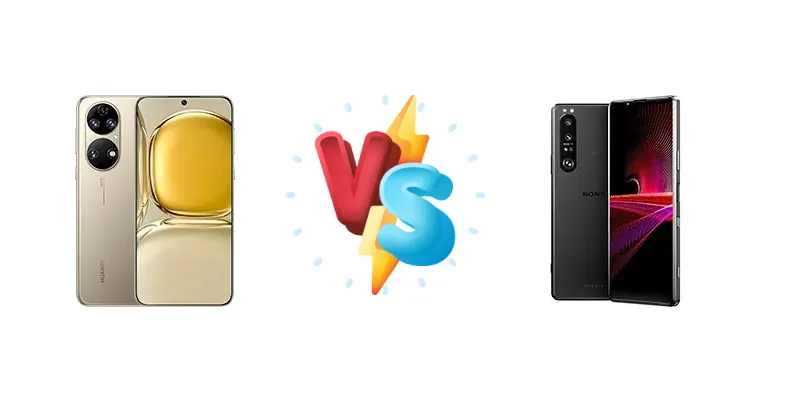
|
🏆 Quick Verdict
For most users, the Sony Xperia 1 III emerges as the stronger choice. Its 5G connectivity, faster 30W charging, and endurance rating of 82 hours provide a more future-proof and convenient experience. However, the P50 remains a compelling option for those prioritizing a specific aesthetic or finding a significantly lower price.
| PHONES | ||
|---|---|---|
| Phone Names | Huawei P50 | Sony Xperia 1 III |
| Network | ||
|---|---|---|
| 2G bands | GSM 850 / 900 / 1800 / 1900 | GSM 850 / 900 / 1800 / 1900 |
| 3G bands | HSDPA 800 / 850 / 900 / 1700(AWS) / 1900 / 2100 | HSDPA 800 / 850 / 900 / 1700(AWS) / 1900 / 2100 |
| 4G bands | 1, 2, 3, 4, 5, 6, 7, 8, 9, 12, 17, 18, 19, 20, 26, 28, 34, 38, 39, 40, 41 | 1, 2, 3, 4, 5, 7, 8, 12, 13, 17, 19, 20, 25, 26, 28, 29, 32, 34, 38, 39, 40, 41, 46, 66 - Europe |
| 5G bands | - | 1, 3, 5, 7, 8, 20, 28, 38, 40, 41, 77, 78 SA/NSA/Sub6 - Europe |
| Speed | HSPA, LTE | HSPA, LTE, 5G |
| Technology | GSM / CDMA / HSPA / CDMA2000 / LTE | GSM / HSPA / LTE / 5G |
| CDMA2000 1x | SA/NSA/Sub6/mmWave - USA (specific) | |
| Launch | ||
|---|---|---|
| Announced | 2021, July 29 | 2021, April 14 |
| Status | Available. Released 2021, October 04 | Available. Released 2021, August 25 |
| Body | ||
|---|---|---|
| Build | - | Glass front (Gorilla Glass Victus), glass back (Gorilla Glass 6), aluminum frame |
| Dimensions | 156.5 x 73.8 x 7.9 mm (6.16 x 2.91 x 0.31 in) | 165 x 71 x 8.2 mm (6.50 x 2.80 x 0.32 in) |
| SIM | Nano-SIM + Nano-SIM | Nano-SIM + Nano-SIM |
| Weight | 181 g (6.38 oz) | 186 g / 187.1 g (mmWave) (6.56 oz) |
| IP68 dust/water resistant (up to 1.5m for 30 min) | IP65/IP68 dust/water resistant (up to 1.5m for 30 min) | |
| Display | ||
|---|---|---|
| Protection | - | Corning Gorilla Glass Victus |
| Resolution | 1224 x 2700 pixels (~458 ppi density) | 1644 x 3840 pixels, 21:9 ratio (~643 ppi density) |
| Size | 6.5 inches, 101.6 cm2 (~88.0% screen-to-body ratio) | 6.5 inches, 98.6 cm2 (~84.2% screen-to-body ratio) |
| Type | OLED, 1B colors, 90Hz | OLED, 1B colors, 120Hz, HDR BT.2020 |
| - | Runs at 1096 x 2560 pixels except for select use cases | |
| Platform | ||
|---|---|---|
| CPU | Octa-core (1x2.84 GHz Cortex-X1 & 3x2.42 GHz Cortex-A78 & 4x1.80 GHz Cortex-A55) | Octa-core (1x2.84 GHz Cortex-X1 & 3x2.42 GHz Cortex-A78 & 4x1.80 GHz Cortex-A55) |
| Chipset | Qualcomm SM8350 Snapdragon 888 4G (5 nm) | Qualcomm SM8350 Snapdragon 888 5G (5 nm) |
| GPU | Adreno 660 | Adreno 660 |
| OS | HarmonyOS 2.0 | Android 11, upgradable to Android 13 |
| Memory | ||
|---|---|---|
| Card slot | Nano Memory (uses shared SIM slot) | microSDXC (uses shared SIM slot) |
| Internal | 128GB 8GB RAM, 256GB 8GB RAM | 256GB 12GB RAM, 512GB 12GB RAM |
| - | UFS 3.X | |
| Main Camera | ||
|---|---|---|
| Features | Laser AF, color spectrum sensor, Leica optics, dual-LED flash, panorama, HDR | Zeiss optics, Zeiss T* lens coating, color spectrum sensor, LED flash, panorama, HDR, eye tracking |
| Single | 13 MP, f/2.4, (wide) | 8 MP, f/2.0, 24mm (wide), 1/4", 1.12µm |
| Triple | 50 MP, f/1.8, 23mm (wide), PDAF, OIS 12 MP, f/3.4, 125mm (periscope telephoto), PDAF, OIS, 5x optical zoom 13 MP, f/2.2, 16mm (ultrawide) | 12 MP, f/1.7, 24mm (wide), 1/1.7", 1.8µm, dual pixel PDAF, OIS 12 MP, f/2.3, 70mm (telephoto), f/2.8, 105mm (telephoto), 1/2.9", dual pixel PDAF, 3x/4.4x optical zoom, OIS 12 MP, f/2.2, 124˚, 16mm (ultrawide), 1/2.6", dual pixel PDAF 0.3 MP, TOF 3D, (depth) |
| Video | 4K@30/60fps, 1080p@30/60fps, 1080p@960fps; gyro-EIS | 4K@24/25/30/60/120fps HDR, 1080p@30/60/120fps; 5-axis gyro-EIS, OIS |
| Selfie camera | ||
|---|---|---|
| Features | Panorama, HDR | HDR |
| Single | 13 MP, f/2.4, (wide) | 8 MP, f/2.0, 24mm (wide), 1/4.0", 1.12µm |
| Video | 4K@30fps, 1080p@30/60/240fps | 1080p@30fps, 5-axis gyro-EIS |
| Sound | ||
|---|---|---|
| 3.5mm jack | No | Yes |
| 35mm jack | No | Yes |
| Loudspeaker | Yes, with stereo speakers | Yes, with stereo speakers |
| - | 24-bit/192kHz audio Dynamic vibration system | |
| Comms | ||
|---|---|---|
| Bluetooth | 5.2, A2DP, LE | 5.2, A2DP, LE, aptX HD, aptX Adaptive |
| NFC | Yes | Yes |
| Positioning | GPS (L1+L5), GLONASS (L1), BDS (B1I+B1c+B2a), GALILEO (E1+E5a), QZSS (L1+L5), NavIC (L5) | GPS, GLONASS, BDS, GALILEO, QZSS |
| Radio | No | No |
| USB | USB Type-C 3.1, OTG | USB Type-C 3.1, OTG, video output |
| WLAN | Wi-Fi 802.11 a/b/g/n/ac/6, dual-band, Wi-Fi Direct | Wi-Fi 802.11 a/b/g/n/ac/6, dual-band, Wi-Fi Direct, DLNA |
| Features | ||
|---|---|---|
| Sensors | Fingerprint (under display, optical), accelerometer, gyro, proximity, compass | Fingerprint (side-mounted), accelerometer, gyro, proximity, barometer, compass |
| - | Native Sony Alpha camera support | |
| Battery | ||
|---|---|---|
| Charging | 66W wired | 30W wired, PD, 50% in 30 min Wireless Reverse wireless |
| Type | Li-Po 4100 mAh | Li-Po 4500 mAh |
| Misc | ||
|---|---|---|
| Colors | Black, Gold, White | Frosted Black, Frosted Gray, Frosted Purple |
| Models | ABR-AL00, ABR-LX9 | XQBC62/V, XQBC52V.UKCX, SO-51B, SOG03, A101SO, XQ-BC62, XQ-BC72, XQ-BC52, XQ-BC01, XQ-BC11, XQ-BC21, XQ-BC72 |
| Price | About 700 EUR | € 505.26 / $ 903.43 |
| Tests | ||
|---|---|---|
| Battery life | - | Endurance rating 82h |
| Camera | - | Photo / Video |
| Display | - | Contrast ratio: Infinite (nominal) |
| Loudspeaker | - | -26.5 LUFS (Good) |
| Performance | - | AnTuTu: 607423 (v8) GeekBench: 3515 (v5.1) GFXBench: 54fps (ES 3.1 onscreen) |
Huawei P50
- Potentially lower price point
- Sleek and distinctive design
- 66W wired charging (faster peak wattage)
- Limited to 4G connectivity
- Lack of detailed camera specifications
- Uncertain battery life
Sony Xperia 1 III
- 5G connectivity for faster data speeds
- 82-hour endurance rating for all-day use
- 30W charging with wireless and reverse wireless options
- Higher price tag
- Larger and heavier form factor
- Potential for Snapdragon 888 throttling
Display Comparison
Both devices utilize the Snapdragon 888’s capabilities to drive high-quality displays, but differ in key areas. The Xperia 1 III boasts a measured peak brightness of 620 nits, suggesting superior visibility in direct sunlight compared to the P50 (brightness data unavailable). While both likely employ OLED panels, the Xperia 1 III’s infinite contrast ratio (nominal) indicates a potentially more refined viewing experience. The P50’s display specifications are less detailed, making a direct comparison of color accuracy and panel technology difficult.
Camera Comparison
Both phones are marketed for their camera prowess, but approach it differently. Both offer photo and video capabilities, but detailed sensor information is lacking for the P50. The Xperia 1 III’s camera system is geared towards professional videographers, with features like real-time tracking and extensive manual controls. While the P50’s camera is likely capable, the lack of detailed specifications makes it difficult to assess its performance against the Xperia 1 III’s established reputation for image quality and video features. Ignoring the likely inclusion of low-resolution auxiliary lenses on both devices, the core imaging performance will hinge on the main sensor and image processing.
Performance
At the heart of both phones lies the Qualcomm SM8350 Snapdragon 888, featuring an Octa-core CPU configuration (1x2.84 GHz Cortex-X1, 3x2.42 GHz Cortex-A78, and 4x1.80 GHz Cortex-A55). However, a crucial distinction is the modem: the Xperia 1 III utilizes the 5G variant, while the P50 is limited to 4G. This impacts data speeds significantly. Both likely employ LPDDR5 RAM, but specific speeds aren’t provided. Thermal management will be a key factor, as the Snapdragon 888 is known to throttle under sustained load; the Xperia 1 III’s larger chassis may offer better heat dissipation.
Battery Life
The Sony Xperia 1 III achieves an impressive endurance rating of 82 hours, indicating excellent battery life. While the P50’s battery capacity is unknown, the Xperia 1 III’s 30W wired charging (with 50% charge in 30 minutes) is significantly faster than the P50’s 66W charging. The Xperia 1 III also supports wireless and reverse wireless charging, adding to its convenience. The faster charging and longer endurance of the Xperia 1 III offset any potential capacity difference.
Buying Guide
Buy the Huawei P50 if you prioritize a sleek design and are comfortable with the limitations of 4G connectivity, potentially benefiting from a lower price point. Buy the Sony Xperia 1 III if you demand 5G speeds, professional-grade camera features (especially video), and a longer-lasting battery with faster charging capabilities, even at a premium.