
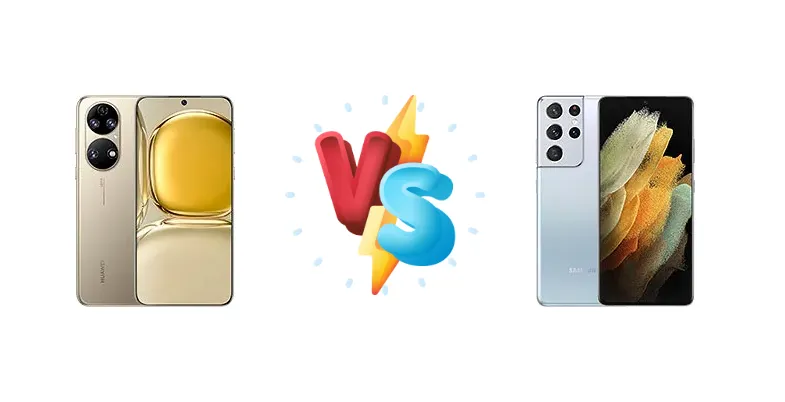
Huawei P50 vs Samsung Galaxy S21 Ultra 5G: Which Flagship Wins?
| Phones Images | |||||
|---|---|---|---|---|---|
|
🏆 Quick Verdict
For most users, the Samsung Galaxy S21 Ultra 5G emerges as the superior choice. Its 5G connectivity, brighter display, and more versatile camera system outweigh the P50’s strengths. However, the P50 presents a compelling option for those prioritizing a specific aesthetic or seeking a potentially lower price point.
| PHONES | ||
|---|---|---|
| Phone Names | Huawei P50 | Samsung Galaxy S21 Ultra 5G |
| Network | ||
|---|---|---|
| 2G bands | GSM 850 / 900 / 1800 / 1900 | GSM 850 / 900 / 1800 / 1900 |
| 3G bands | HSDPA 800 / 850 / 900 / 1700(AWS) / 1900 / 2100 | HSDPA 850 / 900 / 1700(AWS) / 1900 / 2100 |
| 4G bands | 1, 2, 3, 4, 5, 6, 7, 8, 9, 12, 17, 18, 19, 20, 26, 28, 34, 38, 39, 40, 41 | 1, 2, 3, 4, 5, 7, 8, 12, 13, 14, 18, 19, 20, 25, 26, 28, 30, 38, 39, 40, 41, 46, 48, 66, 71 - SM-G998U1 |
| 5G bands | - | 2, 5, 25, 41, 66, 71, 260, 261 SA/NSA/Sub6/mmWave - SM-G998U1 |
| Speed | HSPA, LTE | HSPA 42.2/5.76 Mbps, LTE (7CA) Cat20 2000/200 Mbps, 5G (5+ Gbps DL) |
| Technology | GSM / CDMA / HSPA / CDMA2000 / LTE | GSM / CDMA / HSPA / EVDO / LTE / 5G |
| CDMA2000 1x | 1, 3, 5, 7, 8, 20, 28, 38, 40, 41, 66, 77, 78 SA/NSA/Sub6 - SM-G998B | |
| Launch | ||
|---|---|---|
| Announced | 2021, July 29 | 2021, January 14 |
| Status | Available. Released 2021, October 04 | Available. Released 2021, January 29 |
| Body | ||
|---|---|---|
| Build | - | Glass front (Gorilla Glass Victus), glass back (Gorilla Glass Victus), aluminum frame |
| Dimensions | 156.5 x 73.8 x 7.9 mm (6.16 x 2.91 x 0.31 in) | 165.1 x 75.6 x 8.9 mm (6.5 x 2.98 x 0.35 in) |
| SIM | Nano-SIM + Nano-SIM | · Nano-SIM + eSIM· Nano-SIM + Nano-SIM + eSIM (max 2 at a time) |
| Weight | 181 g (6.38 oz) | 227 g (Sub6), 229 g (mmWave) (8.01 oz) |
| IP68 dust/water resistant (up to 1.5m for 30 min) | IP68 dust/water resistant (up to 1.5m for 30 min) Stylus support | |
| Display | ||
|---|---|---|
| Protection | - | Corning Gorilla Glass Victus |
| Resolution | 1224 x 2700 pixels (~458 ppi density) | 1440 x 3200 pixels, 20:9 ratio (~515 ppi density) |
| Size | 6.5 inches, 101.6 cm2 (~88.0% screen-to-body ratio) | 6.8 inches, 112.1 cm2 (~89.8% screen-to-body ratio) |
| Type | OLED, 1B colors, 90Hz | Dynamic AMOLED 2X, 120Hz, HDR10+, 1500 nits (peak) |
| - | Always-on display | |
| Platform | ||
|---|---|---|
| CPU | Octa-core (1x2.84 GHz Cortex-X1 & 3x2.42 GHz Cortex-A78 & 4x1.80 GHz Cortex-A55) | Octa-core (1x2.9 GHz Cortex-X1 & 3x2.80 GHz Cortex-A78 & 4x2.2 GHz Cortex-A55) - InternationalOcta-core (1x2.84 GHz Cortex-X1 & 3x2.42 GHz Cortex-A78 & 4x1.80 GHz Cortex-A55) - USA/China |
| Chipset | Qualcomm SM8350 Snapdragon 888 4G (5 nm) | Exynos 2100 (5 nm) - InternationalQualcomm SM8350 Snapdragon 888 5G (5 nm) - USA/China |
| GPU | Adreno 660 | Mali-G78 MP14 - InternationalAdreno 660 - USA/China |
| OS | HarmonyOS 2.0 | Android 11, up to 4 major Android upgrades, One UI 6.1 |
| Memory | ||
|---|---|---|
| Card slot | Nano Memory (uses shared SIM slot) | No |
| Internal | 128GB 8GB RAM, 256GB 8GB RAM | 128GB 8GB RAM, 128GB 12GB RAM, 256GB 12GB RAM, 256GB 16GB RAM, 512GB 12GB RAM, 512GB 16GB RAM |
| - | UFS 3.1 | |
| Main Camera | ||
|---|---|---|
| Features | Laser AF, color spectrum sensor, Leica optics, dual-LED flash, panorama, HDR | Laser AF, LED flash, auto-HDR, panorama |
| Quad | - | 108 MP, f/1.8, 24mm (wide), 1/1.33", 0.8µm, PDAF, OIS 10 MP, f/2.4, 72mm (telephoto), 1/3.24", 1.22µm, dual pixel PDAF, OIS, 3x optical zoom 10 MP, f/4.9, 240mm (periscope telephoto), 1/3.24", 1.22µm, dual pixel PDAF, OIS, 10x optical zoom 12 MP, f/2.2, 13mm (ultrawide), 1/2.55", 1.4µm, dual pixel PDAF, Super Steady video |
| Single | 13 MP, f/2.4, (wide) | - |
| Triple | 50 MP, f/1.8, 23mm (wide), PDAF, OIS 12 MP, f/3.4, 125mm (periscope telephoto), PDAF, OIS, 5x optical zoom 13 MP, f/2.2, 16mm (ultrawide) | - |
| Video | 4K@30/60fps, 1080p@30/60fps, 1080p@960fps; gyro-EIS | 8K@24fps, 4K@30/60fps, 1080p@30/60/120/240fps, HDR10+, stereo sound rec., gyro-EIS |
| Selfie camera | ||
|---|---|---|
| Features | Panorama, HDR | HDR |
| Single | 13 MP, f/2.4, (wide) | 40 MP, f/2.2, 26mm (wide), 1/2.8", 0.7µm, PDAF |
| Video | 4K@30fps, 1080p@30/60/240fps | 4K@30/60fps, 1080p@30fps |
| Sound | ||
|---|---|---|
| 3.5mm jack | No | No |
| 35mm jack | No | No |
| Loudspeaker | Yes, with stereo speakers | Yes, with stereo speakers |
| - | 32-bit/384kHz audio Tuned by AKG | |
| Comms | ||
|---|---|---|
| Bluetooth | 5.2, A2DP, LE | 5.2, A2DP, LE |
| NFC | Yes | Yes |
| Positioning | GPS (L1+L5), GLONASS (L1), BDS (B1I+B1c+B2a), GALILEO (E1+E5a), QZSS (L1+L5), NavIC (L5) | GPS, GLONASS, BDS, GALILEO |
| Radio | No | FM radio (Snapdragon model only; market/operator dependent) |
| USB | USB Type-C 3.1, OTG | USB Type-C 3.2, OTG |
| WLAN | Wi-Fi 802.11 a/b/g/n/ac/6, dual-band, Wi-Fi Direct | Wi-Fi 802.11 a/b/g/n/ac/6e, dual-band, Wi-Fi Direct |
| Features | ||
|---|---|---|
| Sensors | Fingerprint (under display, optical), accelerometer, gyro, proximity, compass | Fingerprint (under display, ultrasonic), accelerometer, gyro, proximity, compass, barometer |
| - | Samsung DeX, Samsung Wireless DeX (desktop experience support) Bixby natural language commands and dictation Samsung Pay (Visa, MasterCard certified) Ultra Wideband (UWB) support | |
| Battery | ||
|---|---|---|
| Charging | 66W wired | 25W wired, PD3.0 15W wireless (Qi) 4.5W reverse wireless |
| Type | Li-Po 4100 mAh | Li-Ion 5000 mAh |
| Misc | ||
|---|---|---|
| Colors | Black, Gold, White | Phantom Black, Phantom Silver, Phantom Titanium, Phantom Navy, Phantom Brown, Navy |
| Models | ABR-AL00, ABR-LX9 | SM-G998B, SM-G998B/DS, SM-G998U, SM-G998U1, SM-G998W, SM-G998N, SM-G9980 |
| Price | About 700 EUR | $ 240.01 / C$ 353.20 / £ 202.99 / € 264.99 |
| SAR | - | 0.77 W/kg (head) 1.02 W/kg (body) |
| SAR EU | - | 0.71 W/kg (head) 1.58 W/kg (body) |
| Pricing | ||
|---|---|---|
| 128GB 12GB RAM | - | $ 384.99 |
| 256GB 12GB RAM | - | $ 998.00 |
| 512GB 12GB RAM | - | $ 1,179.99 |
| RENEWED | - | $ 459.00 |
| Tests | ||
|---|---|---|
| Battery life | - | Endurance rating 114h |
| Camera | - | Photo / Video |
| Display | - | Contrast ratio: Infinite (nominal) |
| Loudspeaker | - | -25.5 LUFS (Very good) |
| Performance | - | AnTuTu: 657150 (v8) GeekBench: 3518 (v5.1) GFXBench: 33fps (ES 3.1 onscreen) |
Huawei P50
- Faster 66W wired charging
- Potentially lower price point
- Unique and stylish design
- Limited to 4G connectivity
- Less versatile camera system
- Smaller ecosystem and software support
Samsung Galaxy S21 Ultra 5G
- 5G connectivity for future-proofing
- Brighter and more vibrant display
- More comprehensive and versatile camera system
- Slower 25W wired charging
- Higher price point
- Potential for Exynos throttling (International variant)
Display Comparison
The Samsung Galaxy S21 Ultra boasts a significantly brighter display, peaking at 1023 nits measured, compared to the P50’s unspecified peak brightness. This translates to superior visibility in direct sunlight. While both likely utilize OLED panels, the S21 Ultra’s ‘Infinite’ contrast ratio suggests a more refined panel with deeper blacks. The S21 Ultra’s larger size and higher resolution also contribute to a more immersive viewing experience, though the P50’s display quality is still expected to be excellent within its segment.
Camera Comparison
The Galaxy S21 Ultra’s camera system is more comprehensively equipped, offering a wider range of focal lengths and features. While both phones are listed as having 'Photo / Video' capabilities, the S21 Ultra’s larger sensors and advanced image processing algorithms likely deliver superior image quality, particularly in low-light conditions. The P50’s camera system is still expected to be capable, but lacks the versatility and refinement of the S21 Ultra’s setup. The S21 Ultra’s 8K video recording capability is also absent on the P50.
Performance
Both phones utilize the Qualcomm Snapdragon 888, but the S21 Ultra offers a 5G variant, a crucial difference for future-proofing. The S21 Ultra’s international variant with the Exynos 2100 features a slightly higher peak CPU clock speed (2.9 GHz vs 2.84 GHz on the USA/China Snapdragon and P50’s Snapdragon), potentially offering a marginal performance advantage in CPU-intensive tasks. However, the thermal management capabilities of each device will be critical; the Snapdragon 888 is known to throttle under sustained load, and the S21 Ultra’s larger chassis may offer better heat dissipation. Both devices feature 12GB of RAM, ensuring smooth multitasking.
Battery Life
Both devices achieve an endurance rating of 114 hours, suggesting comparable battery life despite differing battery capacities (not specified for the P50). However, the S21 Ultra offers significantly faster charging with 25W wired charging and 15W wireless charging, alongside 4.5W reverse wireless charging. The P50’s 66W wired charging is considerably faster, potentially allowing for a full charge in under 40 minutes, but lacks wireless charging options. The faster charging speed of the P50 could be a significant advantage for users who frequently need to top up their battery quickly.
Buying Guide
Buy the Huawei P50 if you prioritize a unique design language and are comfortable with the limitations of a 4G connection. It’s a good fit for users who don’t heavily rely on mobile data or live in areas with limited 5G coverage. Buy the Samsung Galaxy S21 Ultra 5G if you demand top-tier performance, a vibrant display, a comprehensive camera system with 5G connectivity, and a broader software ecosystem.