
Huawei P50 vs Oppo Find X3 Pro: A Deep Dive into Snapdragon 888 Flagships
| Phones Images | |||||
|---|---|---|---|---|---|
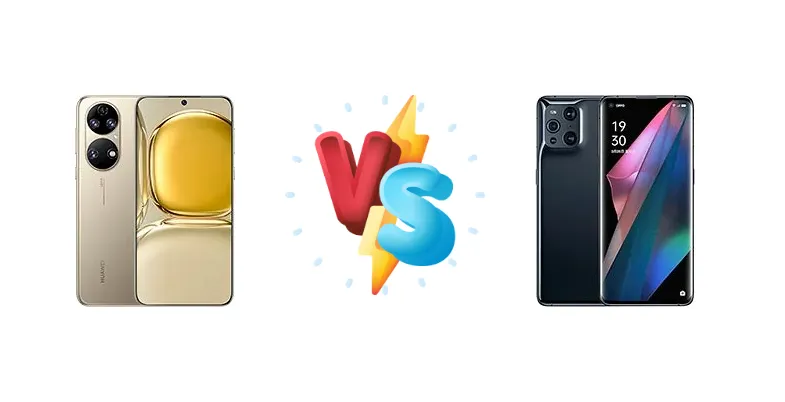
|
🏆 Quick Verdict
For most users, the Oppo Find X3 Pro emerges as the superior choice. Its 5G connectivity, faster and more versatile charging (including 30W wireless), and comparable battery endurance outweigh the P50’s strengths. The P50 remains a viable option for those unconcerned with 5G or Huawei’s ecosystem.
| PHONES | ||
|---|---|---|
| Phone Names | Huawei P50 | Oppo Find X3 Pro |
| Network | ||
|---|---|---|
| 2G bands | GSM 850 / 900 / 1800 / 1900 | GSM 850 / 900 / 1800 / 1900 |
| 3G bands | HSDPA 800 / 850 / 900 / 1700(AWS) / 1900 / 2100 | HSDPA 800 / 850 / 900 / 1700(AWS) / 1900 / 2100 |
| 4G bands | 1, 2, 3, 4, 5, 6, 7, 8, 9, 12, 17, 18, 19, 20, 26, 28, 34, 38, 39, 40, 41 | 1, 2, 3, 4, 5, 7, 8, 12, 13, 17, 18, 19, 20, 25, 26, 28, 32, 34, 38, 39, 40, 41, 42, 66 - International |
| 5G bands | - | 1, 3, 5, 7, 8, 20, 28, 38, 40, 41, 77, 78, 79 SA/NSA - International |
| Speed | HSPA, LTE | HSPA, LTE, 5G |
| Technology | GSM / CDMA / HSPA / CDMA2000 / LTE | GSM / CDMA / HSPA / CDMA2000 / LTE / 5G |
| CDMA2000 1x | 1, 2, 3, 5, 7, 8, 12, 20, 28, 38, 40, 41, 66, 77, 78, 79 SA/NSA - China | |
| Launch | ||
|---|---|---|
| Announced | 2021, July 29 | 2021, March 11 |
| Status | Available. Released 2021, October 04 | Available. Released 2021, March 19 |
| Body | ||
|---|---|---|
| Build | - | Glass front (Gorilla Glass 5), glass back (Gorilla Glass 5), aluminum frame |
| Dimensions | 156.5 x 73.8 x 7.9 mm (6.16 x 2.91 x 0.31 in) | 163.6 x 74 x 8.3 mm (6.44 x 2.91 x 0.33 in) |
| SIM | Nano-SIM + Nano-SIM | Nano-SIM + eSIM |
| Weight | 181 g (6.38 oz) | 193 g (6.81 oz) |
| IP68 dust/water resistant (up to 1.5m for 30 min) | IP68 dust/water resistant (up to 1.5m for 30 min) | |
| Display | ||
|---|---|---|
| Protection | - | Corning Gorilla Glass 5 |
| Resolution | 1224 x 2700 pixels (~458 ppi density) | 1440 x 3216 pixels, 20:9 ratio (~525 ppi density) |
| Size | 6.5 inches, 101.6 cm2 (~88.0% screen-to-body ratio) | 6.7 inches, 108.4 cm2 (~89.6% screen-to-body ratio) |
| Type | OLED, 1B colors, 90Hz | LTPO AMOLED, 1B colors, 120Hz, HDR10+, BT.2020, 500 nits (typ), 1300 nits (peak) |
| Platform | ||
|---|---|---|
| CPU | Octa-core (1x2.84 GHz Cortex-X1 & 3x2.42 GHz Cortex-A78 & 4x1.80 GHz Cortex-A55) | Octa-core (1x2.84 GHz Cortex-X1 & 3x2.42 GHz Cortex-A78 & 4x1.80 GHz Cortex-A55) |
| Chipset | Qualcomm SM8350 Snapdragon 888 4G (5 nm) | Qualcomm SM8350 Snapdragon 888 5G (5 nm) |
| GPU | Adreno 660 | Adreno 660 |
| OS | HarmonyOS 2.0 | Android 11, upgradable to Android 14, ColorOS 14 |
| Memory | ||
|---|---|---|
| Card slot | Nano Memory (uses shared SIM slot) | No |
| Internal | 128GB 8GB RAM, 256GB 8GB RAM | 256GB 8GB RAM, 256GB 12GB RAM, 512GB 16GB RAM |
| - | UFS 3.1 | |
| Main Camera | ||
|---|---|---|
| Features | Laser AF, color spectrum sensor, Leica optics, dual-LED flash, panorama, HDR | Color spectrum sensor, LED flash, HDR, panorama |
| Quad | - | 50 MP, f/1.8, 26mm (wide), 1/1.56", 1.0µm, multi-directional PDAF, OIS 13 MP, f/2.4, 52mm (telephoto), 1/3.4", 1.0µm, 2x optical zoom, PDAF 50 MP, f/2.2, 16mm, 110˚ (ultrawide), 1/1.56", 1.0µm, multi-directional PDAF 3 MP, f/3.0, (microscope), AF, ring flash, 60x magnification |
| Single | 13 MP, f/2.4, (wide) | - |
| Triple | 50 MP, f/1.8, 23mm (wide), PDAF, OIS 12 MP, f/3.4, 125mm (periscope telephoto), PDAF, OIS, 5x optical zoom 13 MP, f/2.2, 16mm (ultrawide) | - |
| Video | 4K@30/60fps, 1080p@30/60fps, 1080p@960fps; gyro-EIS | 4K@30/60fps, 1080p@30/60/240fps; gyro-EIS; HDR, 10‑bit video |
| Selfie camera | ||
|---|---|---|
| Features | Panorama, HDR | Panorama |
| Single | 13 MP, f/2.4, (wide) | 32 MP, f/2.4, 26mm (wide), 1/2.8", 0.8µm |
| Video | 4K@30fps, 1080p@30/60/240fps | 1080p@30fps |
| Sound | ||
|---|---|---|
| 3.5mm jack | No | No |
| 35mm jack | No | No |
| Loudspeaker | Yes, with stereo speakers | Yes, with stereo speakers |
| Comms | ||
|---|---|---|
| Bluetooth | 5.2, A2DP, LE | 5.2, A2DP, LE, aptX HD |
| NFC | Yes | Yes |
| Positioning | GPS (L1+L5), GLONASS (L1), BDS (B1I+B1c+B2a), GALILEO (E1+E5a), QZSS (L1+L5), NavIC (L5) | GPS (L1+L5), GLONASS (L1), BDS (B1I+B1c+B2a), GALILEO (E1+E5a), QZSS (L1+L5) |
| Radio | No | No |
| USB | USB Type-C 3.1, OTG | USB Type-C 3.1, OTG |
| WLAN | Wi-Fi 802.11 a/b/g/n/ac/6, dual-band, Wi-Fi Direct | Wi-Fi 802.11 a/b/g/n/ac/6, dual-band, Wi-Fi Direct |
| Features | ||
|---|---|---|
| Sensors | Fingerprint (under display, optical), accelerometer, gyro, proximity, compass | Fingerprint (under display, optical), accelerometer, gyro, proximity, compass |
| Battery | ||
|---|---|---|
| Charging | 66W wired | 65W wired, PD, 40% in 10 min 30W wireless, 100% in 80 min 10W reverse wireless |
| Type | Li-Po 4100 mAh | Li-Po 4500 mAh |
| Misc | ||
|---|---|---|
| Colors | Black, Gold, White | Gloss Black, Blue, White, Cosmic Mocha, Mars Edition, Photographer Edition |
| Models | ABR-AL00, ABR-LX9 | CPH2173, PEEM00, OPG03 |
| Price | About 700 EUR | About 200 EUR |
| Tests | ||
|---|---|---|
| Battery life | - | Endurance rating 81h |
| Camera | - | Photo / Video |
| Display | - | Contrast ratio: Infinite (nominal) |
| Loudspeaker | - | -25.4 LUFS (Very good) |
| Performance | - | AnTuTu: 656467 (v8) GeekBench: 3316 (v5.1) GFXBench: 33fps (ES 3.1 onscreen) |
Huawei P50
- Potentially lower price point due to 4G limitation
- Clean and minimalist design aesthetic
- 66W wired charging is still relatively fast
- Lacks 5G connectivity, limiting future-proofing
- Limited battery charging options (no wireless)
- Camera specifications are less detailed
Oppo Find X3 Pro
- Full 5G connectivity for faster data speeds
- Versatile charging: 65W wired, 30W wireless, 10W reverse wireless
- High peak display brightness for outdoor visibility
- May be more expensive than the P50
- Snapdragon 888 can still throttle under heavy load
- Software updates may be less frequent than some competitors
Display Comparison
Both phones utilize the Snapdragon 888’s capabilities to drive high-resolution displays, but the Oppo Find X3 Pro boasts a measured peak brightness of 774 nits, suggesting a more vibrant outdoor viewing experience. While both likely employ high refresh rate panels (data not provided), the Find X3 Pro’s infinite contrast ratio (nominal) hints at superior black levels and overall image quality. The P50’s display specifications are less detailed, making a direct comparison challenging, but the Find X3 Pro appears to have a slight edge in visual fidelity.
Camera Comparison
Both phones are advertised as excelling in photo and video capture, but detailed sensor information is lacking for the P50. The Find X3 Pro’s camera system is known for its color science and versatility. Without specific details on the P50’s main sensor size, aperture, and OIS implementation, it’s difficult to make a definitive judgment. However, the Find X3 Pro’s reputation for consistent image quality and advanced video features gives it an advantage. Ignoring the likely inclusion of low-resolution auxiliary cameras on both devices, the core imaging capabilities are likely comparable, but the Find X3 Pro benefits from a more established software pipeline.
Performance
The core processing power is identical: both devices are powered by the Qualcomm SM8350 Snapdragon 888, featuring an octa-core CPU configuration with 1x2.84 GHz Cortex-X1, 3x2.42 GHz Cortex-A78, and 4x1.80 GHz Cortex-A55 cores. However, the crucial difference lies in 5G support. The Oppo Find X3 Pro’s Snapdragon 888 variant *includes* 5G connectivity, while the P50 is limited to 4G due to geopolitical restrictions. This significantly impacts data speeds and future-proofing. Thermal management is also a consideration; while both will throttle under sustained load, the Find X3 Pro’s larger chassis may offer slightly better heat dissipation.
Battery Life
Both the Huawei P50 and Oppo Find X3 Pro achieve an endurance rating of 81 hours, indicating similar overall battery life. However, the charging capabilities diverge significantly. The Oppo Find X3 Pro supports 65W wired charging (reaching 40% in 10 minutes), 30W wireless charging (100% in 80 minutes), and even 10W reverse wireless charging. The P50 offers 66W wired charging, but lacks wireless charging options. This makes the Find X3 Pro far more convenient for users who frequently top up their battery or need to charge accessories on the go.
Buying Guide
Buy the Huawei P50 if you prioritize a clean, minimalist aesthetic and are comfortable with a 4G-only experience, potentially benefiting from a lower price point. Buy the Oppo Find X3 Pro if you demand future-proof 5G connectivity, exceptionally fast charging (wired and wireless), and a consistently high-performing experience without network limitations. The Find X3 Pro is ideal for power users and travelers.