
Huawei P50 vs OnePlus 9 Pro: A Detailed Comparison of Flagship Performance
| Phones Images | |||||
|---|---|---|---|---|---|
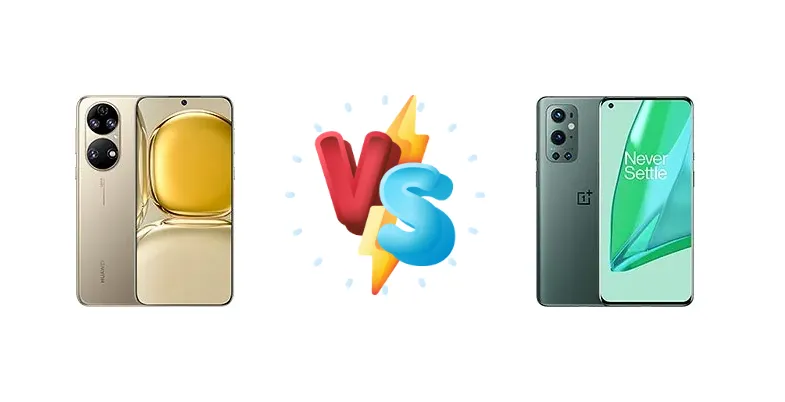
|
🏆 Quick Verdict
For most users, the OnePlus 9 Pro emerges as the superior choice. Its 5G connectivity, faster charging speeds (65W wired, 50W wireless), and comparable performance offset the P50’s potential camera advantages. The P50 remains a viable option for those prioritizing camera quality and not needing 5G.
| PHONES | ||
|---|---|---|
| Phone Names | Huawei P50 | OnePlus 9 Pro |
| Network | ||
|---|---|---|
| 2G bands | GSM 850 / 900 / 1800 / 1900 | GSM 850 / 900 / 1800 / 1900 |
| 3G bands | HSDPA 800 / 850 / 900 / 1700(AWS) / 1900 / 2100 | HSDPA 800 / 850 / 900 / 1700(AWS) / 1800 / 1900 / 2100 |
| 4G bands | 1, 2, 3, 4, 5, 6, 7, 8, 9, 12, 17, 18, 19, 20, 26, 28, 34, 38, 39, 40, 41 | 1, 2, 3, 4, 5, 7, 8, 12, 13, 17, 18, 19, 20, 25, 26, 28, 32, 38, 39, 40, 41, 66 - EU |
| 5G bands | - | 1, 3, 5, 7, 8, 20, 28, 38, 40, 41, 66, 78 SA/NSA - EU |
| Speed | HSPA, LTE | HSPA 42.2/5.76 Mbps, LTE Cat20 2000/200 Mbps, 5G |
| Technology | GSM / CDMA / HSPA / CDMA2000 / LTE | GSM / CDMA / HSPA / LTE / 5G |
| CDMA2000 1x | 1, 3, 28, 41, 78, 79 SA/NSA - CN | |
| Launch | ||
|---|---|---|
| Announced | 2021, July 29 | 2021, March 23 |
| Status | Available. Released 2021, October 04 | Available. Released 2021, March 30 |
| Body | ||
|---|---|---|
| Build | - | Glass front (Gorilla Glass 5), glass back (Gorilla Glass 5), aluminum frame |
| Dimensions | 156.5 x 73.8 x 7.9 mm (6.16 x 2.91 x 0.31 in) | 163.2 x 73.6 x 8.7 mm (6.43 x 2.90 x 0.34 in) |
| SIM | Nano-SIM + Nano-SIM | · Nano-SIM· Nano-SIM + Nano-SIM |
| Weight | 181 g (6.38 oz) | 197 g (6.95 oz) |
| IP68 dust/water resistant (up to 1.5m for 30 min) | IP68 dust/water resistant (up to 1.5m for 30 min) | |
| Display | ||
|---|---|---|
| Protection | - | Corning Gorilla Glass 5 |
| Resolution | 1224 x 2700 pixels (~458 ppi density) | 1440 x 3216 pixels, 20:9 ratio (~525 ppi density) |
| Size | 6.5 inches, 101.6 cm2 (~88.0% screen-to-body ratio) | 6.7 inches, 108.4 cm2 (~90.3% screen-to-body ratio) |
| Type | OLED, 1B colors, 90Hz | LTPO Fluid2 AMOLED, 1B colors, 120Hz, HDR10+, 1300 nits (peak) |
| - | Always-on display | |
| Platform | ||
|---|---|---|
| CPU | Octa-core (1x2.84 GHz Cortex-X1 & 3x2.42 GHz Cortex-A78 & 4x1.80 GHz Cortex-A55) | Octa-core (1x2.84 GHz Cortex-X1 & 3x2.42 GHz Cortex-A78 & 4x1.80 GHz Cortex-A55 |
| Chipset | Qualcomm SM8350 Snapdragon 888 4G (5 nm) | Qualcomm SM8350 Snapdragon 888 5G (5 nm) |
| GPU | Adreno 660 | Adreno 660 |
| OS | HarmonyOS 2.0 | Android 11, upgradable to Android 14, OxygenOS 14 |
| Memory | ||
|---|---|---|
| Card slot | Nano Memory (uses shared SIM slot) | No |
| Internal | 128GB 8GB RAM, 256GB 8GB RAM | 128GB 8GB RAM, 256GB 8GB RAM, 256GB 12GB RAM |
| - | UFS 3.1 | |
| Main Camera | ||
|---|---|---|
| Features | Laser AF, color spectrum sensor, Leica optics, dual-LED flash, panorama, HDR | Laser AF, color spectrum sensor, Hasselblad Color Calibration, dual-LED flash, HDR, panorama |
| Quad | - | 48 MP, f/1.8, 23mm (wide), 1/1.43", 1.12µm, multi-directional PDAF, OIS 8 MP, f/2.4, 77mm (telephoto), 1.0µm, PDAF, OIS, 3.3x optical zoom 50 MP, f/2.2, 14mm (ultrawide), 1/1.56", 1.0µm, AF 2 MP, f/2.4, (monochrome) |
| Single | 13 MP, f/2.4, (wide) | 16 MP, f/2.4, (wide), 1/3.06", 1.0µm |
| Triple | 50 MP, f/1.8, 23mm (wide), PDAF, OIS 12 MP, f/3.4, 125mm (periscope telephoto), PDAF, OIS, 5x optical zoom 13 MP, f/2.2, 16mm (ultrawide) | - |
| Video | 4K@30/60fps, 1080p@30/60fps, 1080p@960fps; gyro-EIS | 8K@30fps, 4K@30/60/120fps, 1080p@30/60/240fps, Auto HDR, gyro-EIS |
| Selfie camera | ||
|---|---|---|
| Features | Panorama, HDR | HDR |
| Single | 13 MP, f/2.4, (wide) | 16 MP, f/2.4, (wide), 1/3.06", 1.0µm |
| Video | 4K@30fps, 1080p@30/60/240fps | 1080p@30fps, gyro-EIS |
| Sound | ||
|---|---|---|
| 3.5mm jack | No | No |
| 35mm jack | No | No |
| Loudspeaker | Yes, with stereo speakers | Yes, with stereo speakers |
| - | 24-bit/192kHz audio | |
| Comms | ||
|---|---|---|
| Bluetooth | 5.2, A2DP, LE | 5.2, A2DP, LE, aptX HD |
| NFC | Yes | Yes |
| Positioning | GPS (L1+L5), GLONASS (L1), BDS (B1I+B1c+B2a), GALILEO (E1+E5a), QZSS (L1+L5), NavIC (L5) | GPS (L1+L5), GLONASS (G1), BDS (B1), GALILEO (E1+E5a) |
| Radio | No | No |
| USB | USB Type-C 3.1, OTG | USB Type-C 3.1, OTG |
| WLAN | Wi-Fi 802.11 a/b/g/n/ac/6, dual-band, Wi-Fi Direct | Wi-Fi 802.11 a/b/g/n/ac/6, dual-band, Wi-Fi Direct, DLNA |
| Features | ||
|---|---|---|
| Sensors | Fingerprint (under display, optical), accelerometer, gyro, proximity, compass | Fingerprint (under display, optical), accelerometer, gyro, proximity, compass |
| Battery | ||
|---|---|---|
| Charging | 66W wired | 65W wired, PD, 100% in 29 min 50W wireless, 100% in 43 min 5W reverse wireless |
| Type | Li-Po 4100 mAh | Li-Po 4500 mAh |
| Misc | ||
|---|---|---|
| Colors | Black, Gold, White | Morning Mist, Forest Green, Stellar Black |
| Models | ABR-AL00, ABR-LX9 | LE2121, LE2125, LE2123, LE2120, LE2127 |
| Price | About 700 EUR | € 246.17 / $ 264.95 / £ 287.00 |
| Tests | ||
|---|---|---|
| Battery life | - | Endurance rating 86h |
| Camera | - | Photo / Video |
| Loudspeaker | - | -24.1 LUFS (Very good) |
Huawei P50
- Potentially superior camera image processing (dependent on sensor details)
- Sleek and refined design aesthetic
- Competitive 66W wired charging
- Limited to 4G connectivity
- Software ecosystem concerns due to Huawei restrictions
- Missing detailed camera specifications
OnePlus 9 Pro
- 5G connectivity for faster data speeds
- Faster charging speeds (wired and wireless)
- Brighter and more efficient display with LTPO technology
- OxygenOS software can be divisive
- Potential for software bloat
- Camera color science may not appeal to all users
Display Comparison
The OnePlus 9 Pro features a display capable of reaching 859 nits of peak brightness, offering superior visibility in direct sunlight compared to the P50 (brightness data unavailable). While both utilize high refresh rate panels, the OnePlus 9 Pro’s LTPO technology dynamically adjusts the refresh rate for improved power efficiency. The OnePlus 9 Pro’s display is likely to offer a more vibrant and responsive visual experience, particularly for gaming and video consumption.
Camera Comparison
Both phones are marketed as having strong camera systems, but detailed sensor information for the P50 is missing. The OnePlus 9 Pro’s camera system, developed in partnership with Hasselblad, focuses on natural color reproduction and improved dynamic range. The P50’s camera is likely to excel in specific scenarios, but without detailed specs, a direct comparison is difficult. The OnePlus 9 Pro’s video capabilities are also likely to be superior due to its 5G connectivity enabling faster uploads and live streaming.
Performance
Both devices are powered by the Qualcomm SM8350 Snapdragon 888, utilizing the same Octa-core CPU configuration. However, the OnePlus 9 Pro’s variant supports 5G connectivity, a significant advantage for users in areas with 5G coverage. The P50 is limited to 4G. While both will handle demanding tasks with ease, the 5G capability of the OnePlus 9 Pro provides future-proofing and faster data speeds. Thermal management will be similar, with both potentially experiencing throttling under sustained heavy load due to the 5nm process.
Battery Life
Both the Huawei P50 and OnePlus 9 Pro achieve an endurance rating of 86 hours, suggesting comparable battery life in typical usage. However, the OnePlus 9 Pro significantly outperforms the P50 in charging speed, offering 65W wired charging (100% in 29 minutes), 50W wireless charging (100% in 43 minutes), and 5W reverse wireless charging. The P50’s 66W wired charging is competitive, but lacks the wireless charging options and reverse wireless charging capabilities of the OnePlus 9 Pro.
Buying Guide
Buy the Huawei P50 if you prioritize camera versatility and are willing to accept the limitations of 4G connectivity and potential software ecosystem constraints. Buy the OnePlus 9 Pro if you demand 5G speeds, exceptionally fast charging, a brighter display, and a more streamlined software experience. The OnePlus 9 Pro is the better all-rounder for power users.