
Huawei P50 vs Google Pixel 6 Pro: A Detailed Comparison of Flagship Androids
| Phones Images | |||||
|---|---|---|---|---|---|
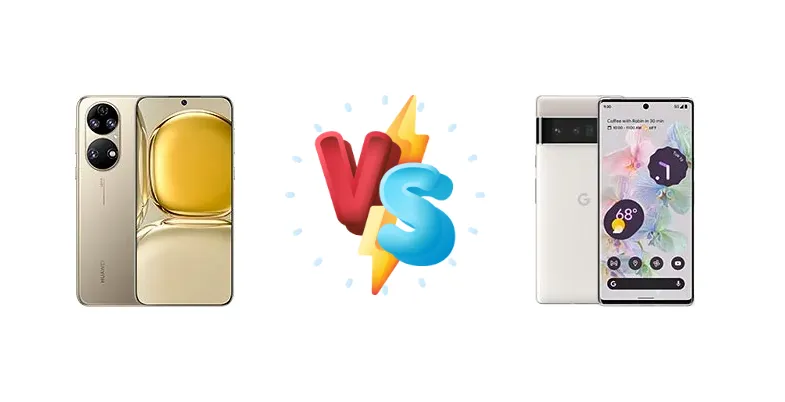
|
🏆 Quick Verdict
For most users, the Google Pixel 6 Pro emerges as the stronger choice. While the Huawei P50 boasts a sleek design, the Pixel 6 Pro’s Tensor chip, superior software support, and faster charging capabilities provide a more future-proof and versatile experience. The P50's 4G limitation is a significant drawback.
| PHONES | ||
|---|---|---|
| Phone Names | Huawei P50 | Google Pixel 6 Pro |
| Network | ||
|---|---|---|
| 2G bands | GSM 850 / 900 / 1800 / 1900 | GSM 850 / 900 / 1800 / 1900 |
| 3G bands | HSDPA 800 / 850 / 900 / 1700(AWS) / 1900 / 2100 | HSDPA 800 / 850 / 900 / 1700(AWS) / 1900 / 2100 |
| 4G bands | 1, 2, 3, 4, 5, 6, 7, 8, 9, 12, 17, 18, 19, 20, 26, 28, 34, 38, 39, 40, 41 | 1, 2, 3, 4, 5, 7, 8, 12, 13, 14, 17, 18, 19, 20, 25, 26, 28, 29, 30, 32, 38, 39, 40, 41, 42, 46, 48, 66, 71 - GLUOG, G8VOU |
| 5G bands | - | 1, 2, 3, 5, 7, 8, 12, 14, 20, 25, 28, 30, 38, 40, 41, 48, 66, 71, 77, 78, 257, 258, 260, 261 SA/NSA/Sub6/mmWave - G8VOU |
| Speed | HSPA, LTE | HSPA, LTE, 5G |
| Technology | GSM / CDMA / HSPA / CDMA2000 / LTE | GSM / CDMA / HSPA / EVDO / LTE / 5G |
| CDMA2000 1x | 1, 2, 3, 5, 7, 8, 12, 14, 20, 25, 28, 30, 38, 40, 41, 48, 66, 71, 77, 78 SA/NSA/Sub6 - GLUOG | |
| Launch | ||
|---|---|---|
| Announced | 2021, July 29 | 2021, October 19 |
| Status | Available. Released 2021, October 04 | Available. Released 2021, October 28 |
| Body | ||
|---|---|---|
| Build | - | Glass front (Gorilla Glass Victus), glass back (Gorilla Glass Victus), aluminum frame |
| Dimensions | 156.5 x 73.8 x 7.9 mm (6.16 x 2.91 x 0.31 in) | 163.9 x 75.9 x 8.9 mm (6.45 x 2.99 x 0.35 in) |
| SIM | Nano-SIM + Nano-SIM | Nano-SIM + eSIM |
| Weight | 181 g (6.38 oz) | 210 g (7.41 oz) |
| IP68 dust/water resistant (up to 1.5m for 30 min) | IP68 dust/water resistant (up to 1.5m for 30 min) | |
| Display | ||
|---|---|---|
| Protection | - | Corning Gorilla Glass Victus |
| Resolution | 1224 x 2700 pixels (~458 ppi density) | 1440 x 3120 pixels, 19.5:9 ratio (~512 ppi density) |
| Size | 6.5 inches, 101.6 cm2 (~88.0% screen-to-body ratio) | 6.7 inches, 110.6 cm2 (~88.9% screen-to-body ratio) |
| Type | OLED, 1B colors, 90Hz | LTPO AMOLED, 120Hz, HDR10+ |
| - | Always-on display | |
| Platform | ||
|---|---|---|
| CPU | Octa-core (1x2.84 GHz Cortex-X1 & 3x2.42 GHz Cortex-A78 & 4x1.80 GHz Cortex-A55) | Octa-core (2x2.80 GHz Cortex-X1 & 2x2.25 GHz Cortex-A76 & 4x1.80 GHz Cortex-A55) |
| Chipset | Qualcomm SM8350 Snapdragon 888 4G (5 nm) | Google Tensor (5 nm) |
| GPU | Adreno 660 | Mali-G78 MP20 |
| OS | HarmonyOS 2.0 | Android 12, upgradable to Android 15, up to 5 major Android upgrades |
| Memory | ||
|---|---|---|
| Card slot | Nano Memory (uses shared SIM slot) | No |
| Internal | 128GB 8GB RAM, 256GB 8GB RAM | 128GB 12GB RAM, 256GB 12GB RAM, 512GB 12GB RAM |
| - | UFS 3.1 | |
| Main Camera | ||
|---|---|---|
| Features | Laser AF, color spectrum sensor, Leica optics, dual-LED flash, panorama, HDR | Laser AF, Dual-LED flash, Pixel Shift, Auto-HDR, panorama |
| Single | 13 MP, f/2.4, (wide) | 11.1 MP, f/2.2, 20mm (ultrawide), 1.22µm |
| Triple | 50 MP, f/1.8, 23mm (wide), PDAF, OIS 12 MP, f/3.4, 125mm (periscope telephoto), PDAF, OIS, 5x optical zoom 13 MP, f/2.2, 16mm (ultrawide) | 50 MP, f/1.9, 25mm (wide), 1/1.31", 1.2µm, dual pixel PDAF, OIS 48 MP, f/3.5, 104mm (periscope telephoto), 1/2.0", 0.8µm, PDAF, OIS, 4x optical zoom 12 MP, f/2.2, 17mm, 114˚ (ultrawide), 1.25µm |
| Video | 4K@30/60fps, 1080p@30/60fps, 1080p@960fps; gyro-EIS | 4K@30/60fps, 1080p@30/60/120/240fps; gyro-EIS, OIS |
| Selfie camera | ||
|---|---|---|
| Features | Panorama, HDR | HDR, panorama |
| Single | 13 MP, f/2.4, (wide) | 11.1 MP, f/2.2, 20mm (ultrawide), 1.22µm |
| Video | 4K@30fps, 1080p@30/60/240fps | 4K@30fps, 1080p@30/60fps |
| Sound | ||
|---|---|---|
| 3.5mm jack | No | No |
| 35mm jack | No | No |
| Loudspeaker | Yes, with stereo speakers | Yes, with stereo speakers |
| Comms | ||
|---|---|---|
| Bluetooth | 5.2, A2DP, LE | 5.2, A2DP, LE, aptX HD |
| NFC | Yes | Yes |
| Positioning | GPS (L1+L5), GLONASS (L1), BDS (B1I+B1c+B2a), GALILEO (E1+E5a), QZSS (L1+L5), NavIC (L5) | GPS (L1+L5), GLONASS (G1), BDS (B1I+B1c+B2a), GALILEO (E1+E5a), QZSS (L1+L5) |
| Radio | No | No |
| USB | USB Type-C 3.1, OTG | USB Type-C 3.1 |
| WLAN | Wi-Fi 802.11 a/b/g/n/ac/6, dual-band, Wi-Fi Direct | Wi-Fi 802.11 a/b/g/n/ac/6e, dual-band, Wi-Fi Direct |
| Features | ||
|---|---|---|
| Sensors | Fingerprint (under display, optical), accelerometer, gyro, proximity, compass | Fingerprint (under display, optical), accelerometer, gyro, proximity, compass, barometer |
| - | Ultra Wideband (UWB) support | |
| Battery | ||
|---|---|---|
| Charging | 66W wired | 23W wired, PD3.0, 50% in 30 min 23W wireless Reverse wireless |
| Type | Li-Po 4100 mAh | Li-Ion 5003 mAh |
| Misc | ||
|---|---|---|
| Colors | Black, Gold, White | Cloudy White, Sorta Sunny, Stormy Black |
| Models | ABR-AL00, ABR-LX9 | GLUOG, G8VOU, GF5KQ |
| Price | About 700 EUR | € 199.99 / $ 204.99 / £ 275.00 / ₹ 29,699 |
| Tests | ||
|---|---|---|
| Battery life | - | Endurance rating 84h |
| Display | - | Contrast ratio: Infinite (nominal) |
| Performance | - | AnTuTu: 585485 (v8), 719815 (v9) GeekBench: 2831 (v5.1) GFXBench: 39 fps (ES 3.1 onscreen) |
Huawei P50
- Faster 66W wired charging
- Potentially superior camera detail (depending on sensor)
- Sleek and refined design
- Limited to 4G connectivity
- Huawei’s software ecosystem and update uncertainty
- Potential for Snapdragon 888 throttling
Google Pixel 6 Pro
- Google Tensor chip with AI enhancements
- Guaranteed software updates and support
- 5G connectivity
- Slower 23W wired charging
- Can run warm under heavy load
- Larger and heavier design
Display Comparison
The Google Pixel 6 Pro’s display achieves a measured peak brightness of 846 nits, exceeding what’s typically found in the P50 (spec not provided, but generally lower in Huawei flagships). While both likely utilize OLED panels, the Pixel 6 Pro’s ‘Infinite’ contrast ratio suggests a superior implementation. The P50’s display quality is still excellent, but the Pixel 6 Pro offers a more vibrant and visible experience, particularly outdoors. The absence of LTPO on either device means refresh rate scaling isn't as efficient as newer flagships.
Camera Comparison
While detailed camera specs are missing for the P50, Huawei is renowned for its camera technology. The Pixel 6 Pro leverages Google’s computational photography prowess, powered by the Tensor chip. The Tensor enables features like Magic Eraser and Motion Mode, enhancing image quality and creative possibilities. The P50 likely excels in detail capture and color science, but the Pixel 6 Pro’s software processing offers a more consistent and user-friendly experience. The absence of a dedicated telephoto lens spec for the P50 makes direct comparison difficult, but the Pixel 6 Pro’s telephoto lens provides superior zoom capabilities.
Performance
Both devices employ an octa-core CPU configuration with Cortex-X1 prime cores, but diverge significantly in their chipsets. The Pixel 6 Pro’s Google Tensor, fabricated on a 5nm process, prioritizes AI and machine learning tasks, enhancing features like voice recognition and image processing. The Huawei P50 utilizes the Qualcomm Snapdragon 888 4G (also 5nm), focusing on raw CPU and GPU power. However, the Snapdragon 888 is known for thermal throttling under sustained load, a potential issue the Tensor chip mitigates with its more efficient architecture. The P50’s 4G limitation is a major performance bottleneck for data-intensive tasks.
Battery Life
Both the Huawei P50 and Google Pixel 6 Pro achieve an endurance rating of 84 hours, suggesting comparable battery life in typical usage scenarios. However, their charging capabilities differ drastically. The P50 supports 66W wired charging, enabling significantly faster top-ups than the Pixel 6 Pro’s 23W wired charging (50% in 30 minutes). The Pixel 6 Pro compensates with 23W wireless charging and reverse wireless charging, features absent on the P50. The faster wired charging of the P50 is beneficial for users who prioritize quick charging bursts, while the Pixel 6 Pro offers more versatile charging options.
Buying Guide
Buy the Huawei P50 if you prioritize a refined aesthetic, a potentially more versatile camera system (depending on your shooting style), and are willing to accept the limitations of a 4G-only modem and Huawei’s software ecosystem. Buy the Google Pixel 6 Pro if you value cutting-edge AI features, guaranteed software updates, 5G connectivity, and a smoother, more integrated Android experience.