
Huawei P50 vs. Apple iPhone 13 Pro Max: A Head-to-Head Comparison
| Phones Images | |||||
|---|---|---|---|---|---|
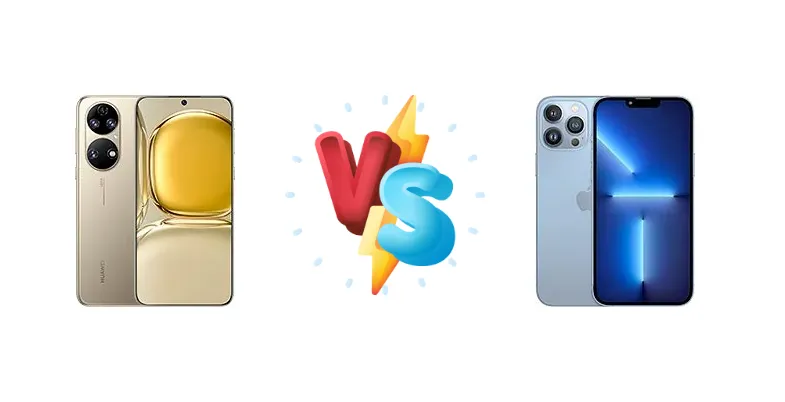
|
🏆 Quick Verdict
For the average user prioritizing long-term software support, seamless ecosystem integration, and consistently strong performance, the Apple iPhone 13 Pro Max is the superior choice. However, the Huawei P50 offers a compelling alternative for those seeking a unique camera experience and aren't constrained by the 4G limitation.
| PHONES | ||
|---|---|---|
| Phone Names | Huawei P50 | Apple iPhone 13 Pro Max |
| Network | ||
|---|---|---|
| 2G bands | GSM 850 / 900 / 1800 / 1900 | GSM 850 / 900 / 1800 / 1900 |
| 3G bands | HSDPA 800 / 850 / 900 / 1700(AWS) / 1900 / 2100 | HSDPA 850 / 900 / 1700(AWS) / 1900 / 2100 |
| 4G bands | 1, 2, 3, 4, 5, 6, 7, 8, 9, 12, 17, 18, 19, 20, 26, 28, 34, 38, 39, 40, 41 | 1, 2, 3, 4, 5, 7, 8, 12, 13, 17, 18, 19, 20, 25, 26, 28, 30, 32, 34, 38, 39, 40, 41, 42, 46, 48, 66 - A2643, A2644, A2645 |
| 5G bands | - | 1, 2, 3, 5, 7, 8, 12, 20, 25, 28, 30, 38, 40, 41, 48, 66, 77, 78, 79 SA/NSA/Sub6 - A2643, A2644 |
| Speed | HSPA, LTE | HSPA, LTE, 5G, EV-DO Rev.A 3.1 Mbps |
| Technology | GSM / CDMA / HSPA / CDMA2000 / LTE | GSM / CDMA / HSPA / EVDO / LTE / 5G |
| CDMA2000 1x | 1, 2, 3, 5, 7, 8, 12, 20, 25, 28, 29, 30, 38, 40, 41, 48, 66, 71, 77, 78, 79 SA/NSA/Sub6 - A2641 | |
| Launch | ||
|---|---|---|
| Announced | 2021, July 29 | 2021, September 14 |
| Status | Available. Released 2021, October 04 | Available. Released 2021, September 24 |
| Body | ||
|---|---|---|
| Build | - | Glass front, glass back, stainless steel frame |
| Dimensions | 156.5 x 73.8 x 7.9 mm (6.16 x 2.91 x 0.31 in) | 160.8 x 78.1 x 7.7 mm (6.33 x 3.07 x 0.30 in) |
| SIM | Nano-SIM + Nano-SIM | · Nano-SIM + eSIM· Nano-SIM + Nano-SIM |
| Weight | 181 g (6.38 oz) | 240 g (8.47 oz) |
| IP68 dust/water resistant (up to 1.5m for 30 min) | IP68 dust/water resistant (up to 6m for 30 min) Apple Pay (Visa, MasterCard, AMEX certified) | |
| Display | ||
|---|---|---|
| Protection | - | Ceramic Shield glass |
| Resolution | 1224 x 2700 pixels (~458 ppi density) | 1284 x 2778 pixels, 19.5:9 ratio (~458 ppi density) |
| Size | 6.5 inches, 101.6 cm2 (~88.0% screen-to-body ratio) | 6.7 inches, 109.8 cm2 (~87.4% screen-to-body ratio) |
| Type | OLED, 1B colors, 90Hz | Super Retina XDR OLED, 120Hz, HDR10, Dolby Vision, 1000 nits (HBM), 1200 nits (peak) |
| Platform | ||
|---|---|---|
| CPU | Octa-core (1x2.84 GHz Cortex-X1 & 3x2.42 GHz Cortex-A78 & 4x1.80 GHz Cortex-A55) | Hexa-core (2x3.23 GHz Avalanche + 4x1.82 GHz Blizzard) |
| Chipset | Qualcomm SM8350 Snapdragon 888 4G (5 nm) | Apple A15 Bionic (5 nm) |
| GPU | Adreno 660 | Apple GPU (5-core graphics) |
| OS | HarmonyOS 2.0 | iOS 15, upgradable to iOS 26.1 |
| Memory | ||
|---|---|---|
| Card slot | Nano Memory (uses shared SIM slot) | No |
| Internal | 128GB 8GB RAM, 256GB 8GB RAM | 128GB 6GB RAM, 256GB 6GB RAM, 512GB 6GB RAM, 1TB 6GB RAM |
| - | NVMe | |
| Main Camera | ||
|---|---|---|
| Features | Laser AF, color spectrum sensor, Leica optics, dual-LED flash, panorama, HDR | Dual-LED dual-tone flash, HDR (photo/panorama) |
| Single | 13 MP, f/2.4, (wide) | 12 MP, f/2.2, 23mm (wide), 1/3.6" SL 3D, (depth/biometrics sensor) |
| Triple | 50 MP, f/1.8, 23mm (wide), PDAF, OIS 12 MP, f/3.4, 125mm (periscope telephoto), PDAF, OIS, 5x optical zoom 13 MP, f/2.2, 16mm (ultrawide) | 12 MP, f/1.5, 26mm (wide), 1/1.7", 1.9µm, dual pixel PDAF, sensor-shift OIS 12 MP, f/2.8, 77mm (telephoto), PDAF, 1/3.4", 1.0µm, OIS, 3x optical zoom 12 MP, f/1.8, 13mm, 120˚ (ultrawide), 1/3.4", 1.0µm, PDAF TOF 3D LiDAR scanner (depth) |
| Video | 4K@30/60fps, 1080p@30/60fps, 1080p@960fps; gyro-EIS | 4K@24/25/30/60fps, 1080p@25/30/60/120/240fps, 10-bit HDR, Dolby Vision HDR (up to 60fps), ProRes, stereo sound rec. |
| Selfie camera | ||
|---|---|---|
| Features | Panorama, HDR | HDR |
| Single | 13 MP, f/2.4, (wide) | 12 MP, f/2.2, 23mm (wide), 1/3.6", 1.0µm SL 3D, (depth/biometrics sensor) |
| Video | 4K@30fps, 1080p@30/60/240fps | 4K@24/25/30/60fps, 1080p@25/30/60/120fps, gyro-EIS |
| Sound | ||
|---|---|---|
| 3.5mm jack | No | No |
| 35mm jack | No | No |
| Loudspeaker | Yes, with stereo speakers | Yes, with stereo speakers |
| Comms | ||
|---|---|---|
| Bluetooth | 5.2, A2DP, LE | 5.0, A2DP, LE |
| NFC | Yes | Yes |
| Positioning | GPS (L1+L5), GLONASS (L1), BDS (B1I+B1c+B2a), GALILEO (E1+E5a), QZSS (L1+L5), NavIC (L5) | GPS, GLONASS, GALILEO, BDS, QZSS |
| Radio | No | No |
| USB | USB Type-C 3.1, OTG | Lightning, USB 2.0 |
| WLAN | Wi-Fi 802.11 a/b/g/n/ac/6, dual-band, Wi-Fi Direct | Wi-Fi 802.11 a/b/g/n/ac/6, dual-band, hotspot |
| Features | ||
|---|---|---|
| Sensors | Fingerprint (under display, optical), accelerometer, gyro, proximity, compass | Face ID, accelerometer, gyro, proximity, compass, barometer |
| - | Ultra Wideband (UWB) support | |
| Battery | ||
|---|---|---|
| Charging | 66W wired | Wired, PD2.0, 50% in 30 min 15W wireless (MagSafe) 15W wireless (Qi2) - requires iOS 17.2 update |
| Type | Li-Po 4100 mAh | Li-Ion 4352 mAh (16.75 Wh) |
| Misc | ||
|---|---|---|
| Colors | Black, Gold, White | Graphite, Gold, Silver, Sierra Blue, Alpine Green |
| Models | ABR-AL00, ABR-LX9 | A2643, A2484, A2641, A2644, A2645, iphone14,3 |
| Price | About 700 EUR | € 423.38 / $ 394.86 / £ 355.00 |
| SAR | - | 1.18 W/kg (head) 1.20 W/kg (body) |
| SAR EU | - | 0.99 W/kg (head) 0.98 W/kg (body) |
| Tests | ||
|---|---|---|
| Battery life | - | Endurance rating 121h |
| Camera | - | Photo / Video |
| Display | - | Contrast ratio: Infinite (nominal) |
| Loudspeaker | - | -24.0 LUFS (Very good) |
| Performance | - | AnTuTu: 801691 (v9) GeekBench: 4706 (v5.1) GFXBench: 60fps (ES 3.1 onscreen) |
Huawei P50
- Faster 66W wired charging
- Potentially unique camera features (Huawei's strength)
- Distinctive design aesthetic
- Limited to 4G connectivity
- Less consistent software updates
- Performance lags behind the A15 Bionic
Apple iPhone 13 Pro Max
- Industry-leading A15 Bionic performance
- Excellent camera system with computational photography
- Long-term software support and ecosystem integration
- Slower wired charging compared to P50
- Less customizable Android alternative
- Higher price point
Display Comparison
The iPhone 13 Pro Max boasts a significantly brighter display, reaching a measured 1050 nits, compared to an unspecified peak brightness for the P50. While both offer excellent viewing experiences, the iPhone’s higher brightness translates to better outdoor visibility. The iPhone’s infinite contrast ratio, typical of OLED panels, provides deeper blacks and more vibrant colors. The P50’s display technology isn’t detailed, but Huawei historically focuses on color accuracy, potentially offering a more natural look, though lacking the iPhone’s peak luminance.
Camera Comparison
Both devices excel in photography and videography, but approach it differently. The iPhone 13 Pro Max’s camera system is renowned for its computational photography and consistent results across various lighting conditions. While sensor sizes aren’t specified, Apple’s image processing pipeline prioritizes natural-looking images. The Huawei P50, historically, emphasizes innovative camera technology, potentially offering unique features and a distinct aesthetic. Without specific sensor details, it’s difficult to directly compare image quality, but Huawei often focuses on maximizing detail and dynamic range. The absence of a telephoto lens specification for the P50 is a notable omission, potentially limiting its zoom capabilities compared to the iPhone.
Performance
Apple’s A15 Bionic, a hexa-core chip with two high-performance Avalanche cores clocked at 3.23 GHz, demonstrably outperforms the Qualcomm Snapdragon 888 4G in the Huawei P50. The A15’s architectural advantages, coupled with Apple’s tight software integration, result in superior single-core and multi-core performance. While the Snapdragon 888 is a capable chip, its 5nm process is less efficient than the A15, potentially leading to more thermal throttling under sustained load. The P50’s 4G limitation further restricts its connectivity capabilities, impacting data speeds and online experiences.
Battery Life
Both the Huawei P50 and iPhone 13 Pro Max achieve an impressive endurance rating of 121 hours, suggesting comparable real-world battery life. However, the charging speeds differ significantly. The P50 supports 66W wired charging, enabling significantly faster top-ups compared to the iPhone’s 50% charge in 30 minutes via PD2.0. The iPhone offers 15W wireless charging with MagSafe and Qi2 (requiring iOS 17.2), providing convenient charging options, but slower than the P50’s wired charging. The P50’s faster charging is a clear advantage for users who frequently need to quickly replenish their battery.
Buying Guide
Buy the Huawei P50 if you prioritize camera versatility and a distinctive design aesthetic, and are comfortable with the limitations of a 4G-only connection. Buy the Apple iPhone 13 Pro Max if you value a polished user experience, industry-leading performance, a robust app ecosystem, and guaranteed software updates for years to come. The iPhone is the safer, more future-proof investment.