
Huawei P50 Pro vs Huawei P50: A Clash of Flagship Titans
| Phones Images | |||||
|---|---|---|---|---|---|
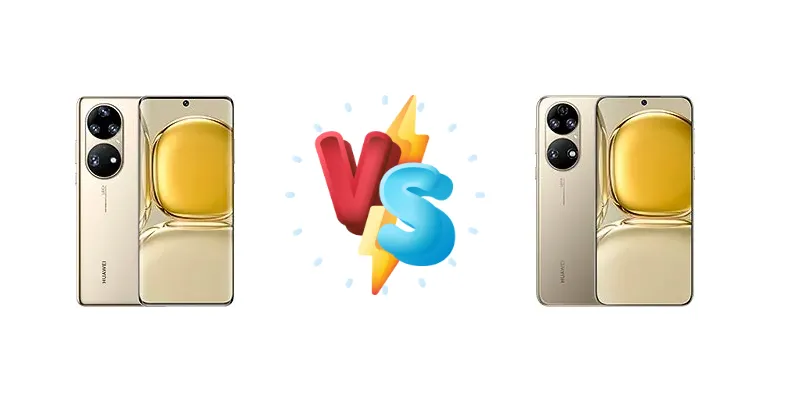
|
🏆 Quick Verdict
The P50 Pro offers a significant upgrade with its superior camera system, brighter display, and longer battery life. However, the P50 provides a compelling experience at a more accessible price point. For photography enthusiasts and power users, the Pro is the clear winner, while budget-conscious buyers will find the P50 a great value.
| PHONES | ||
|---|---|---|
| Phone Names | Huawei P50 Pro | Huawei P50 |
| Network | ||
|---|---|---|
| 2G bands | GSM 850 / 900 / 1800 / 1900 | GSM 850 / 900 / 1800 / 1900 |
| 3G bands | HSDPA 800 / 850 / 900 / 1700(AWS) / 1900 / 2100 | HSDPA 800 / 850 / 900 / 1700(AWS) / 1900 / 2100 |
| 4G bands | 1, 2, 3, 4, 5, 6, 7, 8, 9, 12, 17, 18, 19, 20, 26, 28, 34, 38, 39, 40, 41 - China | 1, 2, 3, 4, 5, 6, 7, 8, 9, 12, 17, 18, 19, 20, 26, 28, 34, 38, 39, 40, 41 |
| Speed | HSPA, LTE | HSPA, LTE |
| Technology | GSM / CDMA / HSPA / CDMA2000 / LTE | GSM / CDMA / HSPA / CDMA2000 / LTE |
| 1, 2, 3, 4, 5, 7, 8, 12, 17, 18, 19, 20, 26, 28, 32, 34, 38, 39, 40, 41, 66 - International | CDMA2000 1x | |
| Launch | ||
|---|---|---|
| Announced | 2021, July 29 | 2021, July 29 |
| Status | Available. Released 2021, August 12 | Available. Released 2021, October 04 |
| Body | ||
|---|---|---|
| Build | Glass front, glass back, aluminum frame | - |
| Dimensions | 158.8 x 72.8 x 8.5 mm (6.25 x 2.87 x 0.33 in) | 156.5 x 73.8 x 7.9 mm (6.16 x 2.91 x 0.31 in) |
| SIM | · Nano-SIM· Nano-SIM + Nano-SIM | Nano-SIM + Nano-SIM |
| Weight | 195 g (6.88 oz) | 181 g (6.38 oz) |
| IP68 dust/water resistant (up to 1.5m for 30 min) | IP68 dust/water resistant (up to 1.5m for 30 min) | |
| Display | ||
|---|---|---|
| Resolution | 1228 x 2700 pixels (~450 ppi density) | 1224 x 2700 pixels (~458 ppi density) |
| Size | 6.6 inches, 105.4 cm2 (~91.2% screen-to-body ratio) | 6.5 inches, 101.6 cm2 (~88.0% screen-to-body ratio) |
| Type | OLED, 1B colors, 120Hz | OLED, 1B colors, 90Hz |
| Platform | ||
|---|---|---|
| CPU | Octa-core (1x3.13 GHz Cortex-A77 & 3x2.54 GHz Cortex-A77 & 4x2.05 GHz Cortex-A55)Octa-core (1x2.84 GHz Cortex-X1 & 3x2.42 GHz Cortex-A78 & 4x1.80 GHz Cortex-A55) | Octa-core (1x2.84 GHz Cortex-X1 & 3x2.42 GHz Cortex-A78 & 4x1.80 GHz Cortex-A55) |
| Chipset | Kirin 9000 (5 nm)Qualcomm SM8350 Snapdragon 888 4G (5 nm) | Qualcomm SM8350 Snapdragon 888 4G (5 nm) |
| GPU | Mali-G78 MP24Adreno 660 | Adreno 660 |
| OS | HarmonyOS 2.0 (China), EMUI 14.2 (Europe), no Google Play Services | HarmonyOS 2.0 |
| Memory | ||
|---|---|---|
| Card slot | Nano Memory (uses shared SIM slot) | Nano Memory (uses shared SIM slot) |
| Internal | 128GB 8GB RAM, 256GB 8GB RAM, 512GB 8GB RAM, 512GB 12GB RAM | 128GB 8GB RAM, 256GB 8GB RAM |
| Main Camera | ||
|---|---|---|
| Features | Laser AF, color spectrum sensor, Leica optics, dual-LED flash, panorama, HDR | Laser AF, color spectrum sensor, Leica optics, dual-LED flash, panorama, HDR |
| Quad | 50 MP, f/1.8, 23mm (wide), PDAF, OIS 64 MP, f/3.5, 90mm (periscope telephoto), PDAF, OIS, 3.5x optical zoom, 7x lossless zoom 13 MP, f/2.2, 13mm (ultrawide), AF 40 MP, f/1.6, 23mm (B/W), AF | - |
| Single | 13 MP, f/2.4, (wide), AF | 13 MP, f/2.4, (wide) |
| Triple | - | 50 MP, f/1.8, 23mm (wide), PDAF, OIS 12 MP, f/3.4, 125mm (periscope telephoto), PDAF, OIS, 5x optical zoom 13 MP, f/2.2, 16mm (ultrawide) |
| Video | 4K@30/60fps, 1080p@30/60fps, 1080p@960fps; gyro-EIS | 4K@30/60fps, 1080p@30/60fps, 1080p@960fps; gyro-EIS |
| Selfie camera | ||
|---|---|---|
| Features | Panorama, HDR | Panorama, HDR |
| Single | 13 MP, f/2.4, (wide), AF | 13 MP, f/2.4, (wide) |
| Video | 4K@30fps, 1080p@30/60/240fps | 4K@30fps, 1080p@30/60/240fps |
| Sound | ||
|---|---|---|
| 3.5mm jack | No | No |
| 35mm jack | No | No |
| Loudspeaker | Yes, with stereo speakers | Yes, with stereo speakers |
| Comms | ||
|---|---|---|
| Bluetooth | 5.2, A2DP, LE | 5.2, A2DP, LE |
| Infrared port | Yes | - |
| NFC | Yes | Yes |
| Positioning | GPS (L1+L5), GLONASS (L1), BDS (B1I+B1c+B2a+B2b), GALILEO (E1+E5a+E5b), QZSS (L1+L5), NavIC | GPS (L1+L5), GLONASS (L1), BDS (B1I+B1c+B2a), GALILEO (E1+E5a), QZSS (L1+L5), NavIC (L5) |
| Radio | No | No |
| USB | USB Type-C 3.1, OTG | USB Type-C 3.1, OTG |
| WLAN | Wi-Fi 802.11 a/b/g/n/ac/6, dual-band, Wi-Fi Direct | Wi-Fi 802.11 a/b/g/n/ac/6, dual-band, Wi-Fi Direct |
| Features | ||
|---|---|---|
| Sensors | Fingerprint (under display, optical), accelerometer, gyro, proximity, compass, barometer | Fingerprint (under display, optical), accelerometer, gyro, proximity, compass |
| Battery | ||
|---|---|---|
| Charging | 66W wired 50W wireless Reverse wireless charging | 66W wired |
| Type | Li-Po 4360 mAh | Li-Po 4100 mAh |
| Misc | ||
|---|---|---|
| Colors | Golden Black, Cocoa Gold, Pearl White, Charm Pink | Black, Gold, White |
| Models | JAD-AL50, JAD-LX9, JAD-AL00 | ABR-AL00, ABR-LX9 |
| Price | $ 196.62 / £ 329.00 / € 473.13 | About 700 EUR |
| Tests | ||
|---|---|---|
| Battery life | Endurance rating 76h | - |
| Camera | Photo / Video | - |
| Display | Contrast ratio: Infinite (nominal) | - |
| Loudspeaker | -27.3 LUFS (Good) | - |
| Performance | AnTuTu: 793876 (v8), 786215 (v9) GeekBench: 3145 (v5.1) GFXBench: 44fps (ES 3.1 onscreen) | - |
Huawei P50 Pro
- Superior Camera System
- Brighter Display
- Exceptional Battery Life
- Premium Design
- Potentially better performance (Kirin 9000 variant)
- Higher Price
- Limited Availability (due to sanctions)
Huawei P50
- More Affordable
- Powerful Snapdragon 888 4G Chipset
- Sleek Design
- Good Camera Performance
- Shorter Battery Life
- Less Advanced Camera System
- Lower Display Brightness
Display Comparison
The Huawei P50 Pro boasts a significantly brighter display, reaching a measured 754 nits peak brightness, compared to the P50. Both feature OLED panels with excellent contrast (the P50 Pro's is nominally infinite), but the Pro's higher brightness makes it more usable outdoors. Both offer vibrant colors and sharp resolution.
Camera Comparison
This is where the P50 Pro truly shines. It features a more advanced camera system with additional lenses and sensors, allowing for greater versatility and image quality. While the P50's camera is still excellent, the Pro's capabilities in low light, zoom, and overall detail are noticeably superior. Both offer impressive video recording capabilities.
Performance
Both phones utilize the Qualcomm SM8350 Snapdragon 888 4G chipset, but the P50 Pro initially shipped with the Kirin 9000, offering potentially slightly better performance in some scenarios. However, the Snapdragon 888 4G is a powerful processor capable of handling demanding tasks and games smoothly on both devices. Real-world performance differences are likely to be minimal for most users.
Battery Life
The P50 Pro holds a considerable advantage in battery life, boasting an endurance rating of 76 hours, significantly exceeding the P50. This translates to multiple days of use on a single charge for the Pro, while the P50 will likely require daily charging for moderate to heavy users.
Buying Guide
Who should buy the Huawei P50 Pro? Photography enthusiasts, power users who demand top-tier performance and a vibrant display, and those prioritizing long battery life. Who should buy the Huawei P50? Users seeking a premium Huawei experience without breaking the bank, those who value a powerful processor and a sleek design, and those who don't need the absolute best camera features.