
Huawei P50 Pocket vs P50 Pro: A Clash of Flagship Foldables
| Phones Images | |||||
|---|---|---|---|---|---|
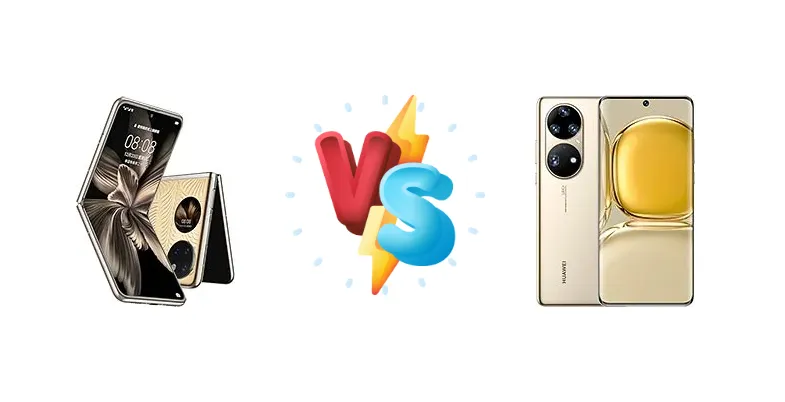
|
🏆 Quick Verdict
The P50 Pro generally edges out the P50 Pocket thanks to its superior battery life, faster charging, and the Kirin 9000 chipset (depending on region). However, the P50 Pocket's unique foldable design and compact form factor make it a compelling choice for those prioritizing style and portability.
| PHONES | ||
|---|---|---|
| Phone Names | Huawei P50 Pocket | Huawei P50 Pro |
| Network | ||
|---|---|---|
| 2G bands | GSM 850 / 900 / 1800 / 1900 | GSM 850 / 900 / 1800 / 1900 |
| 3G bands | HSDPA 800 / 850 / 900 / 1700(AWS) / 1900 / 2100 | HSDPA 800 / 850 / 900 / 1700(AWS) / 1900 / 2100 |
| 4G bands | 1, 2, 3, 4, 5, 7, 8, 12, 17, 18, 19, 20, 26, 28, 32, 34, 38, 39, 40, 41 - International | 1, 2, 3, 4, 5, 6, 7, 8, 9, 12, 17, 18, 19, 20, 26, 28, 34, 38, 39, 40, 41 - China |
| Speed | HSPA, LTE | HSPA, LTE |
| Technology | GSM / CDMA / HSPA / CDMA2000 / LTE | GSM / CDMA / HSPA / CDMA2000 / LTE |
| 1, 2, 3, 4, 5, 7, 8, 12, 17, 18, 19, 20, 26, 28, 34, 38, 39, 40, 41 - China | 1, 2, 3, 4, 5, 7, 8, 12, 17, 18, 19, 20, 26, 28, 32, 34, 38, 39, 40, 41, 66 - International | |
| Launch | ||
|---|---|---|
| Announced | 2021, December 23 | 2021, July 29 |
| Status | Available. Released 2021, December 23 | Available. Released 2021, August 12 |
| Body | ||
|---|---|---|
| Build | - | Glass front, glass back, aluminum frame |
| Dimensions | Unfolded: 170 x 75.5 x 7.2 mm Folded: 87.3 x 75.5 x 15.2 mm | 158.8 x 72.8 x 8.5 mm (6.25 x 2.87 x 0.33 in) |
| SIM | Nano-SIM + Nano-SIM | · Nano-SIM· Nano-SIM + Nano-SIM |
| Weight | 190 g (6.70 oz) | 195 g (6.88 oz) |
| - | IP68 dust/water resistant (up to 1.5m for 30 min) | |
| Display | ||
|---|---|---|
| Resolution | 1188 x 2790 pixels, 21:9 ratio (~442 ppi density) | 1228 x 2700 pixels (~450 ppi density) |
| Size | 6.9 inches, 109.2 cm2 (~85.1% screen-to-body ratio) | 6.6 inches, 105.4 cm2 (~91.2% screen-to-body ratio) |
| Type | Foldable OLED, 1B colors, 120Hz | OLED, 1B colors, 120Hz |
| Cover display: OLED, 1.04 inch, 340 x 340 pixels, 328 ppi | - | |
| Platform | ||
|---|---|---|
| CPU | Octa-core (1x2.84 GHz Cortex-X1 & 3x2.42 GHz Cortex-A78 & 4x1.80 GHz Cortex-A55) | Octa-core (1x3.13 GHz Cortex-A77 & 3x2.54 GHz Cortex-A77 & 4x2.05 GHz Cortex-A55)Octa-core (1x2.84 GHz Cortex-X1 & 3x2.42 GHz Cortex-A78 & 4x1.80 GHz Cortex-A55) |
| Chipset | Qualcomm SM8350 Snapdragon 888 4G (5 nm) | Kirin 9000 (5 nm)Qualcomm SM8350 Snapdragon 888 4G (5 nm) |
| GPU | Adreno 660 | Mali-G78 MP24Adreno 660 |
| OS | HarmonyOS 2.0 (China), EMUI 12 (Europe), no Google Play Services | HarmonyOS 2.0 (China), EMUI 14.2 (Europe), no Google Play Services |
| Memory | ||
|---|---|---|
| Card slot | Nano Memory (uses shared SIM slot) | Nano Memory (uses shared SIM slot) |
| Internal | 256GB 8GB RAM, 256GB 12GB RAM, 512GB 8GB RAM, 512GB 12GB RAM | 128GB 8GB RAM, 256GB 8GB RAM, 512GB 8GB RAM, 512GB 12GB RAM |
| Main Camera | ||
|---|---|---|
| Features | Laser AF, color spectrum sensor, LED flash, HDR, panorama | Laser AF, color spectrum sensor, Leica optics, dual-LED flash, panorama, HDR |
| Quad | - | 50 MP, f/1.8, 23mm (wide), PDAF, OIS 64 MP, f/3.5, 90mm (periscope telephoto), PDAF, OIS, 3.5x optical zoom, 7x lossless zoom 13 MP, f/2.2, 13mm (ultrawide), AF 40 MP, f/1.6, 23mm (B/W), AF |
| Single | 10.7 MP, f/2.2, (ultrawide) | 13 MP, f/2.4, (wide), AF |
| Triple | 40 MP, f/1.8, (wide), PDAF 13 MP, f/2.2, 120˚ (ultrawide), AF 32 MP, f/1.8, (wide), 1/3.14", 0.7µm, AF | - |
| Video | 4K@30/60fps, 1080p@30/120/240fps, gyro-EIS | 4K@30/60fps, 1080p@30/60fps, 1080p@960fps; gyro-EIS |
| Selfie camera | ||
|---|---|---|
| Features | HDR, panorama | Panorama, HDR |
| Single | 10.7 MP, f/2.2, (ultrawide) | 13 MP, f/2.4, (wide), AF |
| Video | 4K@30/60fps, 1080p@30/60/120/240fps | 4K@30fps, 1080p@30/60/240fps |
| Sound | ||
|---|---|---|
| 3.5mm jack | No | No |
| 35mm jack | No | No |
| Loudspeaker | Yes, with stereo speakers | Yes, with stereo speakers |
| Comms | ||
|---|---|---|
| Bluetooth | 5.2, A2DP, LE | 5.2, A2DP, LE |
| Infrared port | - | Yes |
| NFC | Yes | Yes |
| Positioning | GPS (L1+L5), GLONASS (L1), BDS (B1I+B1c+B2a), GALILEO (E1+E5a), QZSS (L1+L5), NavIC (L5) | GPS (L1+L5), GLONASS (L1), BDS (B1I+B1c+B2a+B2b), GALILEO (E1+E5a+E5b), QZSS (L1+L5), NavIC |
| Radio | No | No |
| USB | USB Type-C 2.0, OTG | USB Type-C 3.1, OTG |
| WLAN | Wi-Fi 802.11 a/b/g/n/ac/6, dual-band, Wi-Fi Direct | Wi-Fi 802.11 a/b/g/n/ac/6, dual-band, Wi-Fi Direct |
| Features | ||
|---|---|---|
| Sensors | Fingerprint (side-mounted), accelerometer, gyro, proximity, compass, barometer | Fingerprint (under display, optical), accelerometer, gyro, proximity, compass, barometer |
| UV illuminator | - | |
| Battery | ||
|---|---|---|
| Charging | 40W wired 5W reverse wired | 66W wired 50W wireless Reverse wireless charging |
| Type | Li-Po 4000 mAh | Li-Po 4360 mAh |
| Misc | ||
|---|---|---|
| Colors | Black, Gold, Silver | Golden Black, Cocoa Gold, Pearl White, Charm Pink |
| Models | BAL-AL00, BAL-L49 | JAD-AL50, JAD-LX9, JAD-AL00 |
| Price | About 870 EUR | $ 196.62 / £ 329.00 / € 473.13 |
| Tests | ||
|---|---|---|
| Battery life | Endurance rating 66h | Endurance rating 76h |
| Camera | Photo / Video | Photo / Video |
| Display | Contrast ratio: Infinite (nominal) | Contrast ratio: Infinite (nominal) |
| Loudspeaker | -30.1 LUFS (Below average) | -27.3 LUFS (Good) |
| Performance | AnTuTu: 768513 (v9) GeekBench: 3077 (v5.1) GFXBench: 40fps (ES 3.1 onscreen) | AnTuTu: 793876 (v8), 786215 (v9) GeekBench: 3145 (v5.1) GFXBench: 44fps (ES 3.1 onscreen) |
Huawei P50 Pocket
- Unique foldable design
- Compact and portable
- Vibrant display
- Stylish aesthetic
- Slightly less powerful chipset
- Shorter battery life
- Slower charging speeds
- Potentially less durable due to folding mechanism
Huawei P50 Pro
- Excellent battery life
- Faster charging (wired & wireless)
- Potentially more powerful Kirin 9000 chipset (region dependent)
- Versatile camera system
- More durable design
- Less unique design
- Larger form factor
- Can be more expensive
Display Comparison
The P50 Pocket boasts a vibrant, foldable display, offering a novel user experience. While its peak brightness is 803 nits, the P50 Pro's 754 nits is still excellent. Both offer infinite contrast ratios. The P50 Pocket's foldable nature is its key differentiator, while the P50 Pro provides a more traditional, potentially more durable, flagship display.
Camera Comparison
Both phones feature excellent camera systems, but the P50 Pro generally has the edge. While specific camera specs are not detailed, the P50 Pro typically offers more versatile lens options and potentially better image processing due to its more powerful chipset. Both are capable of producing stunning photos and videos.
Performance
Here's where things get interesting. The P50 Pro, depending on the region, can feature the Kirin 9000 chipset, offering a significant performance boost over the P50 Pocket's Snapdragon 888. Both phones handle everyday tasks with ease, but the P50 Pro will excel in demanding games and multitasking. The Snapdragon 888 in the P50 Pocket is still a capable processor, but not as powerful.
Battery Life
The P50 Pro clearly wins in the battery department, with an endurance rating of 76 hours compared to the P50 Pocket's 66 hours. The P50 Pro also supports faster 66W wired charging and 50W wireless charging, while the P50 Pocket offers 40W wired and 5W reverse wired charging. This translates to significantly quicker charging times and longer usage between charges for the P50 Pro.
Buying Guide
The Huawei P50 Pocket is ideal for fashion-conscious users who want a compact, foldable phone with a unique aesthetic. It's great for those who value portability and don't need the absolute best performance. The Huawei P50 Pro is better suited for power users and photography enthusiasts who demand top-tier performance, longer battery life, and a more versatile camera system.