
Huawei P40 vs Sony Xperia 1 III: A Detailed Comparison of Flagship Androids
| Phones Images | |||||
|---|---|---|---|---|---|
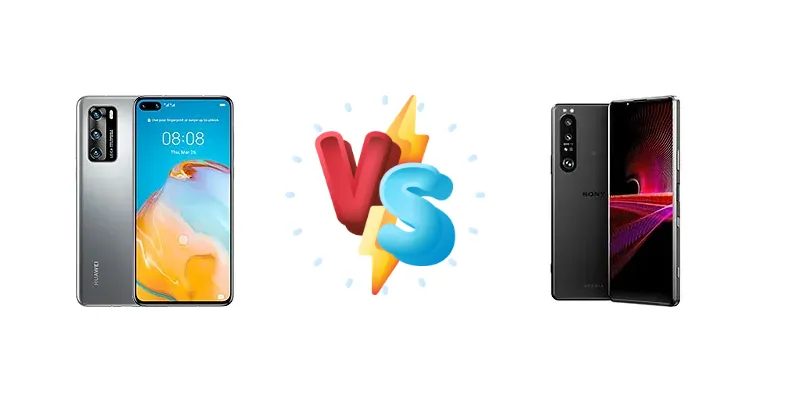
|
🏆 Quick Verdict
For most users, the Sony Xperia 1 III is the superior choice. While the Huawei P40 boasts respectable endurance, the Xperia 1 III’s Snapdragon 888 5G chipset delivers significantly faster performance and benefits from faster 30W charging. The slightly brighter display and more modern feature set further solidify its position.
| PHONES | ||
|---|---|---|
| Phone Names | Huawei P40 | Sony Xperia 1 III |
| Network | ||
|---|---|---|
| 2G bands | GSM 850 / 900 / 1800 / 1900 | GSM 850 / 900 / 1800 / 1900 |
| 3G bands | HSDPA 800 / 850 / 900 / 1700(AWS) / 1900 / 2100 | HSDPA 800 / 850 / 900 / 1700(AWS) / 1900 / 2100 |
| 4G bands | 1, 2, 3, 4, 5, 6, 7, 8, 9, 12, 17, 18, 19, 20, 26, 28, 32, 34, 38, 39, 40, 41 | 1, 2, 3, 4, 5, 7, 8, 12, 13, 17, 19, 20, 25, 26, 28, 29, 32, 34, 38, 39, 40, 41, 46, 66 - Europe |
| 5G bands | 1, 3, 28, 38, 41, 77, 78, 79 SA/NSA | 1, 3, 5, 7, 8, 20, 28, 38, 40, 41, 77, 78 SA/NSA/Sub6 - Europe |
| Speed | HSPA, LTE, 5G | HSPA, LTE, 5G |
| Technology | GSM / HSPA / LTE / 5G | GSM / HSPA / LTE / 5G |
| - | SA/NSA/Sub6/mmWave - USA (specific) | |
| Launch | ||
|---|---|---|
| Announced | 2020, March 26 | 2021, April 14 |
| Status | Available. Released 2020, April 07 | Available. Released 2021, August 25 |
| Body | ||
|---|---|---|
| Build | Glass front, glass back, aluminum frame | Glass front (Gorilla Glass Victus), glass back (Gorilla Glass 6), aluminum frame |
| Dimensions | 148.9 x 71.1 x 8.5 mm (5.86 x 2.80 x 0.33 in) | 165 x 71 x 8.2 mm (6.50 x 2.80 x 0.32 in) |
| SIM | · Nano-SIM + eSIM· Nano-SIM + Nano-SIM | Nano-SIM + Nano-SIM |
| Weight | 175 g (6.17 oz) | 186 g / 187.1 g (mmWave) (6.56 oz) |
| IP53, dust and splash resistant | IP65/IP68 dust/water resistant (up to 1.5m for 30 min) | |
| Display | ||
|---|---|---|
| Protection | - | Corning Gorilla Glass Victus |
| Resolution | 1080 x 2340 pixels, 19.5:9 ratio (~422 ppi density) | 1644 x 3840 pixels, 21:9 ratio (~643 ppi density) |
| Size | 6.1 inches, 91.3 cm2 (~86.3% screen-to-body ratio) | 6.5 inches, 98.6 cm2 (~84.2% screen-to-body ratio) |
| Type | OLED | OLED, 1B colors, 120Hz, HDR BT.2020 |
| - | Runs at 1096 x 2560 pixels except for select use cases | |
| Platform | ||
|---|---|---|
| CPU | Octa-core (2x2.86 GHz Cortex-A76 & 2x2.36 GHz Cortex-A76 & 4x1.95 GHz Cortex-A55) | Octa-core (1x2.84 GHz Cortex-X1 & 3x2.42 GHz Cortex-A78 & 4x1.80 GHz Cortex-A55) |
| Chipset | Kirin 990 5G (7 nm+) | Qualcomm SM8350 Snapdragon 888 5G (5 nm) |
| GPU | Mali-G76 MP16 | Adreno 660 |
| OS | Android 10, EMUI 12, no Google Play Services | Android 11, upgradable to Android 13 |
| Memory | ||
|---|---|---|
| Card slot | Nano Memory (uses shared SIM slot) | microSDXC (uses shared SIM slot) |
| Internal | 128GB 6GB RAM, 128GB 8GB RAM, 256GB 8GB RAM | 256GB 12GB RAM, 512GB 12GB RAM |
| UFS 3.0 | UFS 3.X | |
| Main Camera | ||
|---|---|---|
| Features | Leica optics, color spectrum sensor, LED flash, panorama, HDR | Zeiss optics, Zeiss T* lens coating, color spectrum sensor, LED flash, panorama, HDR, eye tracking |
| Single | - | 8 MP, f/2.0, 24mm (wide), 1/4", 1.12µm |
| Triple | 50 MP, f/1.9, 23mm (wide), 1/1.28", 1.22µm, multi-directional PDAF, OIS 8 MP, f/2.4, 80mm (telephoto), PDAF, OIS, 3x optical zoom 16 MP, f/2.2, 17mm (ultrawide), AF | 12 MP, f/1.7, 24mm (wide), 1/1.7", 1.8µm, dual pixel PDAF, OIS 12 MP, f/2.3, 70mm (telephoto), f/2.8, 105mm (telephoto), 1/2.9", dual pixel PDAF, 3x/4.4x optical zoom, OIS 12 MP, f/2.2, 124˚, 16mm (ultrawide), 1/2.6", dual pixel PDAF 0.3 MP, TOF 3D, (depth) |
| Video | 4K@30/60fps, 1080p@30/60fps, 720p@960fps; gyro-EIS | 4K@24/25/30/60/120fps HDR, 1080p@30/60/120fps; 5-axis gyro-EIS, OIS |
| Selfie camera | ||
|---|---|---|
| Features | HDR | HDR |
| Single | 32 MP, f/2.0, 26mm (wide), 1/2.8", 0.8µm IR TOF 3D, (biometrics sensor only) | 8 MP, f/2.0, 24mm (wide), 1/4.0", 1.12µm |
| Video | 4K@30/60fps, 1080p@30/60fps | 1080p@30fps, 5-axis gyro-EIS |
| Sound | ||
|---|---|---|
| 3.5mm jack | No | Yes |
| 35mm jack | No | Yes |
| Loudspeaker | Yes | Yes, with stereo speakers |
| - | 24-bit/192kHz audio Dynamic vibration system | |
| Comms | ||
|---|---|---|
| Bluetooth | 5.1, A2DP, LE | 5.2, A2DP, LE, aptX HD, aptX Adaptive |
| NFC | Yes | Yes |
| Positioning | GPS (L1+L5), GLONASS (L1), BDS (B1I+B1c+B2a), GALILEO (E1+E5a), QZSS (L1+L5), NavIC | GPS, GLONASS, BDS, GALILEO, QZSS |
| Radio | No | No |
| USB | USB Type-C 3.1, OTG | USB Type-C 3.1, OTG, video output |
| WLAN | Wi-Fi 802.11 a/b/g/n/ac/6, dual-band, Wi-Fi Direct | Wi-Fi 802.11 a/b/g/n/ac/6, dual-band, Wi-Fi Direct, DLNA |
| Features | ||
|---|---|---|
| Sensors | Infrared Face ID, fingerprint (under display, optical), accelerometer, gyro, proximity, compass | Fingerprint (side-mounted), accelerometer, gyro, proximity, barometer, compass |
| - | Native Sony Alpha camera support | |
| Battery | ||
|---|---|---|
| Charging | 22.5W wired | 30W wired, PD, 50% in 30 min Wireless Reverse wireless |
| Type | Li-Po 3800 mAh | Li-Po 4500 mAh |
| Misc | ||
|---|---|---|
| Colors | Silver Frost, Blush Gold, Deep Sea Blue, Ice White, Black | Frosted Black, Frosted Gray, Frosted Purple |
| Models | ANA-AN00, ANA-TN00, ANA-NX9, ANA-LX4 | XQBC62/V, XQBC52V.UKCX, SO-51B, SOG03, A101SO, XQ-BC62, XQ-BC72, XQ-BC52, XQ-BC01, XQ-BC11, XQ-BC21, XQ-BC72 |
| Price | About 520 EUR | € 505.26 / $ 903.43 |
| Tests | ||
|---|---|---|
| Battery life | Endurance rating 89h | Endurance rating 82h |
| Camera | Photo / Video | Photo / Video |
| Display | Contrast ratio: Infinite (nominal) | Contrast ratio: Infinite (nominal) |
| Loudspeaker | -28.9 LUFS (Average) | -26.5 LUFS (Good) |
| Performance | AnTuTu: 486583 (v8) GeekBench: 12619 (v4.4), 3148 (v5.1) GFXBench: 37fps (ES 3.1 onscreen) | AnTuTu: 607423 (v8) GeekBench: 3515 (v5.1) GFXBench: 54fps (ES 3.1 onscreen) |
Huawei P40
- Excellent battery endurance (89h)
- Competitive price point (likely lower now due to age)
- Sleek design
- Older chipset (Kirin 990 5G)
- Slower charging (22.5W)
- Limited app ecosystem due to Huawei restrictions
Sony Xperia 1 III
- Powerful Snapdragon 888 5G chipset
- Faster 30W charging with wireless options
- Brighter display (620 nits)
- Slightly lower battery endurance (82h)
- Potentially higher price
- Larger physical size
Display Comparison
Both devices feature displays with an 'Infinite' contrast ratio, suggesting excellent black levels. However, the Sony Xperia 1 III edges out the Huawei P40 with a measured peak brightness of 620 nits compared to the P40’s 589 nits, resulting in better visibility in direct sunlight. While both are excellent, the Xperia 1 III’s display is marginally more usable outdoors. Neither manufacturer specifies PWM dimming rates, making it difficult to assess flicker sensitivity for users prone to eye strain.
Camera Comparison
Both phones are marketed as camera-centric, but their approaches differ. While both offer photo and video capabilities, detailed sensor information is lacking in the provided data. However, the Xperia 1 III benefits from Sony’s expertise in image sensor technology and advanced image processing algorithms. The Snapdragon 888’s ISP also provides superior image processing capabilities compared to the Kirin 990. Without specific sensor size or aperture details, it’s difficult to definitively declare a winner, but Sony’s track record suggests a more refined and versatile camera experience.
Performance
The core difference lies in the chipsets. The Sony Xperia 1 III’s Qualcomm Snapdragon 888 5G (5nm) offers a substantial performance advantage over the Huawei P40’s Kirin 990 5G (7nm+). The Snapdragon 888’s Cortex-X1 prime core, clocked at 2.84 GHz, provides a significant boost in single-core performance, crucial for responsive UI and app loading. The 5nm process node also contributes to improved thermal efficiency, potentially reducing throttling during sustained workloads. The P40’s octa-core CPU, while capable, cannot match the raw power of the Snapdragon 888.
Battery Life
The Huawei P40 boasts an endurance rating of 89 hours, slightly exceeding the Xperia 1 III’s 82 hours. However, this advantage is partially offset by the Xperia 1 III’s faster 30W wired charging, capable of reaching 50% charge in just 30 minutes. The P40 is limited to 22.5W wired charging. The Xperia 1 III also adds the convenience of wireless and reverse wireless charging, features absent on the P40. While the P40 lasts longer on a single charge, the Xperia 1 III’s faster charging and added wireless capabilities provide greater flexibility.
Buying Guide
Buy the Huawei P40 if you prioritize long battery life and are comfortable with the limitations of the Huawei ecosystem. Its 89-hour endurance rating remains competitive. Buy the Sony Xperia 1 III if you demand top-tier performance for gaming and content creation, value faster charging speeds, and prefer a more open Android experience with broader app compatibility.